
 Someday I will own an art-deco cedar chest crafted by my great-grandfather.
My aunt and uncle, who love the work of Frank Lloyd Wright, introduced me to the joys of travel at a rather young age.
I spent a college semester in Glasgow, where the marks left by Charles Rennie Mackintosh are proudly exhibited.
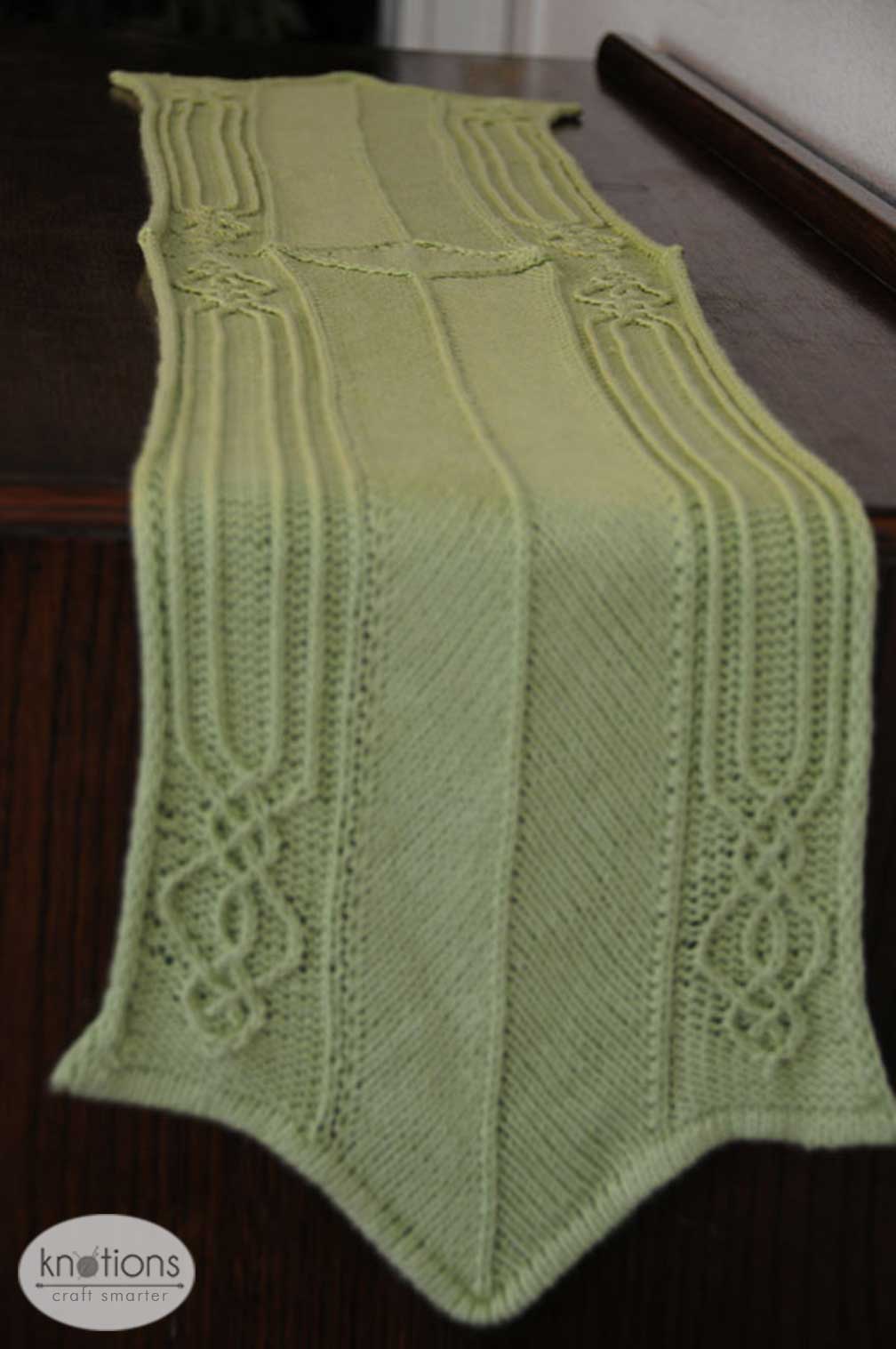
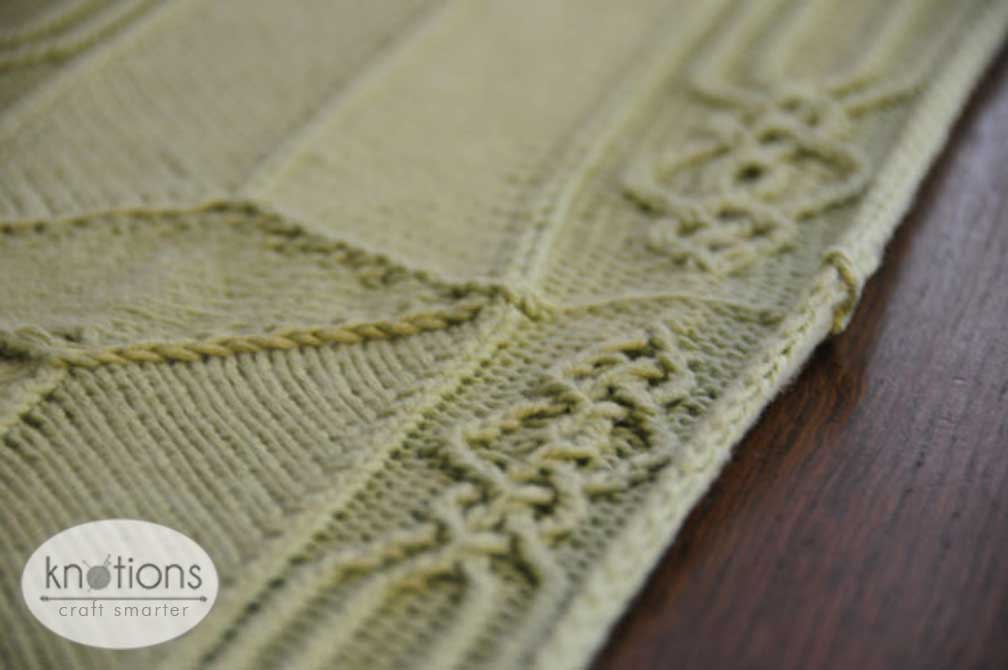
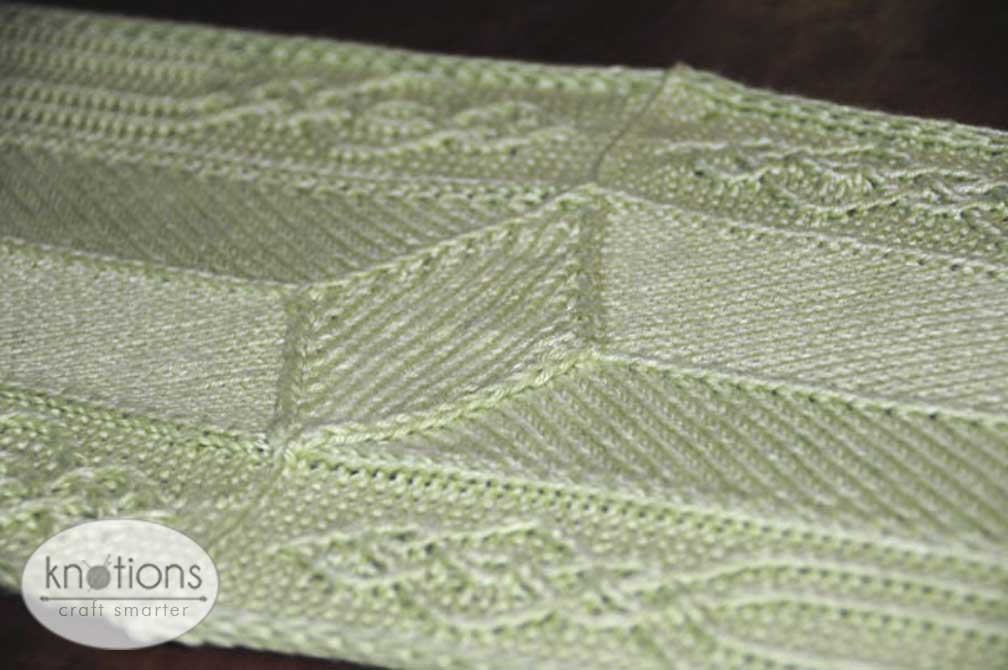
With this background, when I saw a cable pattern in a book of Viking inspirations, I immediately began envisioning its use in an Art-Deco knitted design. This tablerunner, with its sleek, streamlined twisted stitches and biased stockinette mimicking wood-grain play is the result of the adventure. I used a bamboo/silk blend yarn to represent Art-Deco’s fascination with man’s achievements and its revelry in luxury.

Size
11″x 54″(28 cm x 137 cm)
Yarn
Ella Rae Bamboo Silk (70% bamboo, 30% silk; 99yards [90.5 meters]/50 g ball): Color 05 Baby Olivine 5 balls
Needles
US #6 (4mm): 24” circular
Gauge
22 sts and 30 rows = 4” (10 cm) in St st
Notions
G6/4.2mm crochet hook; stitch markers; cable needle; waste yarn for provisional cast on; stitch holders (or more waste yarn)
Chart


Abbreviations
Please see our standard list of abbreviations.
| k/p: | first knit then purl into the same stitch |
| ptbl: | purl through the back loop |
| t1b: | (RS) place p st on cn and drop to back, ktbl, p st on cn |
| (WS) place p st on cn and drop to back, kn, ptbl st on cn | |
| t1f | (RS) place k st on cn and drop to front, p1, ktbl st on cn |
| (WS) place k st on cn and drop to front, ptbl, k st on cn | |
| c1f: | (RS) place 1st st on cn and drop to front, ktbl, ktbl st on cn |
| (WS) place 1st st on cn and drop to front, ptbl, ptbl st on cn | |
| c1b: | (RS)place 1st st on cn and drop to back, ktbl, ktbl st on cn |
| (WS) place 1st st on cn and drop to back, ptbl, ptbl st on cn |
Pattern Notes
This piece is worked in two separate pieces: first the two sides are worked from outside ends into the center, then a diamond panel is worked using k2togs, ssks, and cdds to join the live stitches from the two sides seamlessly together.
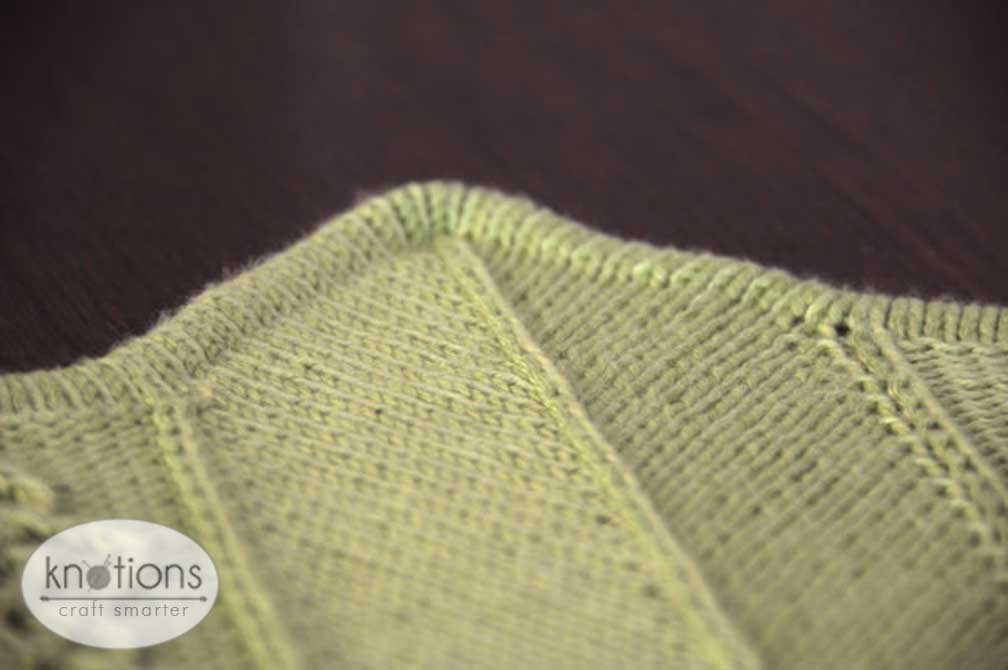
This piece uses both hemmed edges and a slipped stitch rolled edge.
The twisted stitch cable has twisted stitches on both the RS and the WS. For ease, on both RS and WS in a knit/purl cross, the knit stitch always crosses in front of the purl stitch (sometimes the purl stitch is changed to a knit stitch after the cross and vice versa), and all knits crossing knits take place only on RS.
This yarn grows tremendously after blocking. Keep this in mind when determining length.
Stitch Patterns
Edge stitch pattern
Row 1 (RS): beg of row: sl1k, sl2p; end of row: k3
Row 2 (WS): beg of row: sl3p; end of row: p3
Woodgrain panel
Row 1 (RS): kfb, k12, cdd, k11, kfb, k1
Row 2 (WS): purl across
Cable panel
(Adapted from Elsebeth Lavold’s ‘Wide Panel with Little Lattice’ in Viking Patterns in Knitting)
Worked from chart.
Sides
Using Crochet chain provisional cast on, CO 63 sts
Work 8 rows stockinette, starting with a knit row (slip first stitch of every row)
Hemming row (RS): sl 1st stitch, *unpick 1st full stitch from CO row and slip onto L needle, k2tog, repeat from * to end.
Now work will be in five sections: edge stitches, cable panel stitches, woodgrain panel stitches, cable panel stitches, and edge stitches. Markers may be placed dividing sections as foll:
Row 1 (WS) (1st row of Chart): Sl1p, p1, pfb, k14, p29, k14, k/p, p2
Row 2 (RS) (2nd row of Chart): Sl1k, sl2p, pm, p15, pm, kfb, k12, cdd, k11, kfb, k1, pm, p15, pm, k3
Continue edge stitch pattern, woodgrain panel pattern, and chart, repeating rows 30 and 31 fifty times or until 3 in [7.5 cm] short of halfway), until chart is complete.
Place stitches on holder or waste yarn.
Repeat side instructions for second half.
Joining the two Sides
Place first 32 sts of one side and last 32 sts of other side on needle, leaving all remaining sts on holder or waste yarn. (With RS facing, edge stitches should be in the middle, with the center woodgrain panel stitch of both pieces closest to needles.)
With waste yarn, using crochet provisional cast on method, pick up 15 back loops of crocheted chain with the left needle (if right handed—reverse directions if left handed). These 15 sts will be the ‘diamond’ stitches.
Setup Row (RS): Using main yarn, k1 of the picked up stitches. Slip stitch back onto left needle. K2tog (one diamond st and one center woodgrain st), k across remaining diamond sts, sl last diamond st back to left needle, ssk (one diamond st and one center woodgrain st). Turn.
Row 1 (WS): Sl1p, purl to last two diamond sts. Turn.
Row 2 (RS): Cdd (two diamond sts, one woodgrain st), k to last two diamond sts, cdd (two diamond sts, one woodgrain st). Turn.
Row 3 (WS): Sl1purl, purl across to last diamond st. Turn.
Row 4 (RS): K2tog (one diamond st, one woodgrain st), k to last diamond st, ssk (one diamond st, one woodgrain st)
Rep rows 1-4 until 3 diamond sts remain, and 2 woodgrain sts remain (one on each side).
Work 2 cdd’s from RS slipping sts back onto left needle as necessary, ending with 1 st.
With RS always facing, work cdds using st left from diamond and two cable panel sts (one from each side).
Rep last row until no cable panel sts or edge sts remain.
Break yarn, leaving tail a few inches long. Thread end through last st and pull tight.
Flip work around.
Put remaining held sts from sides on needle, again with edge stitches in center.
Remove crochet waste yarn, picking up live sts with left needle, also picking up a st on either side of the live sts (15sts total).
Setup Row (RS): K2tog (one diamond st and one center woodgrain st), k across remaining diamond sts, sl last diamond st back to left needle, ssk (one diamond st and one center woodgrain st). Turn.
Repeat instructions above for first half of diamond, starting with Row 1.
Finishing
Weave in the two yarn ends pulled through last knit stitch left on either side, tugging a bit to mimic the edge stitch roll.
Wet block. Place pins inside all edging.
Weave in remaining ends.
About the Designer: Dawn Martin
Dawn has been knitting for as long as she has been teaching highschool English (where her students are accustomed to her knitting or spinning during quizzes and exams). She enjoys understanding the hows and whys of knitting techniques, and rarely can leave a pattern alone once she understands what’s going on.
Pattern and images © 2008 Dawn Martin.


This is gorgeous. I see it as a scarf as well as a table runner. It’s going on my knitting bucket list.
Thanks! I’m glad you like it! Let me know when you make it 🙂
Me too! I thought perhaps in a nice 4ply/fingering yarn on 3.50 needles.
Ooh. That would be beautiful!