
Filet crochet is usually taught as the simplest kind of picture crochet: open squares and filled ones. Its history, and its possibilities, run much deeper than that.
By Olha Bykova
At first glance, filet crochet seems almost deceptively simple. A few double crochets, a few chains, a grid of open and filled squares, and an image slowly appears.
It is often introduced as one of the easiest forms of pattern crochet to understand, precisely because its logic is so clear: open space becomes background, solid space becomes design.
But that familiar grid has a much longer story than the crochet technique we know today. Long before crocheters began building pictures one square at a time, textile makers were already using grids as a way to translate flowers, animals, figures, ornament, and even entire scenes into thread.
Before the Hook: Netting, Lacis, and the Grid
The story of filet crochet therefore does not begin with a crochet hook. Its roots lie in older forms of netting and embroidered net, often associated with filet and lacis.
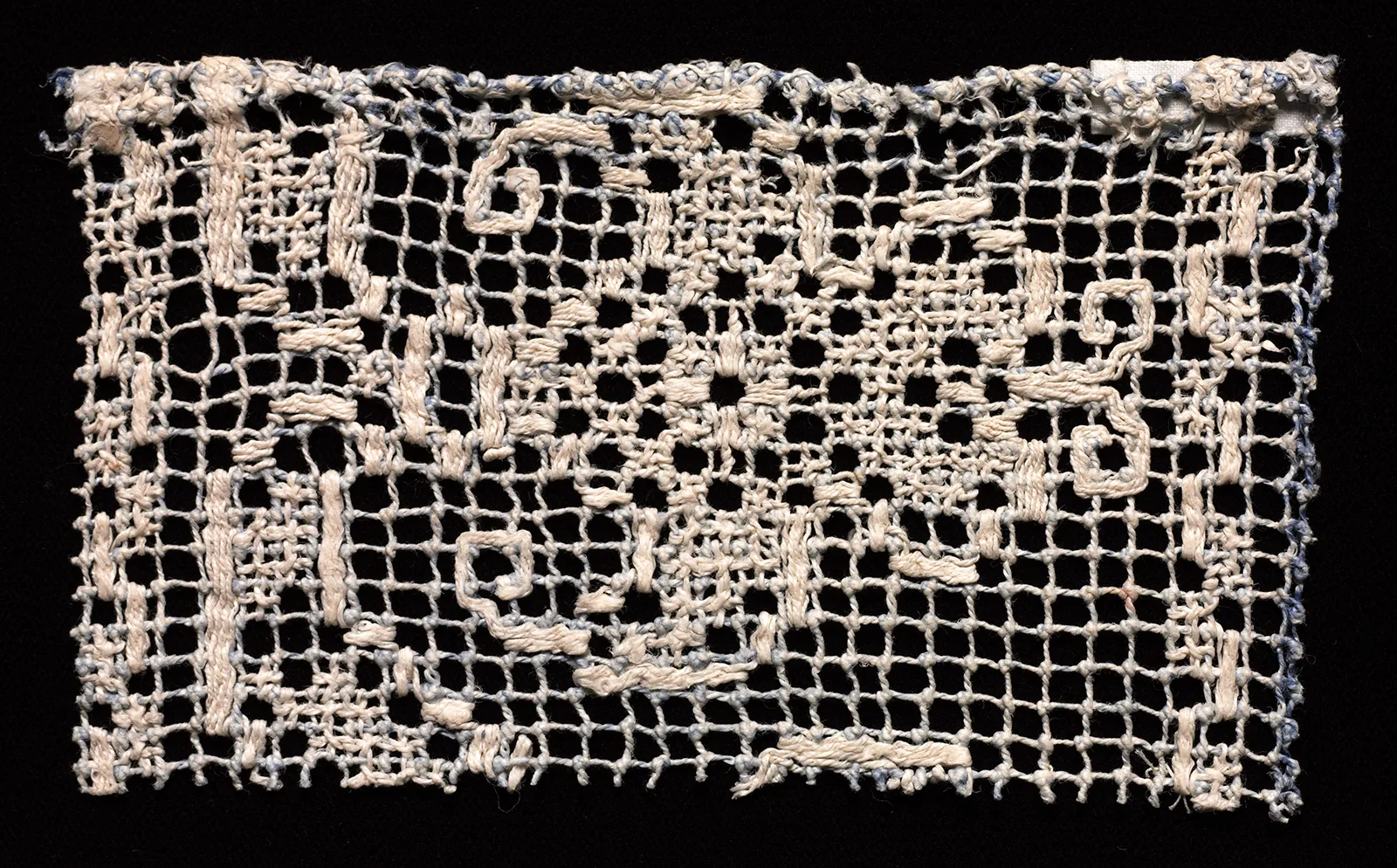
A netted ground was made first, producing a regular field of openings, and selected areas were then filled or embroidered to create a design. The essential idea was already there: a grid provided the structure, while the contrast between open and worked areas created the image.
The technique belonged to a much broader family of openwork and lace traditions that developed in Europe over centuries. By the Renaissance, the grid had become an important tool not only for making textiles, but also for designing them.
The sixteenth century brought another important development: the rapid spread of printed pattern books. Beginning in the 1520s, small books containing designs for embroidery, lace, weaving, and other decorative arts circulated widely in Europe.
These publications allowed patterns to travel far beyond the workshop or household in which they had originated. A design could be copied, adapted, enlarged, simplified, or transferred into another textile technique altogether.
Surviving Renaissance pattern books show just how sophisticated this visual language had already become, ranging from repeating geometric borders to elaborate floral, figurative, and pictorial compositions.
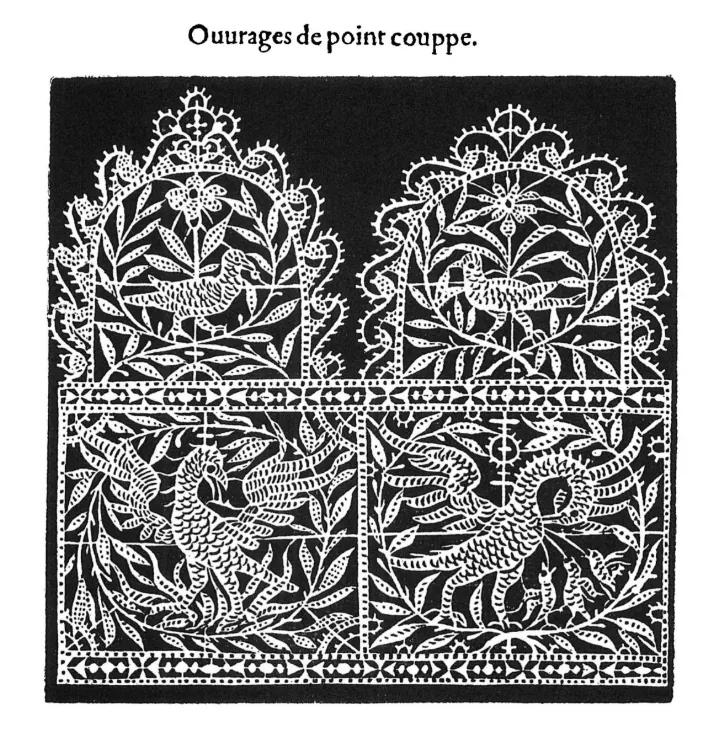
This is one of the most fascinating aspects of filet’s history: the grid did not necessarily belong to a single craft. It functioned as a kind of common design language.
A pattern organized into squares could potentially be interpreted in embroidery, lacis, counted-thread work, beadwork, and, later, crochet. What mattered was not only the stitch being used, but the information contained in the grid itself.
In modern terms, it is difficult not to see a resemblance to pixel-based design: reduce an image to a matrix of units, decide which units carry information and which remain empty, and a surprisingly complex picture can emerge from a very limited visual vocabulary.
How Crochet Changed the Method
Crochet eventually gave that old idea a fundamentally different construction method. In traditional embroidered filet, the ground and the design were separate stages: first the net was created, and then the image was worked into it.
Crochet made it possible to build both at once. Chains created the open areas while groups of stitches created the solid ones, so the structure and the motif grew together row by row.
The result resembled the visual logic of older filet work, but the process was more direct: instead of making a foundation and decorating it afterward, the crocheter could construct the foundation and the image simultaneously.
This development also fits into the wider history of nineteenth-century crochet. As crochet became increasingly popular in Europe and North America, it was frequently used to reproduce the appearance of more labor-intensive lace and openwork traditions.
The hook offered a relatively accessible way to create decorative textiles with intricate-looking structures, and patterns could be reproduced through printed instructions and charts.
Over time, filet made with a crochet hook was no longer simply an imitation of another textile method. It developed its own recognizable construction, conventions, and design possibilities.
The Golden Age of Filet Pattern Books
By the beginning of the twentieth century, filet crochet had become established enough to support entire books devoted to the technique. In the United States, publications such as The Priscilla Filet Crochet Book demonstrate just how mature that system had become.
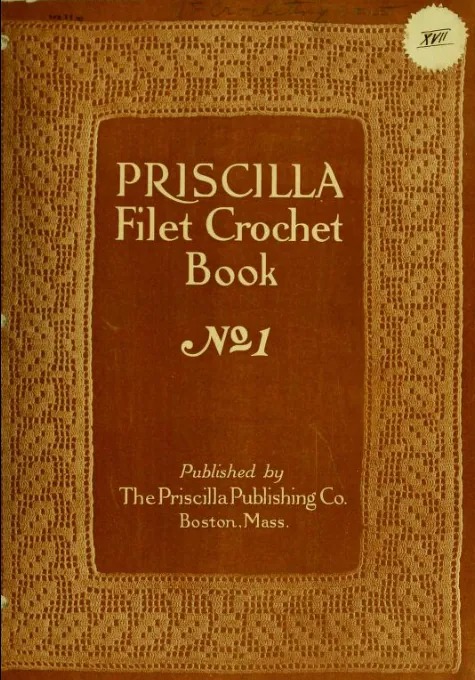
The Smithsonian holds a 1915 edition by Belle Robinson, while its archival collections also document an earlier Priscilla Filet Crochet Book from 1911 and Mary E. Fitch’s Filet Crochet with Instructions.
These were not isolated curiosities. They belonged to a thriving culture of published needlework in which designs circulated widely and crocheters could recreate increasingly ambitious compositions at home.
Looking through these early publications also challenges the modern stereotype that filet crochet belongs mainly to doilies and simple decorative panels. Historical patterns were used for household linens, curtains, edgings, insertions, pillows, bags, garments, yokes, decorative panels, and large-scale pictorial work.
The grid proved remarkably adaptable because it could expand almost indefinitely without changing its basic logic. A small motif might occupy only a few dozen cells; a curtain or table covering could turn the same principle into a much larger visual field.
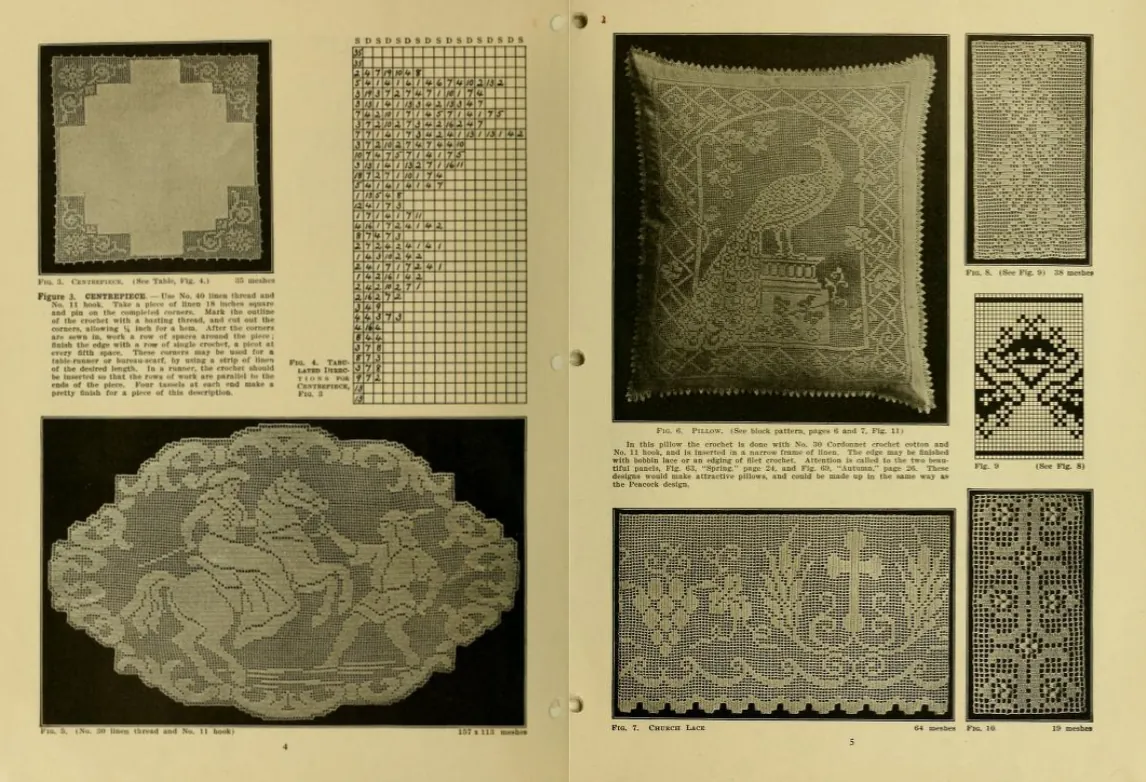
And as the technique grew, designers increasingly treated that field as a surface for drawing. Filet crochet moved beyond repeating ornament into what was often described as picture crochet: recognizable images constructed through the accumulation of open and solid spaces.
Flowers and scrolls gave way to birds, animals, human figures, architectural motifs, lettering, and narrative scenes. The crochet grid was no longer functioning only as lace structure. It had become a graphic medium.
That shift is important because it reveals something easy to overlook when we encounter filet crochet today. Its simplest form may rely on only two visual states (open and filled), but simplicity of vocabulary does not necessarily mean simplicity of expression.
Just as a mosaic builds an image from individual pieces, or a digital image from pixels, filet crochet can use a highly restricted structural system to create remarkably detailed designs. The sophistication lies not in the number of basic elements, but in how they are arranged.
Seen from this perspective, the familiar open and filled square is not the final definition of filet crochet. It is only the beginning of its language.
Beyond Open and Filled: Rethinking the Grid
Once the basic logic of filet crochet is understood, the grid itself becomes much more flexible than it first appears.
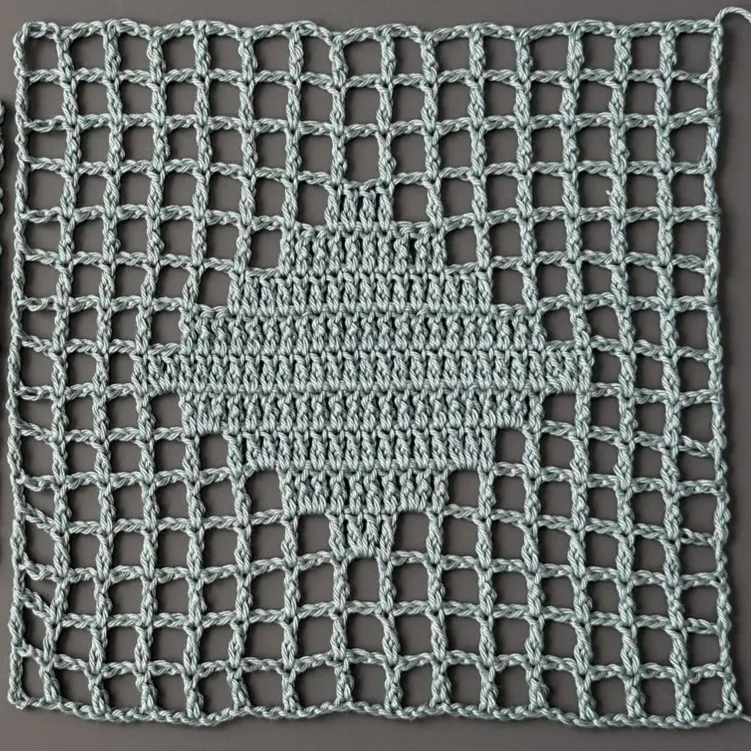
Stitch Height and Mesh Proportion
Most crocheters meet filet through a familiar combination of double crochet and chain spaces, but the mesh does not have to be built that way. Single crochet, half double crochet, treble crochet, and other stitch heights can all be used to form the underlying grid.
What matters is proportion. If the vertical stitch becomes taller, the horizontal span of the cell usually needs to become wider as well. That means adding more chains across an open mesh or more stitches across a filled one so that the cell still reads as roughly square. A shorter stitch requires the opposite adjustment.
The grid, in other words, is not defined by one fixed stitch combination; it is a relationship between height and width.
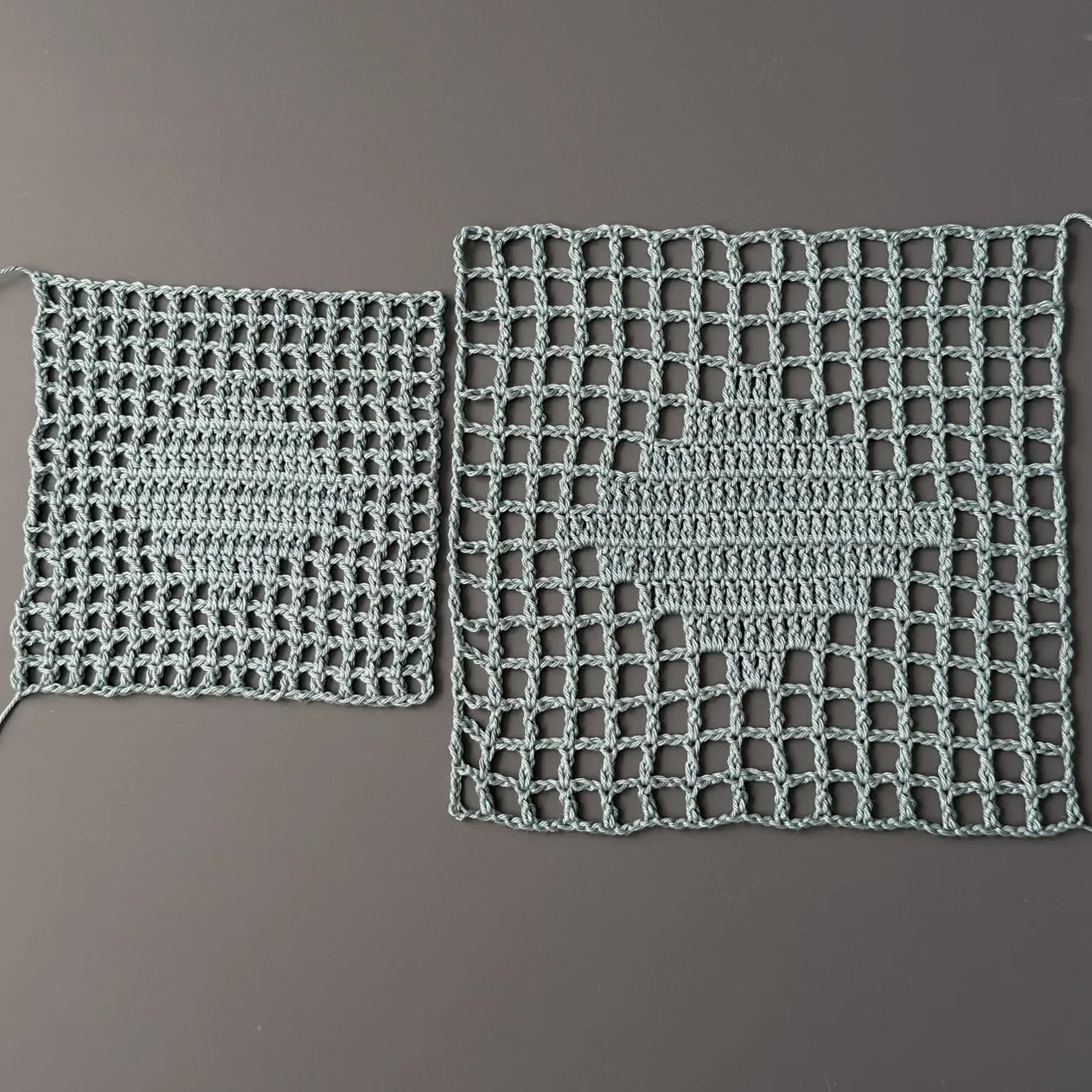
Rhythm and Decorative Mesh
Even that relationship does not have to remain perfectly regular. The rhythm of the mesh can change across the fabric. Cells may be narrow or wide, compact or elongated, evenly spaced or deliberately varied. This immediately changes the visual character of the work.
A dense, small-scale mesh creates a very different surface from one built with taller stitches and wider openings, even if both follow the same charted motif.
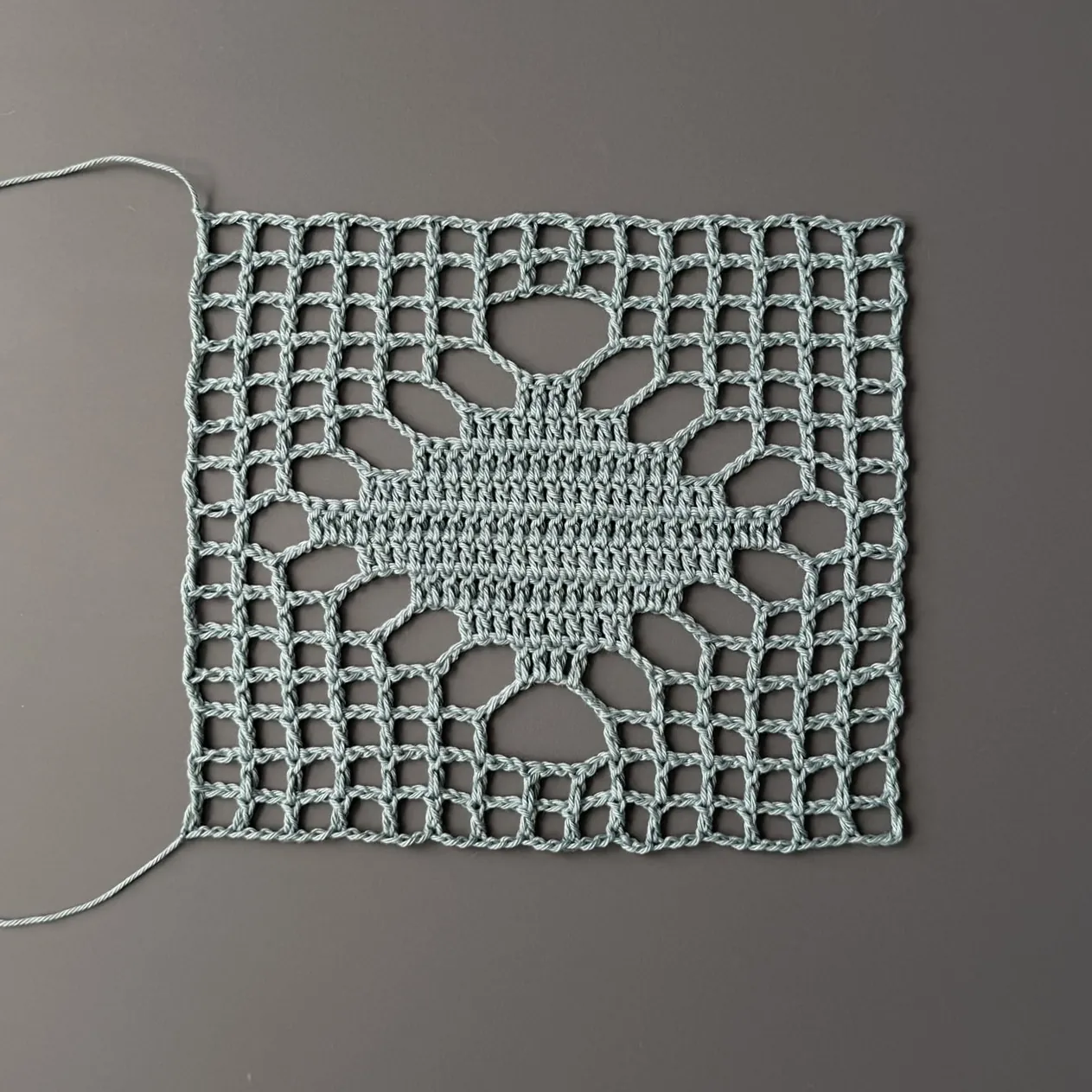
The mesh itself can also become decorative. Instead of being formed only from basic posts and chains, its structure may incorporate V-stitches, shells, clusters, crossed stitches, or textured elements.
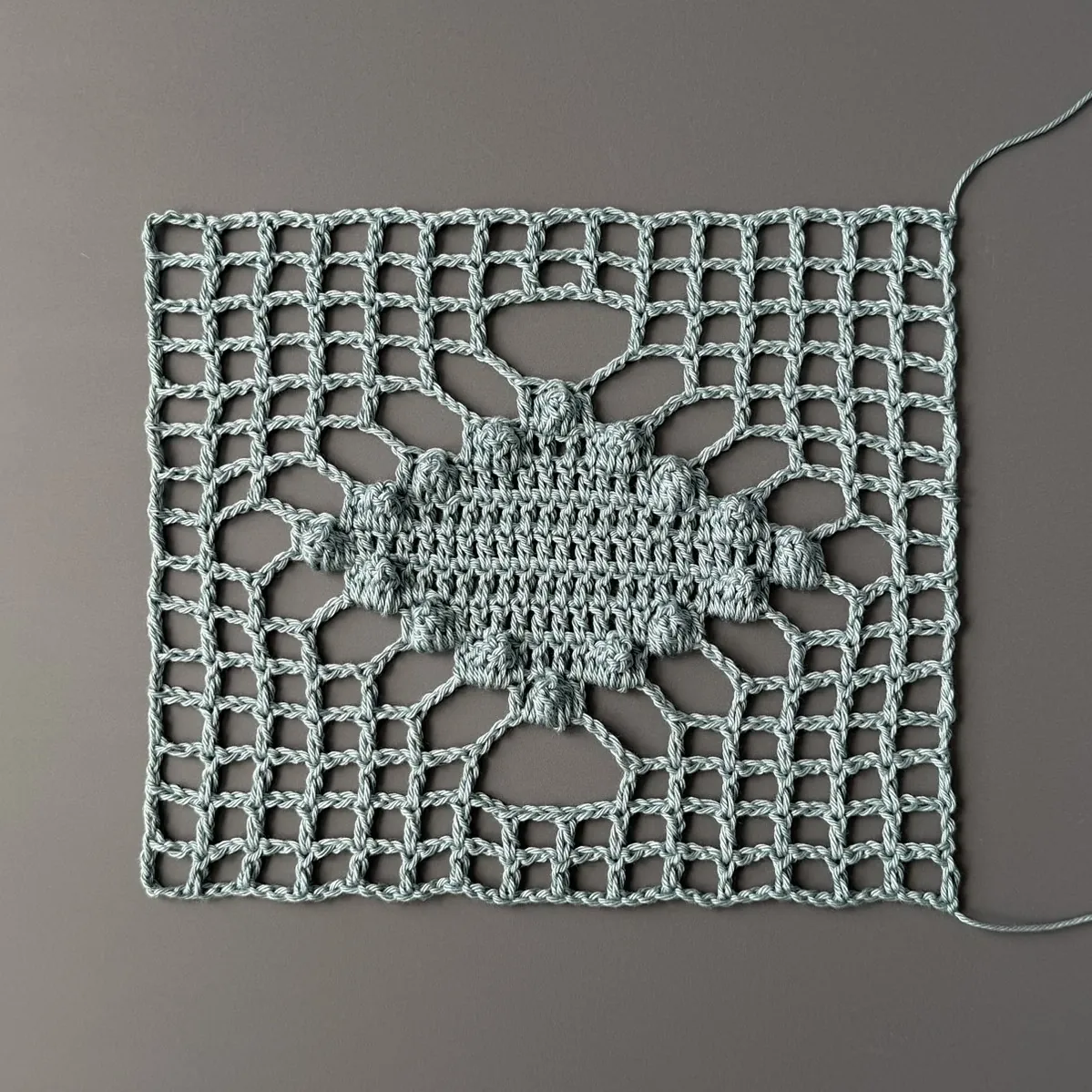
Partial Cells
The same is true of the filled cells. A filet square does not always have to be either completely open or completely solid. Cells can be divided vertically or diagonally, allowing only part of the space to be filled.
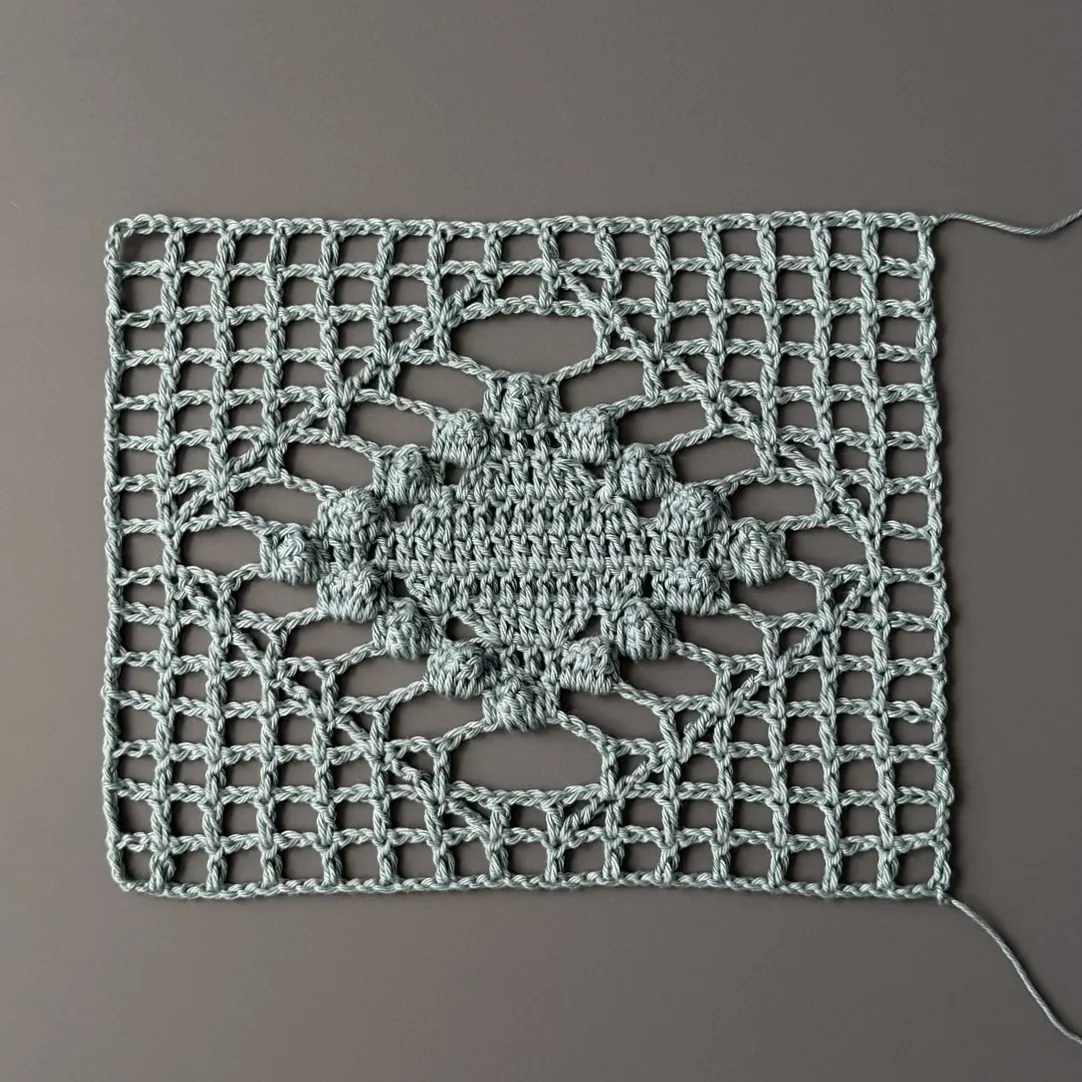
Depending on the construction, that division may represent one half, one third, one quarter, three quarters, or another proportion of the cell.
Diagonal divisions are especially useful because they soften the otherwise strongly stepped character of a square grid and make sloping lines appear more continuous. Vertical partial fills can create narrower columns, transitions, borders, and subtle changes in density without abandoning the logic of the mesh.
Shaping the Edges
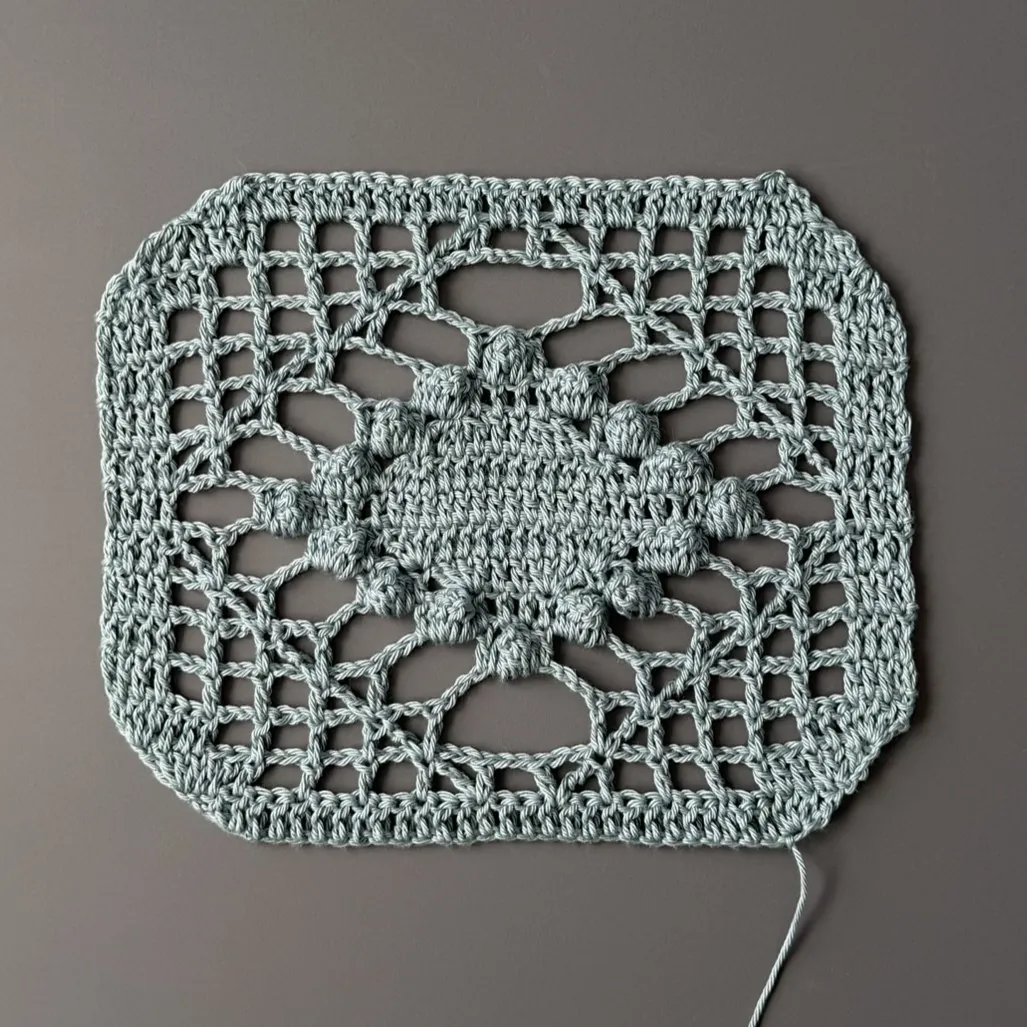
These variations become especially powerful when they move from the interior of the design to its edges. A regular filet chart naturally suggests a rectangle, but the fabric does not have to remain rectangular.
Partial cells, diagonal meshes, increases, decreases, and other shaped constructions can be used to create sloping sides, pointed sections, curved transitions, necklines, wedges, irregular edges, and far more complex silhouettes. The grid remains present, but it no longer dictates the outer shape of the piece.
The Stitches Themselves
And this is still only one layer of possibility. Even the stitches that form the grid can be worked in different ways. Linked stitches, split stitches, post constructions, and other variations can alter the amount of open space between stitches, change the stability of the fabric, or introduce additional texture.
Two pieces may follow a similar structural grid and still look remarkably different because the stitches themselves behave differently.
This is where filet crochet begins to reveal its real depth. Open and filled squares are not a limitation; they are simply the easiest entry point into a much larger system.
The height of the stitches, the proportions of the mesh, the rhythm of the grid, the way a cell is divided, the texture inside it, and the shaping of the outer edge can all be changed independently or combined. The number of possible variations grows very quickly.
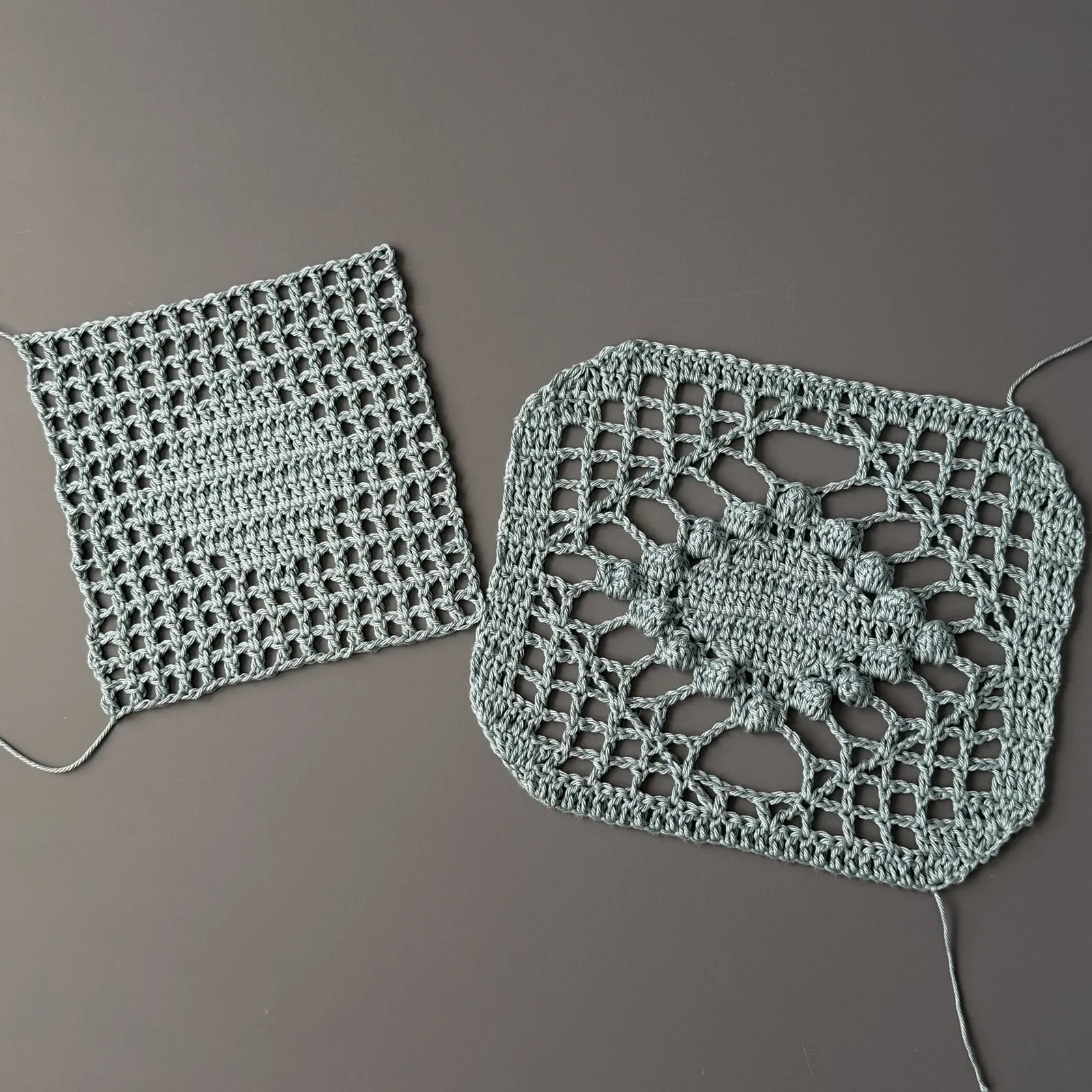
And even this is only the tip of the iceberg. Filet crochet can be explored through construction, texture, shaping, stitch structure, surface design, and combinations with other techniques almost indefinitely.
The familiar square grid may be where the technique begins, but it is certainly not where it ends.
Filet Crochet Today
Today, filet crochet appears across almost every area of crochet design. It is used in garments such as tops, dresses, skirts, cardigans, and lightweight layering pieces; in graphic and pictorial panels; in lettering and typography; in fashion accessories; and in interior pieces such as curtains, wall hangings, table linens, cushions, and decorative panels.
Modern filet is also far less dependent on a perfectly regular grid. Changing the rhythm and proportions of the mesh, dividing cells into smaller sections, combining open and partially filled spaces, and introducing textured or decorative stitches can add another visual layer to the design.
Light passes differently through dense, open, and textured areas, creating shifts of shadow and depth that cannot be achieved through simple open-and-filled squares alone.
As a result, filet crochet can work not only as a way to reproduce an image, but as a complete design language. The grid can carry a graphic motif, define the silhouette of a garment, create transparency and opacity, or become a texture in itself.
By combining structure, negative space, texture, and light, contemporary designers can use the same basic principles of filet crochet to create work that ranges from bold and geometric to delicate, sculptural, and highly detailed.
About the Author: Olha Bykova
I have been holding a crochet hook since childhood. Design is where everything I love comes together: crochet, mathematics, and the ability to tell stories.
I am drawn to texture in all its forms. The most meaningful designs are the ones you can read with your hands as well as your eyes. Much of my work is accessories and home decor, where texture can take center stage.
Find me at olhabykovacrocheting.blog and on Ravelry.
Leave a Reply