
Year of Color 2026 — Month 4 of 12
Welcome to Year of Color!
Fox and Hound takes the classic houndstooth pattern and renders it in mosaic slip stitch, two colors, one at a time. The diagonal interlocking shapes are a visual trick: each row uses only one color, but the slipped stitches carry the pattern across rows to create that signature woven look. Like all slip stitch colorwork, the elongated stitches give the fabric a subtle raised texture, with the pattern sitting just above the surface. The result feels tailored and graphic, a serious pattern wearing spring colors.
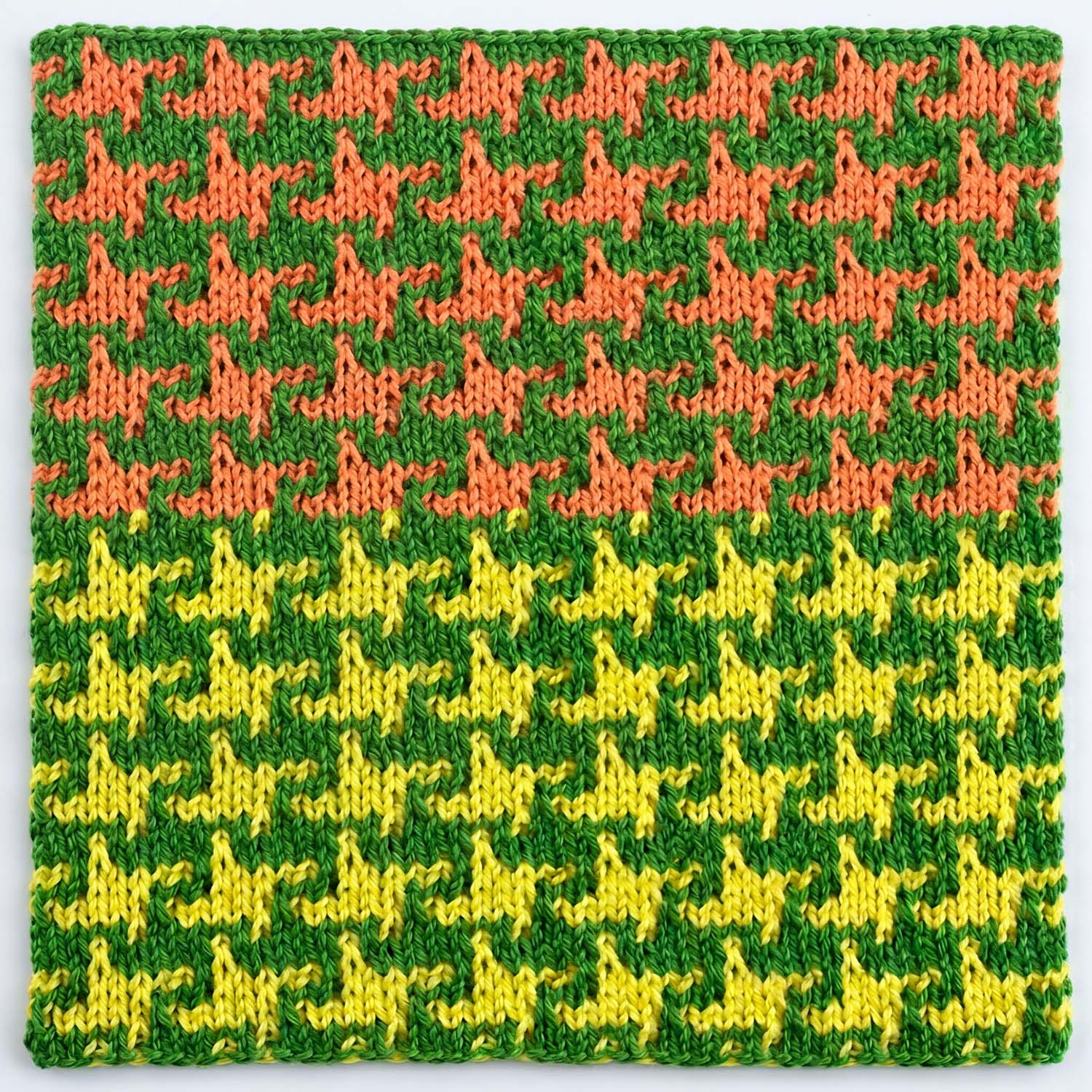
Finished square shown is a digital rendering.
Materials
- Yarn: Cascade Heritage Fingering in 5658 Herb 🟢 (A), 5611 Butter 🟡 (B), and 5737 Dusky Coral 🟠 (C)
- Needles: US 6 (4mm) straight of circular needles or size needed to obtain gauge.
- Gauge: 22 sts and 27½ rows = 4″
- Notions: Tapestry needle, scissors
- Finished size: 8″ × 8″ blocked
In The Loop
- You’ll never carry a float across more than 3 stitches. This keeps you from getting caught in a tangle of long floats.
- All slipped sts are slipped purlwise.
- If you replace the cast-on method, be conscious of where that first row starts. With the long-tail method, your first row is a Wrong Side row.
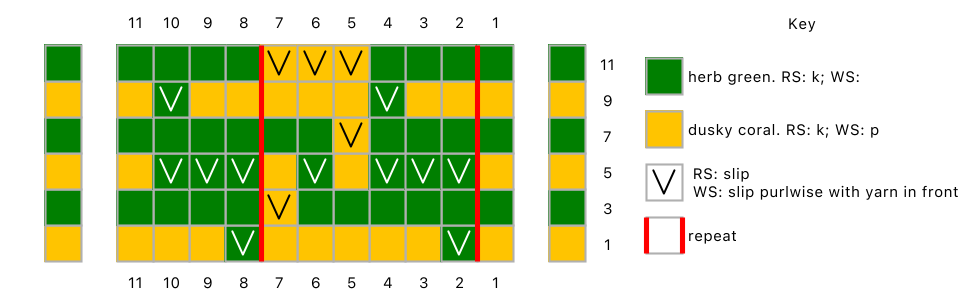
- Reading charts: These are typical mosaic knitting charts, but the first and last columns might throw you off. They’re not actual stitches. The first column tells you which color is active on that row (the other color gets slipped, as shown in the chart), and the last column works the same way. So when you’re counting your stitches, don’t include those two columns. Your actual stitch count starts after the first color indicator and ends before the last one.
- Allow the floats to be stranded across the stitches LOOSELY. Not way loose. But they should span the actual width of the stitches they’re crossing. This gives you good stretch.
Pattern
Using Herb Green A, CO 53 using the Long Tail Method
Setup (WS): Purl across. Do not cut yarn.
Butter Houndstooth
Join Butter B 🟡. Follow Chart 1 or the instructions below.
Row 1 (RS, Butter B 🟡): K1 *sl, k5* sl, k3.
Row 2 (WS, Butter B 🟡): P3, sl wyif *p5, sl wyif* p1.
Row 3 (Herb Green A 🟢): K1 *k5, sl* k4.
Row 4 (Herb Green A 🟢): P4 *sl wyif, p5* p1.
Row 5 (Butter B 🟡): K1 *sl × 3, k1, sl, k1* sl × 3, k1.
Row 6 (Butter B 🟡): P1, sl wyif × 3 *p1, sl wyif, p1, sl wyif × 3* p1.
Row 7 (Herb Green A 🟢): K1 *k3, sl, k2* k4.
Row 8 (Herb Green A 🟢): P4 *p2, sl wyif, p3* p1.
Row 9 (Butter B 🟡): K1 *k2, sl, k3* k2, sl, k1.
Row 10 (Butter B 🟡): P1, sl wyif, p2 *p3, sl wyif, p2* p1.
Row 11 (Herb Green A 🟢): K1 *k3, sl × 3* k4.
Row 12 (Herb Green A 🟢): P4 *sl wyif × 3, p3* p1.
Continue: Repeat Rows 1-12 another 4 times (48 additional rows). Then, work rows 1 – 6 one additional time. Cut Butter B 🟡 and join Dusky Coral C 🟠.
Then, work the houndstooth pattern in Dusky Coral C 🟠.
Dusky Coral Houndstooth
First, work setup rows to complete the rest of the repeat:
Setup rows
Row 7 (Herb Green A 🟢): K1 *k3, sl, k2* k4.
Row 8 (Herb Green A 🟢): P4 *p2, sl wyif, p3* p1.
Row 9 (Dusky Coral C 🟠): K1 *k2, sl, k3* k2, sl, k1.
Row 10 (Dusky Coral C 🟠): P1, sl wyif, p2 *p3, sl wyif, p2* p1.
Row 11 (Herb Green A 🟢): K1 *k3, sl × 3* k4.
Row 12 (Herb Green A 🟢): P4 *sl wyif × 3, p3* p1.
Complete repeat
Follow Chart 2 or the instructions below.
Row 1 (RS, Dusky Coral C 🟠): K1 *sl, k5* sl, k3.
Row 2 (WS,Dusky Coral C 🟠): P3, sl wyif *p5, sl wyif* p1.
Row 3 (Herb Green A 🟢): K1 *k5, sl* k4.
Row 4 (Herb Green A 🟢): P4 *sl wyif, p5* p1.
Row 5 (Dusky Coral C 🟠): K1 *sl × 3, k1, sl, k1* sl × 3, k1.
Row 6 (Dusky Coral C 🟠): P1, sl wyif × 3 *p1, sl wyif, p1, sl wyif × 3* p1.
Row 7 (Herb Green A 🟢): K1 *k3, sl, k2* k4.
Row 8 (Herb Green A 🟢): P4 *p2, sl wyif, p3* p1.
Row 9 (Dusky Coral C 🟠): K1 *k2, sl, k3* k2, sl, k1.
Row 10 (Dusky Coral C 🟠): P1, sl wyif, p2 *p3, sl wyif, p2* p1.
Row 11 (Herb Green A 🟢): K1 *k3, sl × 3* k4.
Row 12 (Herb Green A 🟢): P4 *sl wyif × 3, p3* p1.
Work Rows 1-12 another 3 times (36 rows). Then, work rows 1 – 6 one additional time. Cut Dusky Coral C 🟠.
Bind Off
Bind off all sts using Herb Green A 🟢.
Chart 1

Chart 2
About Year of Color
This square is part of Year of Color 2026, a 12-month program that teaches you a new colorwork technique every month through two free square patterns (one crochet, one knit). Each month features a curated color palette, technique tutorials, and color inspiration articles. By December, you’ll have 12 squares to join together into whatever you’d like, and a whole year of new skills to show for it.
MORE ABOUT YEAR OF COLOR
What you get each month:
- Free crochet square pattern (8″ × 8″)
- Free knitted square pattern (8″ × 8″)
- Color inspiration articles exploring the month’s palette
- Technical tips and tutorials
- Cultural and historical color spotlights
- Community engagement opportunities
2026 Color Themes:
January: Winter Whites & Creams • February: Soft Pastels • March: Jewel Tones • April: Spring Brights • May: Shades of Blue • June: Orange & Blue • July: Sunset Colors • August: Warm Neutrals • September: Dark & Moody • October: Triadic Colors • November: Rich Harvest • December: Winter Sky
Cascade Yarns is partnering on the project to help make quality color education accessible to fiber artists at every skill level. You can join at any time and work at your own pace — the patterns aren’t going anywhere!
Get a new square every month, free
Join over 400 makers exploring color in knit and crochet. Start anywhere, anytime.
Free forever. Unsubscribe anytime.

Leave a Reply