
Some stitches whisper. Fractured Ice speaks in sharp, clean lines, the kind of stitch that looks far more complicated than it is, and earns you every compliment it brings.
The name is earned. Look closely at the finished fabric and you’ll see it: a network of diagonal lines radiating outward from a central point, like the branching cracks that spread across a frozen windowpane. It’s geometric and organic at the same time, and it’s genuinely striking in a way that plain lace rarely is.
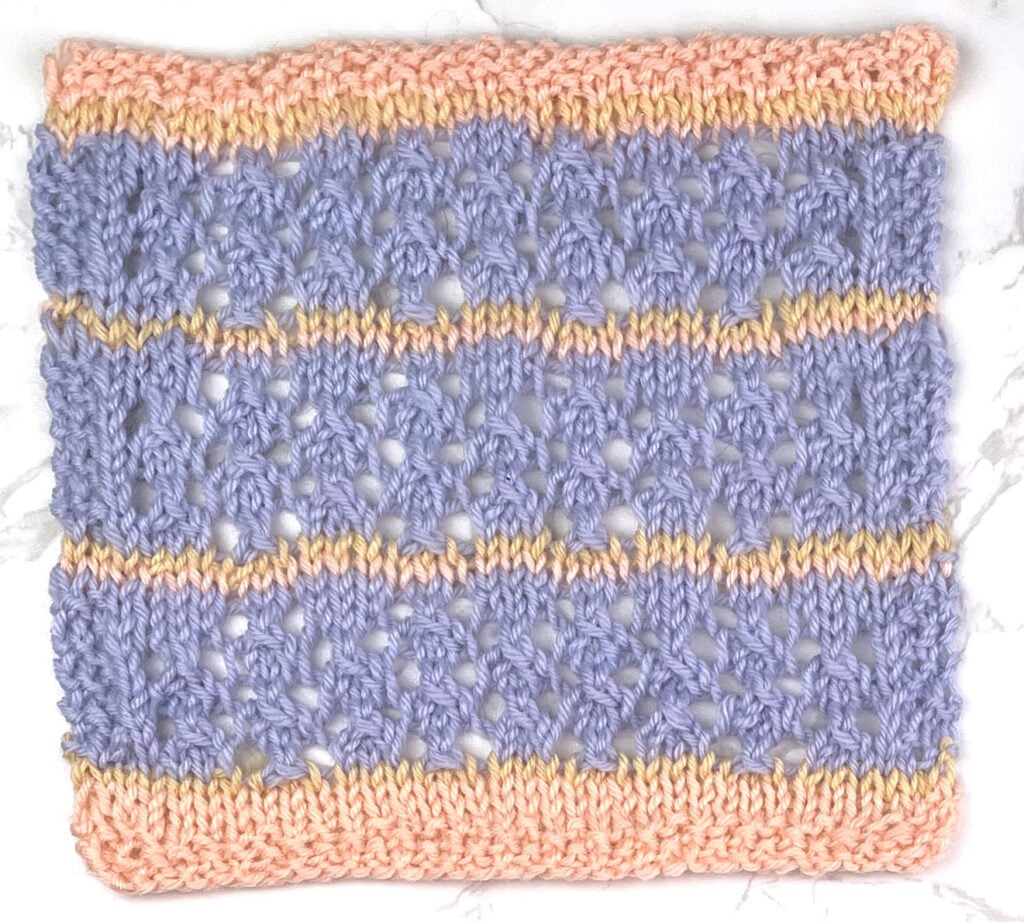
Yarn
Cascade Heritage Fingering in Butter, Pale Peach, and Thistle
Why Fractured Ice Works
The secret is the sssp, a left-leaning triple decrease that pulls three stitches into one, creating a sharp focal point from which the yarn-overs radiate outward on both sides. That single stitch does all the dramatic work. Everything else is just purl fabric setting the stage.
The alternating placement of the decrease in Rows 4 and 6, shifting three stitches to the right on each repeat, is what creates the “fractured” diagonal. It’s not a straight vertical line but a zigzag, giving the stitch its cracked-ice quality.
“In the Knotions colorway, Lilac carries this stitch beautifully. The slight saturation gives the decreases just enough contrast to pop against the background, while Butter and Peach settle into the purl sections so softly they almost disappear into each other.”
That color behavior, how close values blend and how saturation creates contrast, is exactly what we dig into in Year of Color, our free monthly series on color theory for makers. It changes the way you look at every skein you pick up. Plus, you get 2 free squares per month.
Get a new square every month, free
Join over 400 makers exploring color in knit and crochet. Start anywhere, anytime.
Free forever. Unsubscribe anytime.
What to Watch For
- The swatch shown uses 6 repeats of the 7-stitch pattern across 43 stitches (including the selvage stitch).
- The sssp is a left-leaning triple decrease: slip 3 stitches individually knitwise, then purl them together through the back loops. It eats up three stitches and produces a crisp diagonal line. Work it firmly but don’t pull too tight.
- All RS rows are plain knit. This stitch lives entirely on the WS, which means the “right side” of your work is actually the purl side. Plan accordingly.
- The pattern only has 6 rows of patterning (Rows 4–12, even rows only). It’s a quick repeat that builds rhythm fast.
Stitch Instructions

Multiple of 7 sts + 1. The swatch shown works 6 repeats (43 sts).
- Row 1 and all RS rows: Knit.
- Row 2 (WS): Purl.
- Row 4: P1, (yo, sssp, yo, p4) repeat to end.
- Row 6: P1, (p3, yo, sssp, yo, p1) repeat to end.
- Row 8: Repeat Row 4.
- Row 10: Repeat Row 6.
- Row 12: Repeat Row 4.
Repeat Rows 1–12 for pattern.
Perfect Projects
Fractured Ice is a showpiece stitch, use it where it can be seen. A center panel on a simple hat, the yoke of a pullover, or the body of a statement cowl. Because all the patterning happens on WS rows and the RS rows are plain knit, it’s a surprisingly relaxing knit for how impressive it looks. Works best in fingering or sport weight where the decreases can show their definition. The Lilac colorway in the swatch lets the geometry really sing.
Knotions Design Twist
Work just one repeat of Rows 4 and 6 as a single horizontal band on an otherwise plain piece, a hat brim, a sleeve cuff, or a pocket edge. That one stripe of fractured lines reads as an intentional design detail rather than an allover texture, and it’s an elegant way to add interest without committing to a full pattern repeat.
About Jill Bickers, our resident Knitting Nerd

Jill Bickers is a full fledged knitting nerd, who can’t seem to stop buying books on fiber history in general and knitting history in particular. Okay, let’s be honest. She can’t seem to stop buying books, period. She is particularly obsessed with socks , lace, and cables. Her designs can be found on Ravelry as well as Knotions.
Leave a Reply