
You have scrolled past a pattern the second you saw a grid of little symbols. Here is the opposite case.
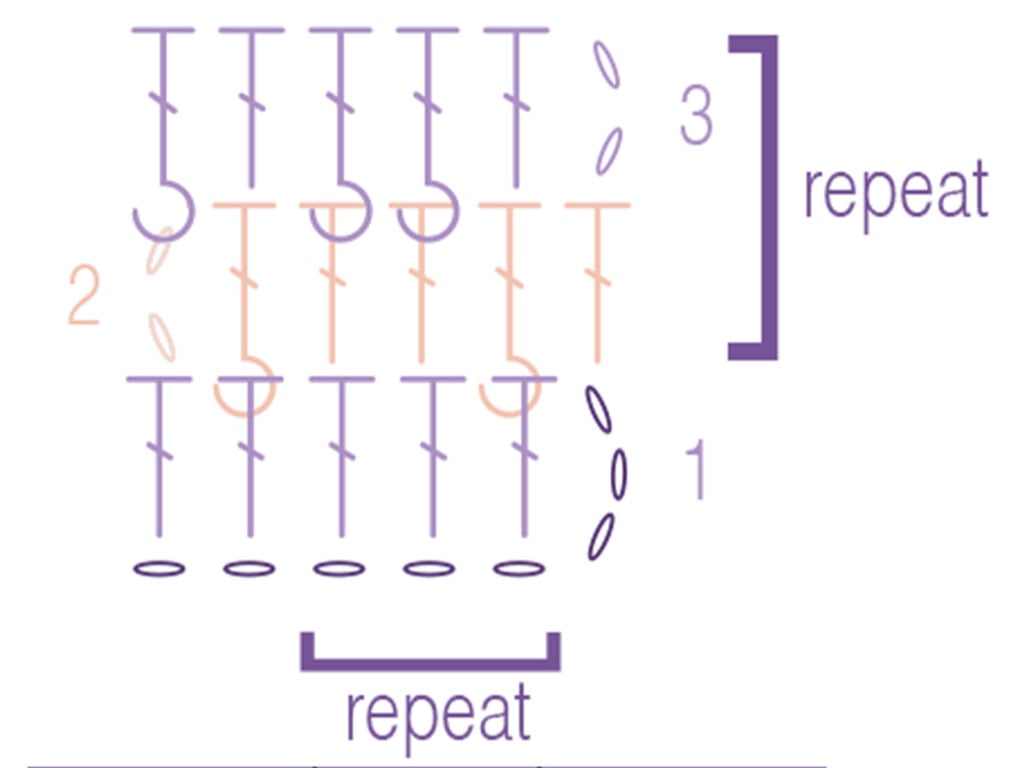
Odd rows start right, even rows start left
Chain a multiple of 3, then add 5.

Row 1: Starting in the 4th ch from hk, dc across.

Row 2: Ch 2 (counts as 1 dc here and throughout), * fpdc, dc in next 2 sts; rep from * until 2 sts rem, fpdc, dc.

Row 3: Ch 2, *dc, fpdc in next 2 sts; rep from * until 2 sts rem, dc, fpdc.

Rep Rows 2 and 3 until complete.
Same fabric. Same two stitches. One of these you can see.
What a chart shows you that words cannot
A written pattern is a set of directions read one stitch at a time. You follow it like a recipe, blind, trusting that if you do each step correctly the shape will appear. You cannot see where you are going. You find out you made a mistake four rows later.
A chart shows you the fabric. Not the instructions for the fabric, the fabric itself, drawn to scale. You can see at a glance where a stitch leans, how a motif lines up with the row below it, where the repeat starts and stops, and what the whole thing is supposed to look like when it is done. The information that written patterns bury inside “rep from star to star” is the exact information a chart puts on the surface.
Once you have read a few, a chart stops being a code you decode and becomes a picture you follow. That is a different, and easier, experience.
The symbols you will actually meet
There are dozens of crochet symbols in total, and the useful thing to know is that you can ignore most of them. These ten cover the large majority of patterns you will pick up, and they are close to universal. The three marked in purple are the only ones on the chart below.
Chain
ch
Slip stitch
sl st
Single crochet
sc
Half double
hdc
Double
dc
Treble
tr
Double treble
dtr
Front post dc
fpdc
Back post dc
bpdc
Back loop only
BLO
Front loop only
FLO
Look at this fabric
This is waffle stitch. Take a second with it before you read on. It looks constructed, deep ridges crossing each other, squares sitting proud of the surface, the kind of texture you would expect to be told is advanced.
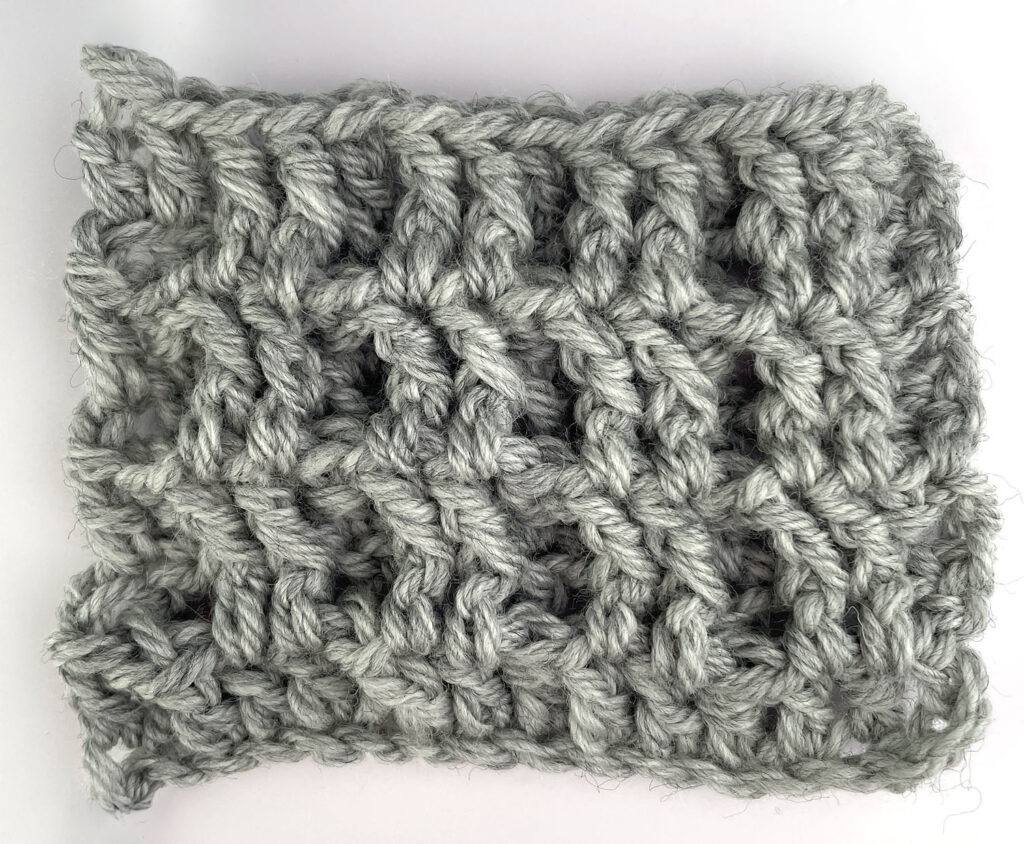
The entire vocabulary
- Double crochet
- Front post double crochet
- Chain, for the foundation and the turns
The repeat
3 stitches × 2 rows
Drawn out on the chart. Try finding that as fast in a paragraph.
That gap, between how complicated the fabric looks and how little it actually asks of you, is the best argument for charts I can give you.
The complaints, answered
The complaint
I get lost.
The answer
Almost every chart tells you where to start and which way to go. On this one, RS and WS are marked and the row numbers alternate sides on purpose. Odd rows begin on the right, even rows begin on the left, which is exactly how the work turns in your hands. Follow the numbers and the direction is built in.
The complaint
The symbols are tiny and I do not know what they mean.
The answer
That is what the key is for, and most keys are short. Three symbols here. You are not memorizing them. You glance down, the same way you would glance at a stitch abbreviation in written instructions.
The complaint
I do not know where the pattern actually repeats.
The answer
On a chart you can see it, and on ours it is boxed and shaded. Three stitches across, two rows up, then it starts again.
Where charts genuinely fall short
Charts are not always the right tool, and pretending they are would lose me the argument. A stitch with a long verbal definition, a special cluster or an unusual construction, does not fit neatly into one symbol and reads better in words. Some heavily textured stitches have no standard symbol at all.
Good patterns often give you both, and there is no shame in reading the written notes alongside the chart. The point is not that charts replace words. It is that for anything with a visual, repeating, geometric structure, and that is a huge share of what we make, the chart is the clearer map.
Give one a try
Do not start with the biggest, densest chart you can find. Start with a small repeat you can see all of at once, like the one above. Read one row across, slowly, and watch it match the stitches on your hook. That click, the moment the picture and the yarn line up, is the whole thing.
Leave a Reply