
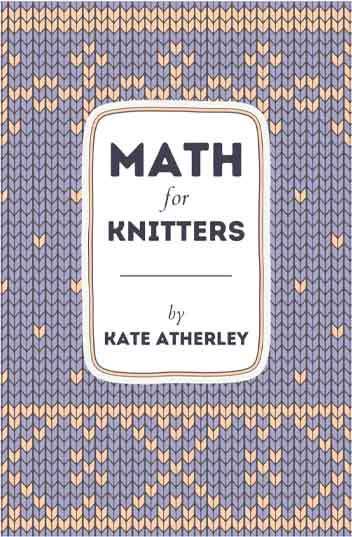
Math for Knitters
by Kate Atherley
180 pages
Spoiler Alert!
This book is not a beautiful book of patterns. It’s not going to take you on a scenic trip to Ireland, Scandinavia, the Andes or any other knitting destination.
What this book WILL do for you is empower you to be a better knitter by teaching you a little simple math.
Wait—Did You Say Math Would Make Me a Better Knitter?
Short Answer: Yes.
Knitting is math in action. Knitting is more than math, of course: it is art, craft, and hobby, all rolled into one. But whatever knitting means to you, math underpins it all. Think about your knitting pattern: it’s full of numbers, isn’t it? From casting on to binding off, from the stitches you work in any given row to the number of rows or rounds you work until you finally reach the bind off—all of these are based on math!
The good news is, knitting math is actually very simple. You don’t need to know calculus or trigonometry to understand it. It’s basic arithmetic: addition, subtraction, multiplication, and division. That’s all. It really is, and Math For Knitters is a terrific introduction to the subject.
Kate Atherley demystifies the math that underlies your knitting. With example after example, she shows how you can use that math to make your project turn out the way you want it to. The book is a knitting class in itself. Unlike a class, however, you can keep referring to it as you need it, whenever you need it. This is a book that should be on almost every knitter’s shelf. For that matter, it is slim enough to keep handy in your knitting bag!
The book is divided into two parts. The first is more basic, covering essential skills such as calculating yardage, understanding gauge, and reading your pattern. The second is about garment knitting, focusing on choosing the proper size, and understanding fit. The author also devotes considerable time in explaining how to adjust patterns so that you can make your garment fit you the way you want it to fit.
Back to Basics: Reading Your Pattern and Your Yarn
Even if you are not someone who sees yourself as ever wanting to adjust a pattern, I heartily recommend reading the first few chapters. Even if you are an experienced knitter, I still recommend reading them as a refresher.

It begins with the most basic of things: how to read a yarn label, and how to calculate yardage to make sure that you have enough yarn for your project. She also tells you how to figure out the yardage on partial balls of yarn—helpful information if you are stashbusting! From there she moves to the extremely important topic of gauge: what it is, how to measure it, and why it is important. In essence: working a pattern at the correct gauge means that you will end up with the finished project the size you want. If your gauge is too big or too small, then your garment will be too. Later in the book, she helps you figure out what to do if your gauge doesn’t quite match: what adjustments you can make easily, and what adjustments take a bit more work. There are times when making one adjustment starts a chain reaction, requiring further adjustments to be made as well. You might end up basically redesigning the pattern just to make it work! It might be better to choose another pattern, or another yarn. As Atherley points out, there are many beautiful options out there, and there will be some that work for you!
If you ever have had trouble deciphering a pattern’s instructions, Chapter 3 will walk you through different pattern writing conventions. If you are an experienced knitter, you may have run into all of these types—but even an experienced knitter occasionally isn’t quite sure how to interpret what she reads. Have you ever debated what it means when a pattern says, “Work a decrease (or increase) every 10 number of rows?” Does that mean once in every ten rows you work, or do you work ten rows and then work a decrease (or increase)? Kate Atherley explains that it means the first. Great! That’s one mystery solved. Except she points out what seems obvious, except that it maybe isn’t: you get to pick where in the repeat those decreases and increases are! She also gives very sound advice on setting these up so that they will be on the easier to work, and how to position them, based on the effect you want and whether there is a seam involved.
Sometimes when we knit, we are told to decrease (or increase) a certain number of stitches across a row, but we aren’t told how to do it—just to do it evenly. With all the apps available, it is very easy to just have your tablet or smartphone do it for you. Atherley recommends grabbing pencil and paper and working it out by hand (and yes, she shows you how to do it.) When you do the calculations by hand, you can see that there is more than one way to do it, and can select the best option for your knitting.
Sometimes low tech is really the best!
Digging Deeper: Simple Changes That Make All the Difference

If you’re knitting a cardigan, are you planning to add buttonholes? What if you don’t want to work the same number as the pattern calls for? Once again, Atherley comes to the rescue. First, she gives you extremely helpful starting information: about where on a button band the top and bottom button should be. Then she explains the math so you can add the number of buttonholes you want, and space them properly, based on the type of buttonhole you are making. And once again, she recommends turning to the low tech but trusty pencil and paper. Sketching it out will save you time, and it will also make you the boss of your knitting.
The final section of the book concerns garment knitting specifically: what to look for in a pattern, how to select the proper size to fit you, and ways to adjust the pattern so that it looks the way you want it to. She walks you through the elements of a pattern schematic, and explains exactly a schematic is an essential piece of any good sweater pattern.
Understanding the schematic is one important step in choosing what size to make. Another is taking your proper measurements, and Atherley explains how to do that too. But having your measurements is only part of what you need to know. You also need to know how much ease you want in your sweater: in other words, do you want your sweater to be figure hugging, classic fit, or oversized? What do you do if some of the measurements you have don’t fit easily into one of the pattern sizes? It may be easy to tweak the numbers to make them work, and the author shows you how. She also shows you how to calculate extra shaping. If you have an hourglass figure, you might want to add waist shaping. Or you might want to change the length of the sweater or the length of the sleeves. All of these can be easily accomplished using the formulas Atherley provides.
As a knitter, I appreciate Kate Atherley’s honesty when she tells you that sometimes the adjustments you would need to make to a pattern work for you in the yarn you want to use are a heavy lift. Too heavy, perhaps, for most of us. Simple calculations are one thing: redesigning a sweater is something else entirely. Mind you, she doesn’t tell that you can’t—just that it may be difficult. If you want to undertake redesigning a pattern, she refers you to other works that may help you to do just that.
I think it would have been even better if Atherley had included a short section helping you to analyze what it was that attracted you to the pattern in the first place. This could help you find a design that would work with your gauge and size to get the effect that you want. Referring back to the schematic would be helpful here. Was it the type of sleeve? The neckline? The kind of stitch used? These aren’t technically the math that she is teaching, but it would help the knitter to understand what it is she wants her garment, so she can choose an alternative where the math is on her side.
Final Thoughts
And this brings me to the final point: this is a book for knitters, not designers. It’s not that designers can’t benefit from it—they certainly can! However, it does not teach you how to design a sweater, a shawl, a hat, or a pair of socks. What it does is help you, the knitter, understand your knitting better. You CAN learn how to make your garments fit the way you want them to, and you can make changes that make it easier to knit and a better fit. This is why I believe that nearly every knitter should have a copy of this book to refer to. Unless you are a numbers geek, you probably won’t want to read it from cover to cover right away. You should, however, read the first few chapters and keep the book ready for when you need it. You almost certainly will some day.
Thank you, Kate Atherley, for a wonderful book.
About the reviewer: Jill Bickers, our resident Knitting Nerd

Jill Bickers is a full fledged knitting nerd, who can’t seem to stop buying books on fiber history in general and knitting history in particular.
Okay, let’s be honest. She can’t seem to stop buying books, period.
She is particularly obsessed with socks , lace, and cables. Her designs can be found on Ravelry as well as Knotions.
Leave a Reply