
Sometimes the best discoveries happen by accident. When Miss Babs sent me a skein of Billow to review, I started hunting for the perfect pattern to showcase it. Mary Annarella’s design kept popping up as the most popular choice, so I decided to give it a try.
What I didn’t expect was how perfectly everything would align—Mary’s background in STEM made her a natural fit for our annual math and science issue, and as I worked through her pattern, I discovered all these clever little details that showed just how thoughtful her design process really is. It became clear that Mary HAD TO be our Designer Focus for this issue. She shared some wonderful insights about herself and her work, and I think you’ll enjoy getting to know her as much as I did.
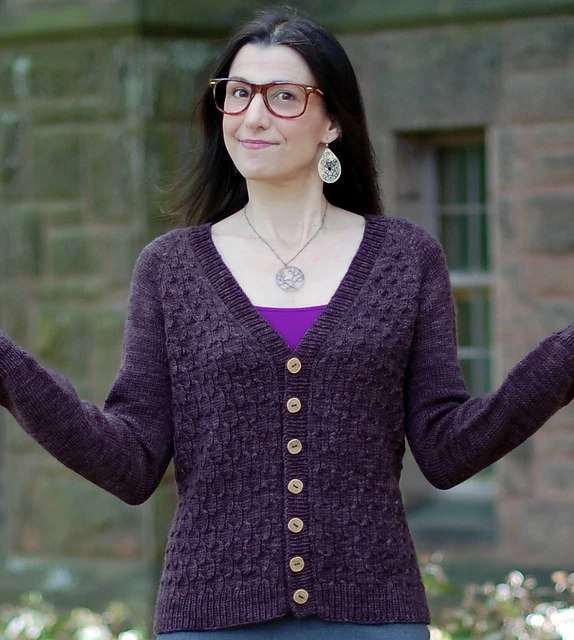
You’re a biology instructor, professional singer, and pattern designer all at once, but people often think these things are separate worlds. Which of these three roles most directly influences the other two? And do knitters realize how much science is baked into your patterns, or do they just enjoy the “set it and forget it” seamless construction?
All three—science, singing, and designing—are all inter-related to me. Singing is an art that requires a lot of technical expertise and practice, practice, practice to train your body what to do. Teaching lab science is technical for sure, but there’s also an art in knowing how to best present a new idea to your students and meet them where they’re at. Pattern designing is something that merges my need to create art and find new ways to create it.
But above all, teaching, singing, and pattern writing are all about Communication. You can do a science experiment, but if you don’t tell anyone about the results, it doesn’t benefit anyone else. You can sing a song that you absolutely love, but without clear diction, people might not understand the words and will miss an opportunity to share in your joy.
So teaching and singing both inform my pattern writing. I want it to be clear enough that anyone taking the time to follow each line of direction can end up with a finished object and have a good time knitting it. At the same time, if a light bulb goes off in a knitter’s head, and they see a garment or shawl in a new way, it’s a real thrill!
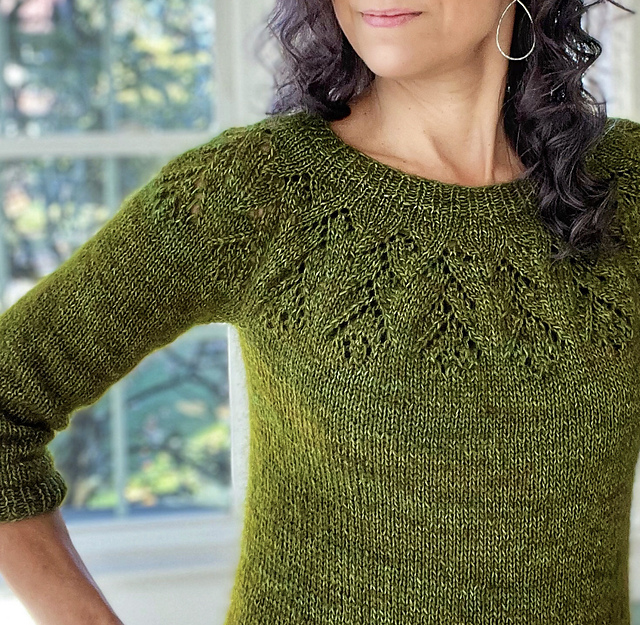
If you had to teach a class called “The Biology of Knitting,” what would be the required reading and required projects?
Ooo this would be fun! For a reading list, Clara Parkes’ Book of Yarn would be a must, then I think I’d kick it old school with Elizabeth Zimmermann’s Knitting Without Tears, and Barbara Walker’s Knitting from the Top. Projects would include things meant to go on a human body: A hat, gloves (we could learn how to use double knitting to make the fingers easier to knit), socks, and a sweater. Knitted hot pants would be for extra credit.
Mary’s Design Philosophy…
Your designs are described as “feminine without being precious or stodgy”. Those are fighting words in the knitting world! What does that mean to you, and what patterns did you knit before you designed that garment?
Oh my, I remember putting that up somewhere (it’s a quote from another knitter) but thought I’d changed it ages ago?! Oops! Honestly, I’d trash that now—garment design and fashion has changed so much in the past 14 years that I’ve been designing, and it’ll continue to evolve. Remember when empire waists were in? They’ll eventually be back just like cropped sweaters and high waist pants have been coming back!
Even if we don’t join the latest trends, what we want to wear and what’s comfortable on our bodies is likely to change, too. I’m not the same size I was 10 years ago, and my tastes have changed. That’s all good. And it also means I’ve had to rethink some things in my wardrobe and let go of some sweaters that either don’t fit or don’t suit my needs anymore.
You’re known for seamless, top-down construction. For knitters who’ve only ever knit from flat pieces, what’s the one thing you wish they’d understand about top-down that might change their mind?
I’m not really out to change anyone’s mind about seamless vs seamed sweaters and which is better, etc…The better way will depend on the knitter and their particular preferences. I’d only want to encourage people to give each a try so that they know for sure what appeals to them the most.
Having said that, I’d always encourage people to look for a top-down project that has shaping that lowers the neckline in the front, even just a bit. This will make any sweater more comfortable to wear and keep it from riding up on your neck.
MKALs & Community…
Your mystery knitalongs (MKALs) have a cult following! What’s the difference between designing for an MKAL versus a regular pattern? And here’s the real question: when you’re designing for an MKAL, do you ever surprise yourself at the end?
With an MKAL, I usually try to build a “festival of stitches” into them. There’s more of a surprise built into it that way, and I get to have a lot of fun testing them out. Often times, there will be a stitch pattern that I think would look great on a hat, sweater, or cowl. Those projects usually go a lot faster because I’m already familiar with how the stitch pattern behaves and all.
And it’s definitely happened that I’ve been surprised by the end of an MKAL shawl! I had a plan for the finish of The Knights Who Say Knit, but when I got to the part where you connect the 2 pieces for the final clue, an idea popped into my head, and the change I made resulted in a stitch pattern that resembled The Grail right in the middle of the shawl!
“Only Yarn in the Building” has nearly 500 projects on Ravelry. That’s not just a pattern, that’s a moment. What did you hope would happen when you first released the MKAL, and what actually happened instead?
The yearly MKAL takes so much planning, and I’m working on it for months in advance. By the time I open the pattern up for preorders in January, the shawl is done, the pattern is almost finished being edited, and I’m questioning all of my life choices.
There’s a lot to coordinate, and when the pattern is ready to go, it’s like releasing your very own baby bird into the world to fly (mostly) on its own. And whether it flies to 3000 people or 30, we’re still going to be knitting along regardless, and I work to help it be a fun experience either way.
Writing & Communication…
As a professional singer, you probably know the power of clarity and rhythm in communication. How does that training show up in your pattern writing? Do you think of your patterns as having a “voice”?
If I could have a voice, I’d aspire for it to sound like Moira Rose from Schitt’s Creek, but who am I kidding? My vocabulary isn’t nearly as “suffonsifying” as hers, and I’m probably more of a Ted.
But in all seriousness, writing instructions for a pattern is writing code, so I approach it as a type of programming. But this program is being read by a human, not a machine, so I’m careful to do things like using bold font for directions that might be different, or putting extra white space around a sentence so that someone doesn’t miss it.
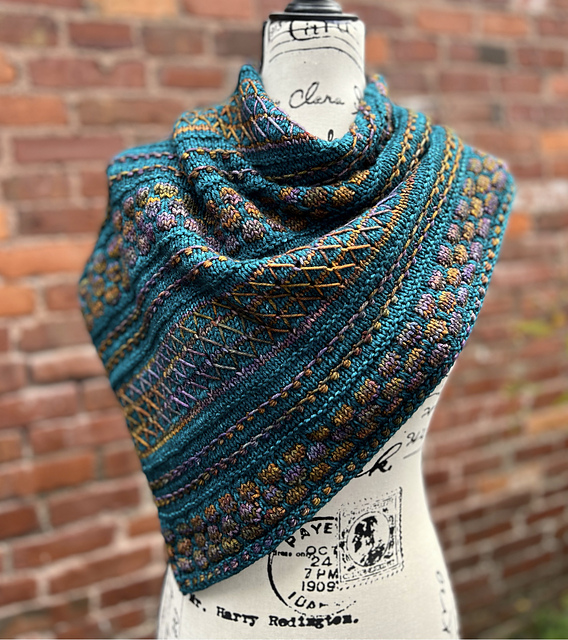
You have over 10,000 Substack subscribers. How do you keep that newsletter feeling personal when you’re talking to that many people?
I’ve been building my newsletter audience for almost 14 years so that’s really why I have so many subscribers! I’ve had to change platforms a few times but moved to Substack when a few other knitting blogs I enjoyed moved there.
While the platform has changed, my newsletter hasn’t. Every time I sit down to write it, I imagine just one or 2 besties reading it on their phone, and I write it for them. These imaginary Besties think I’m hilarious in spite of all evidence to the contrary and will laugh at any of my bad puns and dad jokes, so that helps me actually write them in the first place.
The newsletter is how I let people know about new patterns and tutorials, or geek out about sweater knitting, but the deeper truth is that if it puts a smile on a knitter’s face after reading it, it’s achieved its purpose😊
On the Craft Itself…
If a brand-new knitter asked you what ONE thing would make them genuinely better at knitting, what would you tell them? (And is it something you design around?)
Always swatch and block a yarn & stitch combination that’s new to you! It lets you know if the fabric is something that you like with that particular stitch pattern, and it also will tell you what your gauge is. Knowing these things helps set you up for a more enjoyable knitting experience.
You’ve been knitting for over 20 years, so you’ve seen the knitting world change. What’s one thing that knitters today have that would have blown your mind when you started with those chopsticks?
Two things: Working a set-in sleeve simultaneously with the bodice still blows my mind, as do short rows! They’re so useful!
And just For Fun…
Guardians of the Galaxy cardigans? Hamilton knits? But knitting feels like it can be very serious at times. Where does the playfulness come from, and are there any pop culture references that have come close to making it into a pattern but didn’t?
Without giving away the Special Sauce, the MKAL themes I choose are always ones that jazz me personally. I’ve had some requests for a Game of Thrones theme, for example; but I was never all that into it and only watched a handful of episodes, so I don’t feel like I could do it justice in an MKAL. It should always be written by someone who really loves it.
As for playfulness: It’s probably impossible to be an adult in this world and not have some stress, so it’s up to us to find ways to release it. Knitting can do that, and so can laughter or a good giggle. Why not combine the two? Sure, a knit can still be challenging or even frustrating at times, but we can still have some fun. The more joy we can bring to knitting, the better off we all are.
If you could design ONE pattern that would teach every knitter something they don’t know about their own knitting abilities, what would that pattern be? (And would Knotions readers ever get to make it?)
Probably something that makes use of short rows in both garter and stockinette stitch.
Wow! Thanks, Mary. It’s been great to get to know you a bit more.
Whether you’re drawn to her thoughtful construction details or her STEM background, Mary’s designs are definitely worth exploring.
You can find more of Mary’s work on her Substack at lyricalknits.substack.com and browse her full collection of patterns on Ravelry.
Leave a Reply