
Author Interview
A meatball jellyfish dreamed up on a car ride, a taco shell that folds itself into shape, and a pug who somehow knows the plushies are not toys.
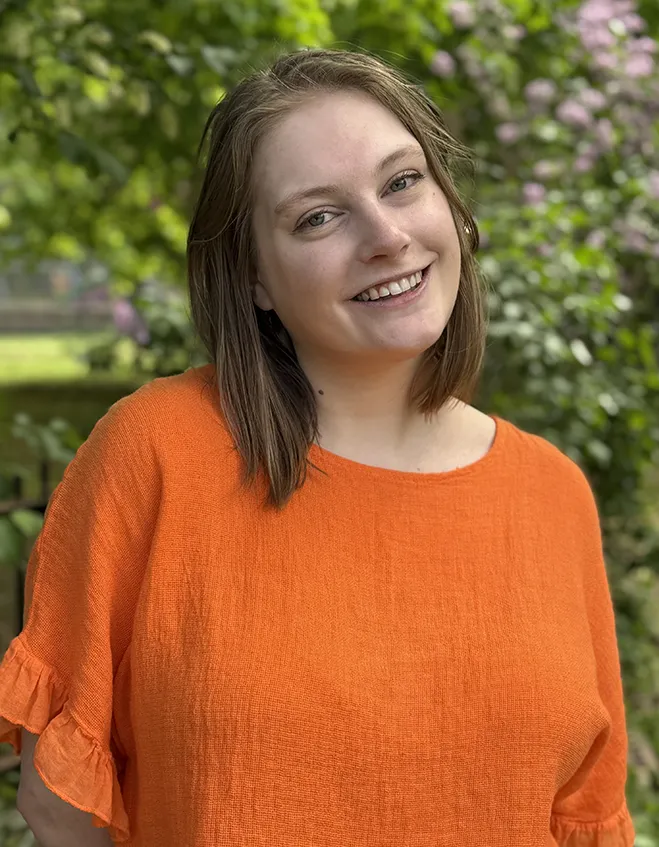
The Author
Naomi Fox
The designer behind Crouton’s Crochet, known for food-animal mashups like the Tacosaurus. She taught herself to crochet during the Covid lockdowns, works almost exclusively in blanket yarn, and shares her studio with a pug named Crouton and six cats.
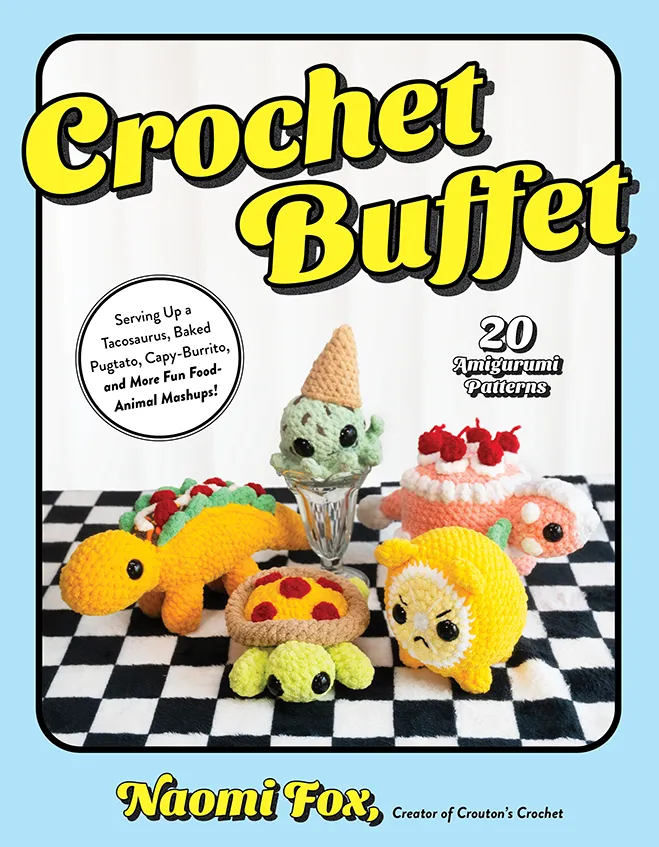
Crochet Buffet
Page Street Publishing · 2026
Win a copy of this book. Enter the giveaway (closes December 13, 2026).
Part One
Hands that wouldn’t cooperate
Two answers about a rough first day with a hook, and the idea that turned into a business.
You write that you’ve never been good at art, and that your first try at crochet took a few hours, some tears, and several near-meltdowns before you had a simple flower. What kept you going past that flower, at the point where most people would have put the hook down?
Honestly, I’m not quite sure. I think it was a mix of a few things. Deciding to try it while over the Covid lockdowns was definitely a factor because I had so much extra time on my hands. Another reason may have been stubbornness. I told my psychiatrist I had at the time (who I’d seen since childhood) that I was going to try to learn to crochet and she reminded me that I have always struggled with hand eye coordination and artistic things and so I shouldn’t get my hopes up. I think subconsciously that helped drive me to want to prove her wrong haha!
Everything started with one thought: crochet-ti and meatballs. Do you remember where you were when the spaghetti jellyfish idea hit, and how long it took for the next mashup to show up?
I was in the car with my boyfriend and the idea just came to me. I truly have no idea what led to the idea except that I was probably craving spaghetti and thinking about crochet (and somehow jellyfish came into the mix?) haha. I think before I even finished making the meatball jellyfish I had already come up with the idea of wanting to make a pizza turtle next. I’m sure I would have made it no matter what, but after posting the meatball jellyfish and having people in the comments really enjoy it, it definitely encouraged me to prioritize creating more food animals.
Part Two
Building a taco from a circle
Four answers about turning a ridiculous idea into a shape that actually holds together.
Every design in the book comes down to a few basic shapes: circles, spheres, cones, the occasional triangle. When a new idea arrives, how do you get from “a turtle with a pizza shell” to the pieces you need to make it? Do you sketch, do math, or go straight to the hook?
For me, the process changes based on how I’m feeling about the design. I actually don’t have the ability to really visualize things in my mind so I’m definitely at a big disadvantage there haha. Typically, I do trial and error but if I’m really unsure of the logistics or need help trying to visualize, I’ll make a drawing out of basic shapes on Canva. Something else I do, especially because I’m not good at visualizing, is I’ll jump between pieces. So let’s say I started with the body, I might wonder if I’ll be able to put enough detail into the head given the limited number of stitches to match the body size, so I’ll start working on the head and then jump back and forth between pieces as needed.
This is our STEM issue, and the taco shell is a great example of geometry doing the work: a flat circle that folds itself into shape when you join it to the filling. Do you think about the math behind your shapes at all, or is it all trial and error and feel?
For me, it totally depends on the pattern. Sometimes I think it is necessary (at least to avoid a million trial and error attempts) so I do my best to figure out the math in those instances and usually do alright at it. I’m definitely not the best at it though when it comes to more complicated things. I’ve worked on projects with my friend Zoe, @gardenhoe.crochet, and sometimes she will start writing down math equations that might as well be written in an alien language to me haha.
The Tacosaurus is the design you’re best known for. Why do you think that one, out of everything you’ve made, is the one that took off?
I think it just comes down to it being such a fun design with so much personality! I mean first of all, who doesn’t love tacos and dinosaurs?! It’s one of those designs where I think it has the perfect balance between details and complexity but also simplicity in immediately recognizing what it is. Tacos are one of my favorite foods and I think dinosaurs are super cool so I have always been biased towards it as well haha.
Which design fought you the hardest? The one with the most failed prototypes before the shape finally worked.
I think that definitely has to be the Sharkcuterie Board. It was actually my dad who came up with the idea and I fell in love with the idea but knew that, because of all the pieces involved (meat, cheese, crackers, fruit, etc.), it would be complicated. The hardest part was trying to balance having the detail of many charcuterie board toppings while also not being overly complicated or giant. When using blanket yarn, knowing that I wanted multiple pieces of each food on the charcuterie board, I had to go back and forth between experimenting with how small I could make each piece while scaling the total size of the shark’s body to have enough space to fit them all! I had to sacrifice some of the complexity I originally wanted the design to have to make the size not feel out of place in the book and also because if I made it as detailed as I wanted, I think I might have driven some people mad with the sewing haha! In the end though, I do love how he turned out.
Part Three
Pun first, or animal first
Two answers about naming, and the yarn behind every pattern in the book.
Which comes first, the pun or the animal? Have you ever had a perfect name with no design that worked, or a finished design you just couldn’t name?
My answer for this is that it’s truly about 50/50. Of course, if I can come up with a pun name and design, I run with it but often I either come up with a great way to incorporate a food into an animal’s body or I come up with an incredible name and then have to work to fill in the gap of the name or the design. If I can’t think of how to make the design work, I usually have to throw out the idea of the pun altogether (or at least put it on the back burner) but there have been many times I’ve thought of an amazing food animal combo based on, for example, body shape and then had to try to grasp at straws for a pun name or release it without one.
A great example of that is the ice cream octo-cone in the book. For that one, I fell in love with the idea of an octopus whose body is an ice cream cone that fell on the ground and the arms are dripping melted ice cream. I just think it’s such a fun idea I had to include it even though I never came up with a perfect pun name for him, we just call him the octo-cone which is fine but not my usual pun name standard haha!
Every pattern in the book is written for chenille. What makes it the right yarn for these, and what would you tell someone picking it up for the first time? It can be hard to see your stitches.
I use blanket yarn almost exclusively for a couple of reasons: 1. It’s much softer and more cuddly than most traditional yarns (like many worsted weight yarns). 2. It lets you make plushies bigger and faster due to the thickness (although sometimes this can have its downsides when it comes to adding details).
And the main reason I use a blanket yarn over most traditional chenille yarns: I can’t stand the shedding that comes with most chenille yarns. If you do use chenille over a blanket yarn for the patterns in my book, my biggest tip would be to sew pieces with a typical 4-weight worsted yarn because it will look much smoother and not shed the way chenille yarn does when you sew with it.
In terms of getting used to using yarn where it can be hard to see your stitches, I have a couple suggestions to use until you get confident with it: 1. Count your stitches as you go each round. 2. Unless the pattern has specific color changes or other details like that, if your stitch count is off by 1 or 2 at the end of a round, just add an increase or decrease and no one will know haha. 3. Use stitch markers! Add a stitch marker every 5 stitches you make. It may seem annoying at first but it helped me until I got comfortable roughly counting stitches by feel instead of only visually.
“Don’t focus on perfection, focus on making it your own.”
On what she wants readers to know before a first project
Part Four
A pug, six cats, and a snake
Four answers about the animals running the studio, and what she wants readers to know.
The book is dedicated to Crouton, who distracts you from counting stitches and sheds on your projects. Has Crouton ever modeled for a photo, weighed in on a design, or stolen a finished piece as a new toy?
One thing that amazes me is that somehow, Crouton knows my crochet animals are not toys. This is truly a blessing because let’s just say she isn’t always the best trained and I have been known to leave projects out on the couch, bed, or even floor unattended, so the fact that she’s never stolen one is honestly a miracle haha! She definitely is used to putting up with some of my shenanigans for social media content. For example, I made a video where I would put plushies on her head and rate them based on how long it took her to push it off (because she is so unbothered and lazy). Maybe I should do that again for the book patterns haha!
You accidentally adopted six cats while writing this book, including a litter born inside your house. Has any of them made it into a design yet? And which one is the worst studio assistant?
Although none of them specifically have made it into a design, I was inspired to include a cat pattern in the book because of them! Since the original 4 cats I took inside were used to being on the streets, there definitely was an adjustment period for each one where they were not so friendly until they felt safe. While explaining this to my parents, my dad joked about one being a sourpuss which ended up inspiring my sourpuss pattern, an angry lemon cat!
Funnily enough, all my pets except for the youngest two kittens are named after food so there’s plenty of opportunity for more food animal combos inspired by them! In terms of the worst assistant, it absolutely has to be one of the two kittens (the only two without food names), Oliver and Pip. Whether it’s a charging cable or yarn, I swear they can sense it from a mile away and come running to play and chew on it.
What’s on your hook right now that has nothing to do with food or animals?
Unfortunately due to hand pain, I have to limit what I crochet which means when I’m not making my food animals, I’m usually taking a break for my hands! However, I have so many other friends with amazing crochet books that I am dying to try some patterns from when I’m able! Some would be: Crochet Goomis, Itty Bitty Amigurumi, Stitchkins Squad, and Woodland Wonders.
What’s one thing you’d want a reader to know before they start their first project from the book, something that isn’t in the pattern instructions?
Don’t focus on perfection, focus on making it your own. I am the furthest from a perfectionist so even though I put so much time and effort into my creations, I also accept little flaws because isn’t that part of the beauty and charm of creating something by hand?! Rather than focusing on a single messed up stitch or a slightly uneven piece you sewed on, focus on how cool it is that yours has personality!
Now open
Win a copy of Crochet Buffet
Page Street is sending one copy straight to the winner. Entering takes about twenty seconds.
01
Drop your email below to enter. You’ll also join the Knotions list if you’re new here.
02
We draw one winner and email you. That is the whole thing.
Optional: repin the review on Pinterest to help us out.
Leave a Reply