
Wow what an unusual yarn. We’re talking about gnarledpaw Hatshepsut. {read our interview with Liz from gnarledpaw too}
It comes in two varieties:
- Fingering at 438 yards per 100 grams
- DK at 273 yards per 100 grams
The alpaca gives it a soft halo (see that halo below?), the silk gives it strength and the linen, stability. What a gorgeous yarn.

In the fingering weight I immediately thought “shawl” but since I just got a sample I stuck to a swatch.
Before we get to the swatch, let’s talk about the yarn in its hanked-up state.
The color is subtle but not muted – dappled with shades of pink (there’s lots of bits of variation in there). I did find a few pieces of foreign matter in the hank but it very easily pulled out (note: I don’t think it was VM but rather, something else – likely from the silk or linen).
 Given the yarn’s fibers – alpaca, linen and silk – the yarn doesn’t have much give to it. In fact, once wound on the ball winder it didn’t even bounce back after I took it off. Very similar to linen and silk.
The hand was lovely – soft (probably that alpaca again) but with some integrity too (there goes that silk and linen).
And a good indicator of how it will behave once knitted up.
Gorgeous – in the right design.
The Swatch
I did a basic swatch in stockinette stitch and kept with the recommended needle size of 2.75mm to give the yarn a test run.
I was concerned the yarn would split given I could easily see the individual plies but it held up like a champ (I’m guessing because of the alpaca?). I also did use Addi Turbos (or as Grumperina rightly calls them, Blunti Stubos) so it could have also been because I used a less-pointy needle.
NTS: I still prefer the sharpeness of ChiaoGoo needles but the Addi’s were good for this purpose.
Blocking
I blocked following the label’s instructions – I soaked in cold water and rolled it up to remove the excess. I didn’t see any color bleeding!
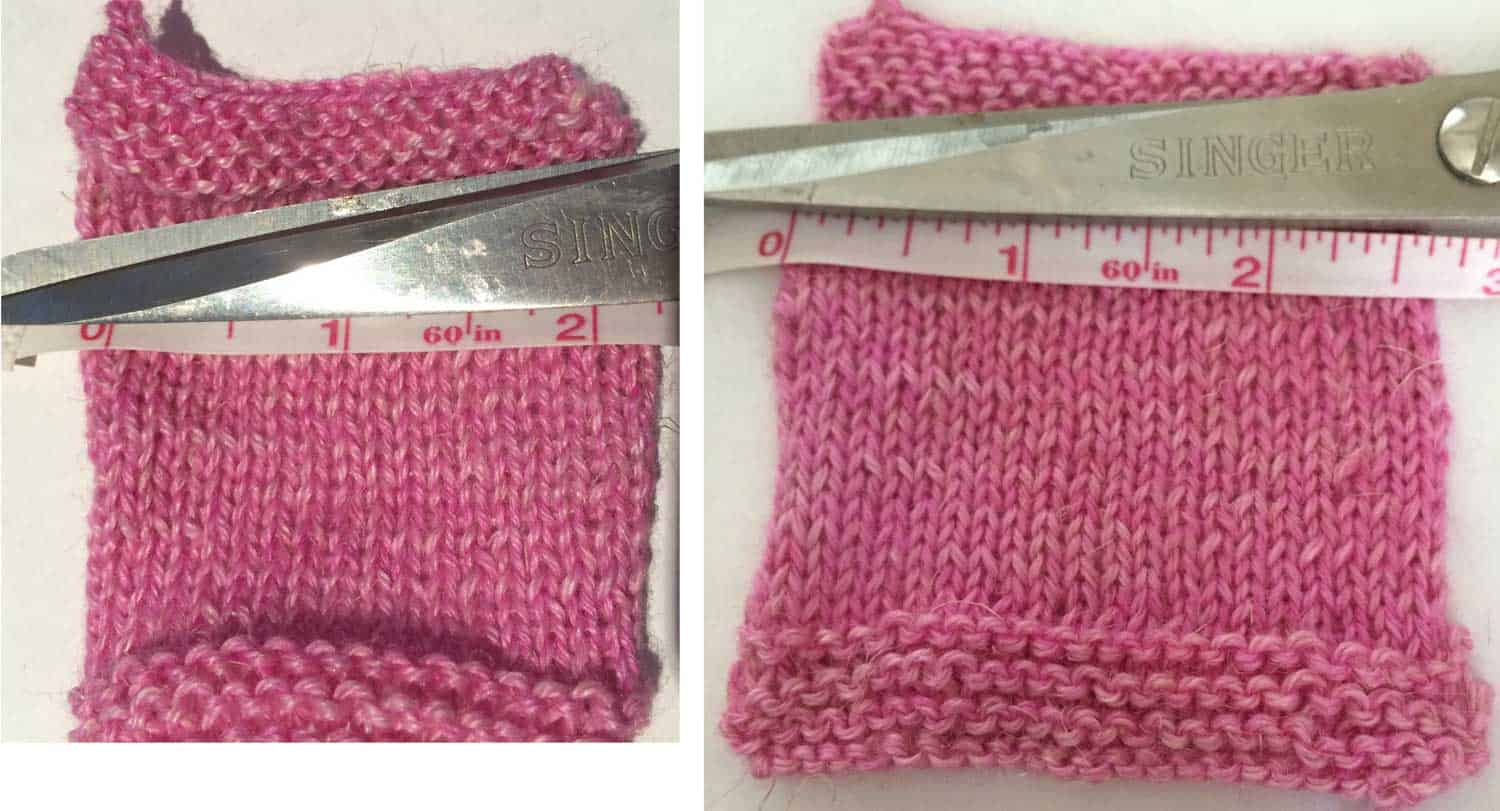
Pre-blocking (left): The stitches were well-defined but you could see the halo.
Post-blocking (right): The halo got a bit more pronounced, the swatch got flatter and the stitches bloomed 15% (from 8 SPI to 7 SPI). I could have stretched it out quite a bit more though – I didn’t block aggressively AT ALL.
Design Ideas
This yarn would be lovely as a shawl or cowl – something close to the face but doesn’t need to do a lot of giving or stretching. I think it’d be beautiful in lace too! Oh, and it is NOT for socks.
I also see both this weight and the DK working up into a lovely sweater.
Again, match the yarn with the design and you’ll have a combo you’ll love.
off to contemplate shawl patterns…
I’ve heard other people mention the halo effect of certain yarns. Is this a desirable quality? I’ve seen the “halo” on acrylic yarns, and always thought it was the mark of a man-made yarn. In this yarn, I presume the alpaca causes the halo.
I know what you mean about a halo with acrylic yarns. This is similar but obviously for a different reason. In this case, the halo is caused by the loftiness of the alpaca. Don’t be afraid of the halo – just know that it’s there and keep that in mind when matching it with a pattern. For example, if texture or ribbing are SUPER important to the design, you may not want ANY halo.