
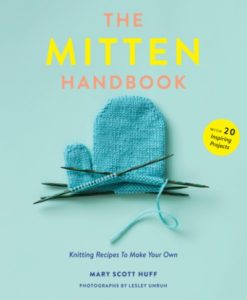
by Mary Scott Huff
159 pages
20 patterns
$13.38 on Amazon, also available for the Kindle for $9.99
This is a smart book if you like to make mittens or want to get started making mittens.
What’s In The Book
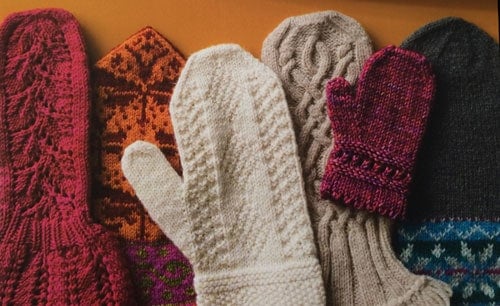
The author goes through the Anatomy of a Mitten and gives you lots of options for each one. Look at all those gorgeous mittens – and that’s just a sampling.
She also gives a standard size chart that goes from Baby to Man’s Large – handy if you’re making a gift and you don’t have access to the recipient or you don’t want to come up with an excuse to measure their hand.
Mary talks about Ease, Swatches, Yarn Choice (plies, weight, fiber and twist) and even covers Mitten Architecture (spoiler alert – there are 4 main types in this section).
Then she gets into the components of mittens – and this is where I think the book shines.
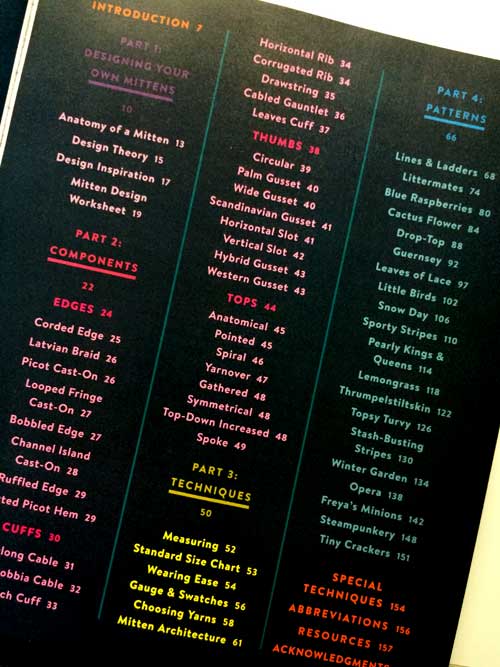
Let’s look at the Table of Contents again.
She gives over 30 different components. And I can see using them on things other than mittens too. The cast on’s would be great for a shawl, the cuffs for a sweater or cardigan, the thumbs of mitts/mittens/gloves, and the tops for sock toes as well.
I think you get a lot more than just mittens, but even if you didn’t use it for anything other than mittens it would still be a good book.
Components
Let’s take a look at a few of the components.
The Latvian Braid is a great addition to your knitting toolbox (and we also have a tutorial for it too), the Knitted Picot Hem will come in handy for many applications, the French Cuff is fun to add to a variety of projects and Horizontal Rib is a pretty addition too.


You can mix and match the components to create your very own mitten, or use one of the patterns if you don’t want to think too much (and that’s OK – sometimes you just want to knit).
Patterns
And then we have the patterns.

One of my favorite features of the book is that she details which components she’s using in each pattern (it’s listed on the right side of each pattern page).
Take the Drop-Top Mitten.
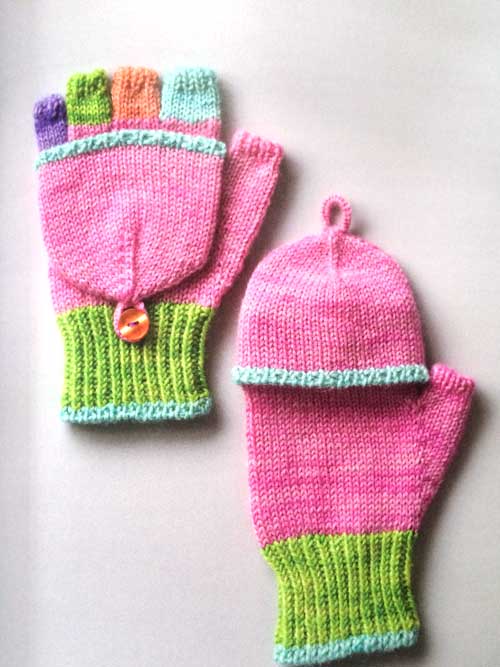
She tells us that she uses the Western Gusset Thumb and Spoke Top. And she shows a clear pic of each mitten. For this one, she shows it both open and closed – very useful so you can see it both ways.

Or look at Stash-Busting Stripes which is a pretty basic mitten but she makes use of scraps in a fun way. I can see making these even as an un-matched pair but maybe using the same contrast color divider on both to just match them a little bit.
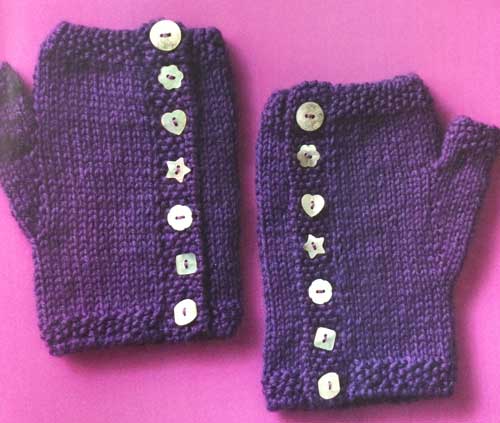
And here are Kings & Queens – a fun implementation of fingerless mitts but decorated with some buttons and seed stitch.
Most of these mittens could be made into fingerless mitts rather easily – especially after reading these patterns. They’re as much a teaching tool as they are a finished pattern.
Is this book for me?
Like I said in the beginning, if you enjoy making mittens or want to start, this can be a great addition to your library. And while I wasn’t hot on mittens before, thumbing through this book has given me a few ideas.
A review copy was furnished by Abrams but the opinions are mine.

Leave a Reply