
Author Interview
Ten months in County Cork, a shelf of bobbins, and a title that promises a blanket in a week. We asked her whether the math holds up.
Win a copy of this book. Enter the giveaway (closes October 31, 2026).
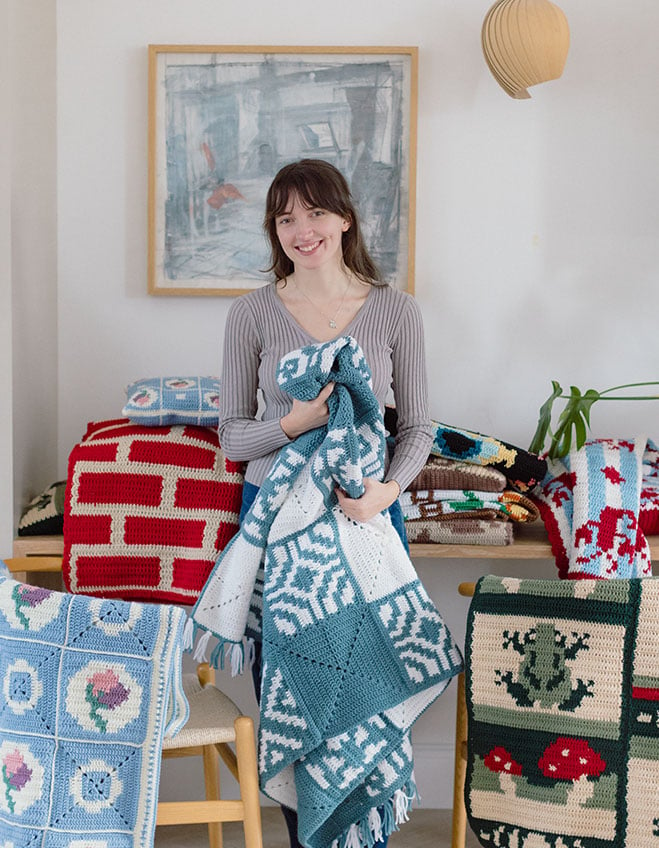
The Author
Savannah Price
Crochet designer, chart obsessive, and author of two books. She wrote most of this one on buses and trains around Ireland, Italy, Switzerland, Albania and Portugal, and has since landed in Indianapolis.
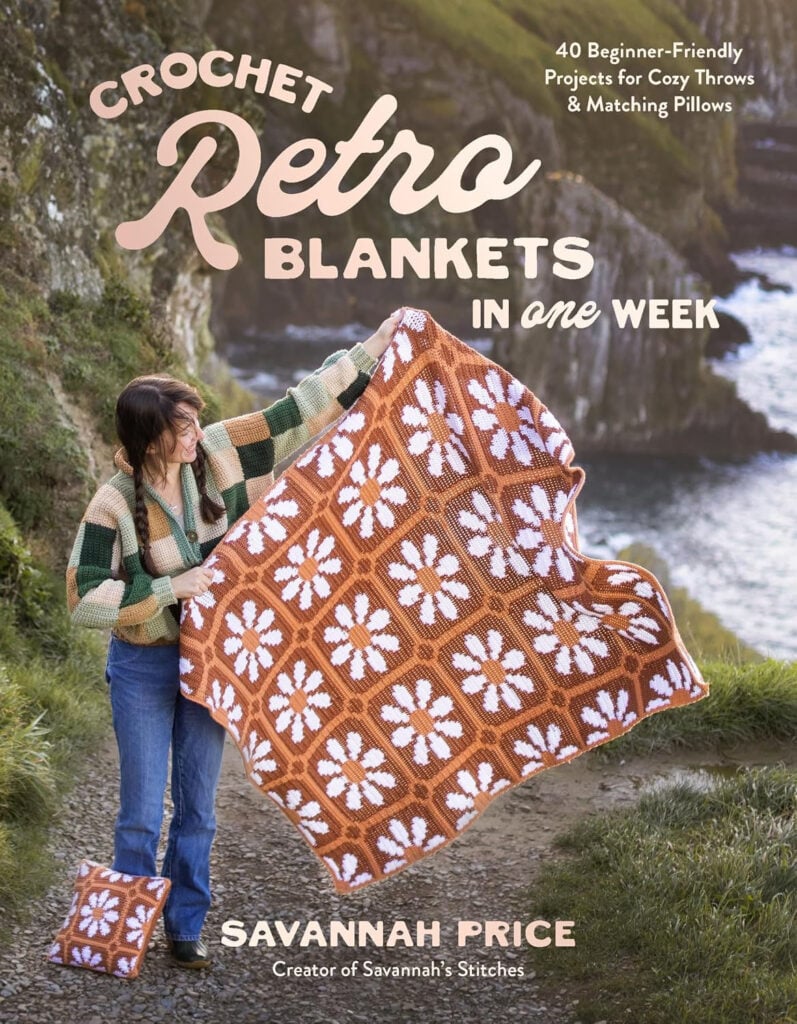
Crochet Retro Blankets in One Week
Page Street Publishing · 2026
Win a copy of this book. Enter the giveaway (closes October 31, 2026).
Part One
Blankets, not bodies
Three answers about decisions that get made before a single stitch does.
Your first book, Retro Crochet Style, was fashion. This one is home. What changes in how you design when the finished piece is going to live in a room instead of on a body?
Great question! I’ve prioritized the same principles for both blankets and garments: comfortable fabric, repetitive stitches and motifs, and elements that can be made as simple or as eye-catching as you want. The technical elements of each design are what change how I work; it’s a different beast to create a swath of flat fabric, versus the same garment across nine sizes! Because of this, I make color charts for blankets before I even think about what size they’ll be, and can see a project from idea to FO within the span of a few days. For a garment, I have to think about sizing before anything else; because of this, far more garment designs end up on the cutting room floor than blanket designs.
You sort the patterns into three construction types: row-by-row, patchwork, and a combination of both. The book tells readers which to start with, but not how you decide which one a given design gets. How does that call get made on your end?
It’s all based on the colorwork charts I make when ideating. All of these blankets started as me messing around on online chart software, Stitch Fiddle to be exact (the $20/year subscription is so worth it!), and adjusting again and again until I have a chart, or set of charts, that I like. If it’s a chart that is continuous and repeatable in every direction, it becomes a row-by-row design. If it’s not repeatable, it becomes patchwork or a combination, which is mostly decided by the chart’s size. For patchwork blankets, I prefer to have a mix of granny squares and colorwork squares to keep things interesting. If the chart isn’t a square shape, though, I’ll make it a combination style, where all the charts are the same width but varying heights.
“All of these blankets started as me messing around on online chart software.”
On how a design finds its construction
Every blanket comes with a matched pillow. Does the pillow ever come first, or is it always the blanket that arrives and the pillow that follows?
The pillow always follows! It’s exciting to see how I can adapt a chart meant for one thing to another. One of my favorites is the Butterfly Garden Throw, which has a fun four-square arrangement of butterflies on one side and a gingham pattern on the other.
Part Two
The one week promise
A book with a deadline in the title, and the arithmetic it prints to back the claim up.
The book includes formulas for estimating how many hours a project will take, based on a reader’s own row or square speed. Most pattern books won’t go near project management. What made you decide crocheters needed that?
Most crocheters are intimidated by blankets because of the sheer scale of the project. I wanted to ease that burden for anyone reading, blankets can be a lot easier than they seem! By using just a few project management tips, you can shave off hours on any project while maintaining a high quality of work. I also always want my books to gift crocheters more than just one-time-use patterns; I want to help them develop skills that can be used for the rest of their lives.
The one week promise rests on the phrase “days full of crocheting,” and your own worked example lands at about 27 hours, with 35 as the comfortable version. Was printing the real numbers an easy call, and how do you want a reader with a full-time job to hold the title?
Honestly, it was not an easy call! I was tempted to make all the projects seem easier than they are, but knew that would ultimately just lead to frustration by setting an impossible standard. Any title with a time-based claim should be taken with a grain of salt, as we all craft at different paces and have different after-work responsibilities besides crochet, but I truly do believe that most of the blankets included can be made within a week. A very dedicated week, but a week nonetheless. I also want it to be a bit of encouragement for crocheters with a full-time job. Hobbies can be relaxing, but they can also give you a sense of purpose outside of salaried work, and setting a goal like making a blanket in a week is a fun way to challenge oneself, and get a beautiful blanket at the end of it all!
“Hobbies can be relaxing, but they can also give you a sense of purpose outside of salaried work.”
On holding a one week title with a full-time job
Part Three
Where the designs come from
Where a design comes from, and what it takes to physically hold one together.
You made nearly this entire book during ten months living in County Cork, and traveling around Europe. Italy, Switzerland, Albania and Portugal. Which project carries the most of a specific place in it, and would a reader ever guess which one?
Oooh, love this question! The Sleepy Sheepy Baby Blanket would have never existed without the long bus and train and plane rides I took in and around Ireland. That whole country is filled with the greenest greens and bluest blues you’ll ever see in your life; all the rain and sea has to be good for something! I think a reader would guess that, though the Sicilian Summer Throw may be the more obvious choice, with its big juicy tomatoes and lemons.
“That whole country is filled with the greenest greens and bluest blues you’ll ever see in your life.”
On ten months in County Cork
The Kaleidoscope Blanket can need up to 48 color changes in a single row. What does your setup actually look like on a project like that, and at what point does bobbin management stop being fiddly and start being automatic?
The setup is difficult, but so rewarding to finish! I typically make a big set of bobbins before I start any blanket project, as there’s nothing worse than pausing every few stitches just to wind another bobbin; I like to frontload my work. Pinning so many bobbins can make the first few rows very awkward, as the bobbins are heavier than the piece itself and make it bend every which way, but before you know it, the fabric is starting to look like the chart, and the bobbins keep to themselves a little more! I’d say around row 15 to 20 is when I usually start getting into the groove with the bobbins. The worst part of making blankets in this way is getting the project out and putting it away; to avoid messing with storage, I’d just put the project to the side on my bed or couch and pick it up the next day.
Part Four
Slowing down
The argument underneath the book, and what she is making now that has nothing to do with it.
The introduction frames the whole book against next-day-delivery consumption. Is that a thing you set out to write about, or something that surfaced once you saw the projects together?
The next-day-delivery model of life is, in my opinion, pretty unnatural. We’ve built worlds to accommodate near-instant gratification for things that used to take years. In some cases, that’s beautiful, like in the medical field or the ability to connect with people across oceans. In most cases, though, it leads to an impatience and entitlement with the world that only leads to negative outcomes. I justify this crochet design work to myself as my small part in fighting against that impulse to satisfy a need in seconds. If I can help even one person see the beauty in slowing down, making something with their hands, and considering a project on all sides before starting it, I’ve achieved more than I’ve ever dreamed.
What’s on your hook right now that has nothing at all to do with this book?
I just moved to Indianapolis, and have a few projects I’d like to create to make my new place more homely. Coasters, a welcome mat, a trim for the cat door that leads to their litterboxes. So many fun little projects!
What’s one thing you’d want a reader to know before they start their first project from the book, something that isn’t in the pattern instructions?
I wish every crocheter knew that they are capable of far more than they could ever think. With patience and persistence, literally any project you dream of can be yours. Having a set of handmade blankets laying around my apartment ready for use by friends and family is such a point of pride for me, and I hope readers know that it’s an achievable goal to create a collection of any kind of crochet work they want!
Now open
Win a copy of Crochet Retro Blankets in One Week
Page Street is sending one copy straight to the winner. Entering takes about twenty seconds.
01
Drop your email below to enter. You’ll also join the Knotions list if you’re new here.
02
We draw one winner and email you. That is the whole thing.
Optional: repin the review on Pinterest to help us out.
Leave a Reply