
A survey of 1,005 fiber artists asked why sustainable yarn hasn’t caught on. The answer is less about caring and more about cost, access, and knowing what to look for.
Most of us have stood in a yarn aisle holding two skeins. One says organic, recycled, or plant-based. The other doesn’t.
And more often than we’d like to admit, the eco option goes back on the shelf.
Maybe it was the price. Maybe we weren’t sure it would behave the same on our needles or hook. Maybe we didn’t know what “sustainable” on the label actually meant.
I’ve been crocheting since first grade, so once I realized how much plastic ends up in yarn, I began looking for sustainable yarns. I wanted to know if other crafters felt the same tension I did with synthetic yarns. That’s what turned into the survey.
Katiella Huffman, founder of Eco Amigurumi
It turns out we’re far from alone.
Between September 2024 and July 2025, Katiella Huffman, founder of Eco Amigurumi, surveyed 1,005 fiber artists through Instagram. She set out to answer three questions:
- What keeps crafters from using sustainable materials?
- How much does each barrier (cost, access, quality, knowledge) shape what we buy?
- If those barriers went away, would we actually switch?
Her report, Identifying Barriers to the Adoption of Sustainable Materials in Fiber Arts, is short, readable, and full of numbers worth sitting with. Here’s a preview.
The interest is there. The habit isn’t.
Asked whether they use natural, sustainable materials in their projects, respondents said:
51.3%
use them sometimes
5.2%
always use them
20.2%
have never used them
That gap between “I’ve tried it” and “it’s what I reach for” is the heart of the study.
Cost leads, but it isn’t the whole story
When asked to name the main barrier, respondents split like this:
39.1%
cost
26.8%
unfamiliar with the options
20.6%
limited availability
13.5%
lack of variety or interest
Cost is no surprise. The second answer is more interesting.
For more than a quarter of crafters, the biggest hurdle isn’t money or shelf space. It’s not knowing what the options are, how they perform, or where to find them.
That’s a problem education can solve.
My advice is simple. Ask at your local yarn shop or search online for 100% cotton, wool, or hemp yarns. They’re more available now than most people realize. A lot of crafters assume sustainable yarns feel rough or thin, and most don’t anymore.
Katiella Huffman, founder of Eco Amigurumi
Where we shop shapes what we see
Over a third of respondents (38.7%) said they have trouble finding sustainable options. Look at where people buy their materials and it starts to make sense:
35.2%
shop at local craft stores
19.6%
shop online
1.1%
use specialty eco-shops
If sustainable yarn mostly lives in shops almost nobody visits, most crafters may simply never see it.
(A resourceful 5.4% skip the store entirely and make their own materials from recycled goods.)
The 10% line
Half of respondents (50%) said they’d pay 10% more for a sustainable option.
After that, support drops off fast. 16.3% would pay 20% more, and only 3.2% would pay 30% or more. Another 30.5% said they’re price-sensitive and choose the cheapest option.
On a $5 skein, that means 50 cents is fine for most people. At a dollar more, only about one in five is still on board.
For anyone who makes or sells yarn, that’s a very specific target.
The number that stands out
Here’s the finding Huffman highlights most:
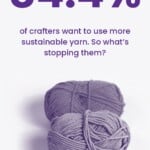
84.4%
would definitely be interested in using more sustainable materials if the obstacles were removed
Another 14.1% said maybe. Only 1.5% said no.
That’s a remarkable level of openness, and it points straight at the fixes: fair pricing, better visibility in the places we already shop, and clearer labeling and education.
Read the full report
The complete report includes the full results, Huffman’s discussion of each barrier, and her recommendations for making sustainable crafting easier for everyone.
And we’d love to hear from you. What’s the biggest thing standing between you and more sustainable yarn? Tell us in the comments.
Leave a Reply