
How Celtic Knotwork Translates to Knitting and Crochet
When you trace the intricate path of a Celtic knot with your finger, you’re following an ancient visual language – one that crafters have been translating into fabric for centuries. The connection between Celtic knotwork and cable work isn’t coincidental. Both are fundamentally about creating dimensional texture through the crossing and interweaving of continuous lines.
The Visual Grammar of Cables and Crochet Cords
Celtic knots follow specific rules: the line never breaks, crossings alternate over and under, and the pattern creates balanced symmetry. Cable knitting and post crochet operate on remarkably similar principles. Each cable or cord is a continuous column that crosses over or under its neighbors, creating the illusion of woven strands.
See it in action:
Basic 2×2 cable (C4F or C4B): The simplest cable crossing mirrors the most basic Celtic knot intersection – two strands passing over two strands. This is your foundation.

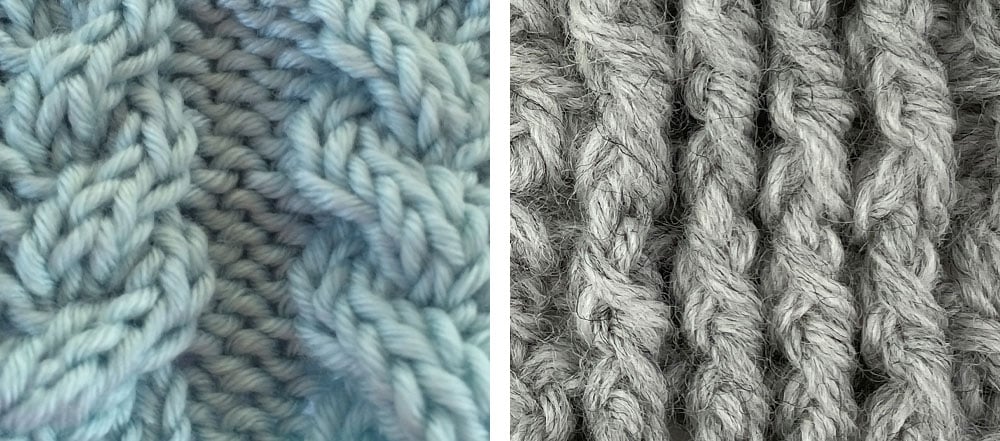
A simple 2×2 cable demonstrates the fundamental principle of cable knitting: two strands crossing over two strands, creating the basic over-under pattern seen in Celtic knotwork.
3-strand braid (plait cable): Worked over at least 9 stitches with three distinct strands that cross in sequence – echoes of braided borders in illuminated manuscripts.
Honeycomb cable: Alternating over-under crossings create the same interlocking effect as Celtic endless knots.
Crochet cord equivalents: Use front post stitches (FPdc/FPtr) to form raised ‘cords’ that mirror the raised columns of knit cables. Just as a simple 2×2 cable creates vertical texture in knitting, front post cords create the same dimensional effect in crochet. Alternate front and back post stitches for honeycomb effects, and sequence three front-post cords for a plait.
Reading Cables (and Cords) Like Knotwork
One reason makers sometimes find charts intimidating is that they’re trying to read them linearly, row by row. Cables and cords make more sense when you view them the way you’d view Celtic knotwork: as a complete pathway.
See it in action:
OXO cable (Hugs and Kisses): Alternating right and left crosses are perfect for practicing ‘following the strand.’ Trace one column from bottom to top and watch it weave across its neighbors.
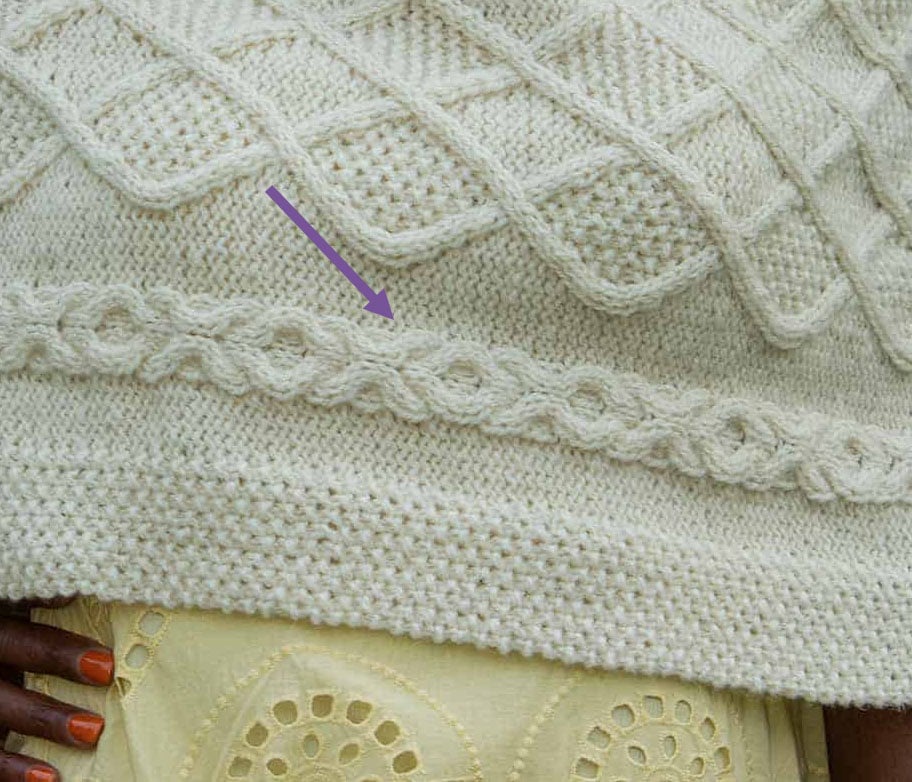
Aran horseshoe cable: Traveling stitches form a U-shape with a clear path to follow. Once you see the journey of each column, the entire repeat becomes intuitive.
Try this: Look at your chart or diagram and trace one ‘strand’ from bottom to top. Follow where it crosses over or under its neighbors. What seemed complicated becomes a simple, repetitive path – just like a single line through a Celtic knot. For crochet, mark overlay rounds and post-stitch paths in a contrasting color and trace the post columns the same way.
The Mathematics of Symmetry
Both Celtic knots and cables rely on mathematical symmetry. Traditional Celtic designs often use rotational symmetry – patterns that repeat when rotated around a center point. Cable panels frequently use this same principle, with center elements that mirror outward.
See it in action:
6-stitch cable variations (2x2x2): Cross three pairs in a rotating order (right, center, left, repeat). Rotational symmetry makes the pattern read the same every 120 degrees.
Diamond cable panels: Traveling stitches that meet at points and separate again demonstrate bilateral symmetry – mirror images on either side of a center line.

Crochet relief panels: FPdc ‘diamonds’ over an sc/hdc background mirror the same symmetry. Rotate the crossing order of three front-post cords for a crochet analog to 2x2x2 rotations.
Tension and Dimension
Here’s where fabric diverges from two-dimensional Celtic art: cables and cords create real depth. In knitting, holding stitches and crossing them builds raised architecture. In crochet, post height and direction pull fabric forward or push it back, sculpting relief.
See it in action:
Staghorn (rope) cable: A tightly twisted cable worked frequently creates high relief – the stitches pop off the fabric.
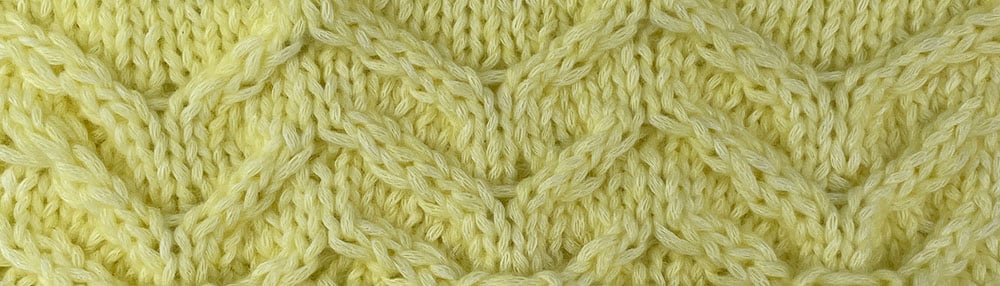
Double cable (two parallel 2x2s): Cross on different schedules to layer depth without complexity.
Crochet cord height: FPdc vs FPtr changes relief just like crossing frequency does in cables. Taller posts = more drama; mixing heights across rounds layers depth without bulk.
Why gauge matters: The stitches need room to cross or your fabric gets dense and unreadable. Think spacing in knotwork – too tight and the pattern muddies; properly spaced and it sings. In crochet, watch for ‘rowing out’ and cord width: keep post-stitch tension even and use a stable sc/hdc background so cords don’t sink or wobble.
Design Principles to Borrow
Celtic knotwork offers several principles that translate beautifully to textured fabric:
Continuous Flow
The best cables and cords have a rhythm that guides the eye naturally through the design.
Chain cable: Connected diamonds create upward flow, like a Celtic chain border.
Meandering vine cable: Traveling stitches curve and flow without abrupt turns – very Celtic.
Crochet cords: A continuous front-post cord meandering across an sc field achieves the same uninterrupted path. Overlay rounds extend a path over earlier stitches cleanly.
Balanced Negative Space
In Celtic art, the spaces between lines are as important as the lines themselves. In textured fabric, reverse stockinette (knit) or a simple sc/hdc field (crochet) lets paths stand out.
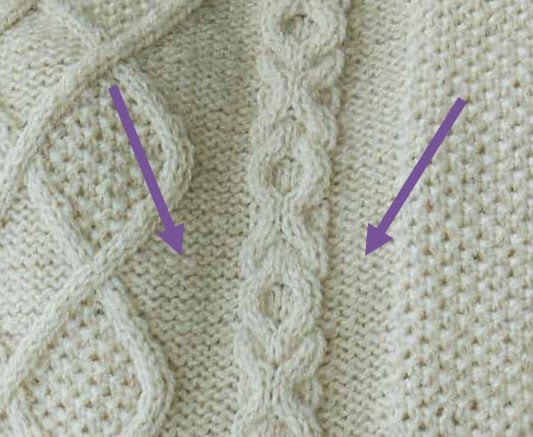
Like Celtic knotwork where the spaces between lines are as important as the lines themselves, cables read most clearly when given breathing room. Here, reverse stockinette background allows the cable paths to stand out boldly – the negative space is what makes the positive space visible.
Blackberry cable panels: Textured nubs between cable columns create ‘filled’ negative space, much like patterned Celtic backgrounds.
Isolated paths: A single cable on stockinette – or one raised crochet cord over sc – reads like ink on paper: bold and unmistakable.
Strategic Complexity
Not every section should be equally intricate. Give the eye a rest.
Aran cable panels: Alternate complex plaits with calmer moss or seed stitches. Rest, then drama.
Graduated designs: Start with simple 2x2s at the edges; build to complex 12-stitch braids at center for a clear hierarchy.
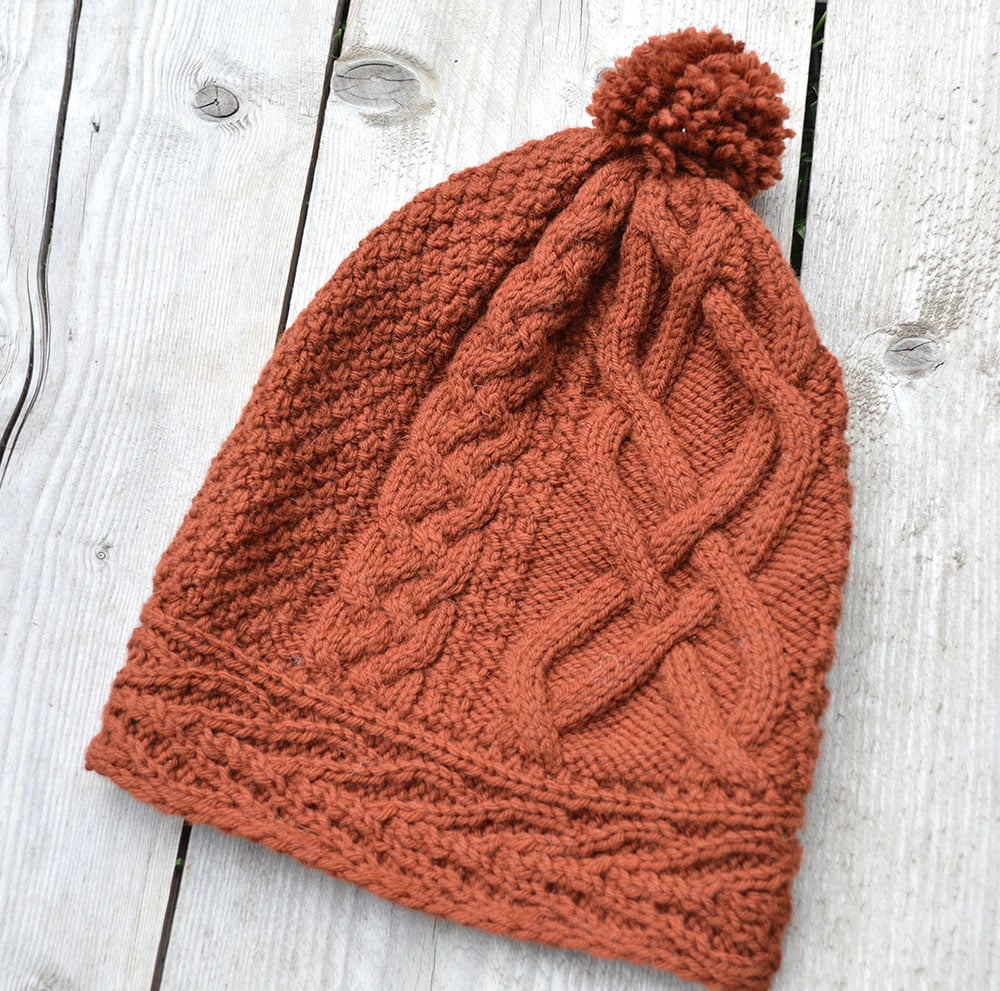
Crochet borders: Alternate dense FP motifs with calm sc/hdc stretches so showpiece cords shine and the shawl stays wearable.
From Page to Needles (and Hooks)
Next time you’re working a textured pattern, see it as the ancient art form it echoes. The crossings you create connect you to centuries of craftspeople who knew that compelling patterns emerge from simple elements woven into complex beauty.
The Celts understood transformation at the crossings – one line yields, another passes, then both continue their journeys. Every cable you knit or cord you crochet is a small lesson in how individual strands create something greater together.
That’s not just craft. That’s architecture in yarn.

The principles come together: continuous flow, balanced negative space, and strategic complexity create cable architecture that honors its Celtic origins. Each crossing is a moment where strands yield to each other, then continue their journey – simple elements woven into complex beauty.
About the Author: Jody Richards

Jody is the founder and lead editor of Knotions. She loves poring over stitch dictionaries and trying out new stitches.
She’s also on a mission to get everyone to embrace the blocking. And, to avoid using garter stitch edges in swatches.
And while she likes all things crafting (well ok, except that one thing), yarn crafts are her true love (and she has the stash to prove it).

Leave a Reply