

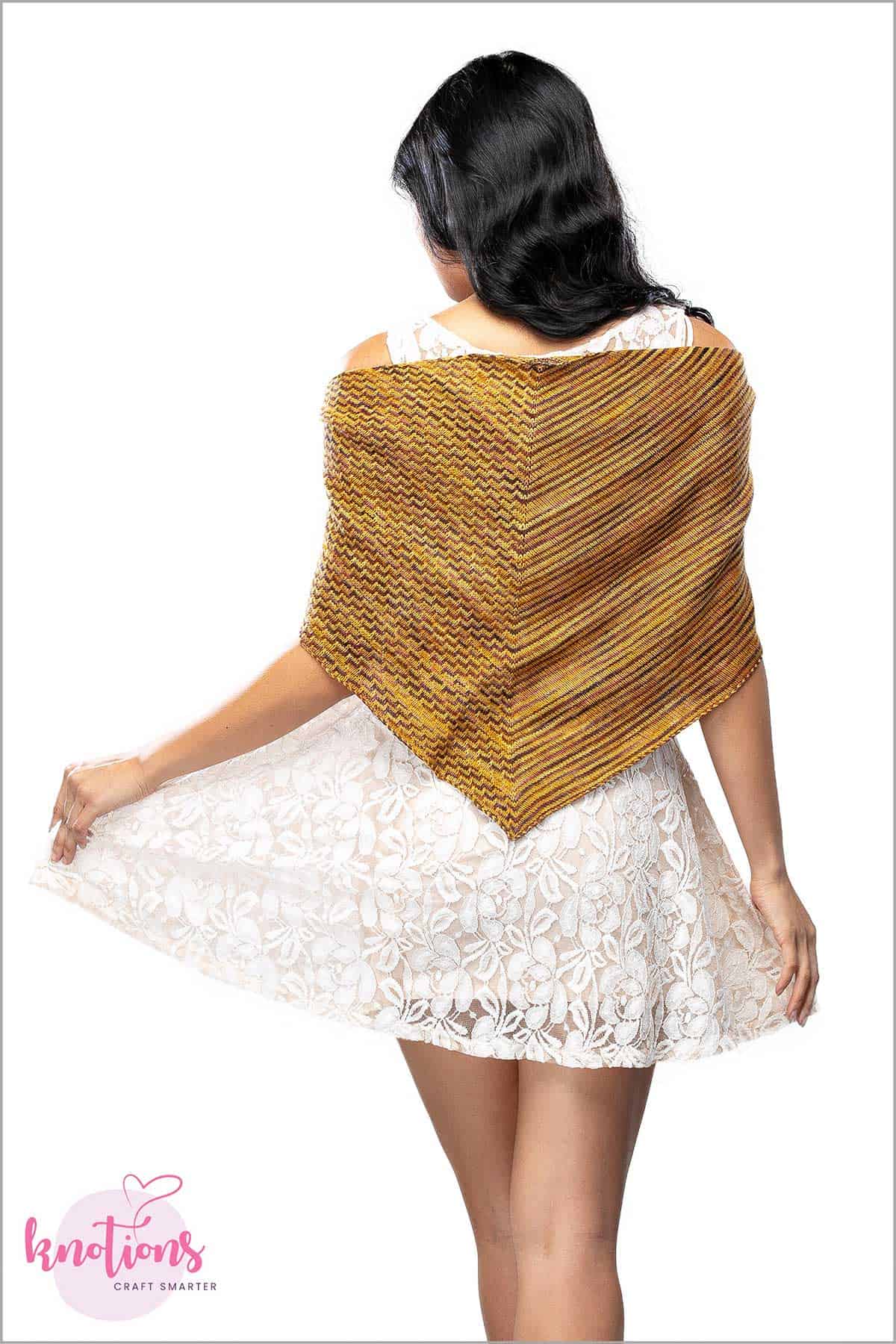


 “Duality” is a triangular shawl, highlighting the contrast between basic stockinette stripes and zig-zagging mosaic knit stripes of the same two colors. The shawl is finished off using a two-color bind-off, alternating the two colors.
This design represents the two sides of a knitter – time to let the “wild” side show!
The size of the shawl is, of course, adjustable, but a wingspan of approximately 60” gives the wearer many styling options. The knitter has the option of aggressively blocking the mosaic section to match the size of the stockinette or allowing the tighter mosaic section to create a slightly asymmetrical shawl, adding to the “duality” of the design.

Size
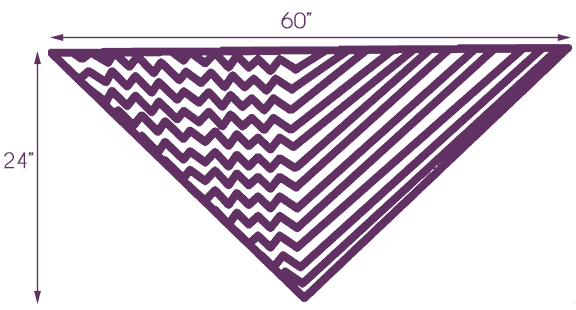
Finished 60” (152.5 cm) wingspan, 24” (61 cm) width down center spine.
Sample measures approximately 59” (149.86 cm) wingspan, 23” (58.42 cm) width down center spine after aggressive blocking.
Yarn
Hedgehog Fibres Sock (90% Merino wool/10% Nylon; 437 yards [400 meters]/100 grams): Truffle (CA), 1 hank
Northbound Knitting Superwash Merino/Nylon Fingering (75% Merino wool/25% Nylon; 460 yards [421 meters]/100 grams): Butterscotch (CB), 1 hank
It’s VERY important to pick 2 yarns that contrast from each other. You need that in order to see the stripes and see the mosaic. This is both for you while you’re knitting and also for seeing it when it’s done.
Needles
Size US 2.5 (3.0 mm): 24” (60 cm) or longer circular or size to obtain gauge.
Notions
4 stitch markers for marking increases; tapestry needle
Gauge
24 sts and 42 rows = 4” [10 cm] in St st after wet blocking.
Abbreviations
See our standard abbreviations.
Tutorials
Chart

Pattern Notes
Every 2 rows, you will be switching to the opposite color yarn (do not break yarn – leave unused color attached with yarn at the back of work. When it is time to knit the next stripe of that color, pick it up and begin knitting).
The first half of the shawl (before center spine marker) is worked mosaic; the half after the center spine marker is worked as stockinette stripes.
You will be working a total of 4 increases per rowon the RS only. Markers are placed to differentiate the edge stitches, as well as the center spine stitch. You will increase after slipping the first marker, before slipping the second, after slipping the third, and before slipping the fourth.
Shawl Instructions
Using long-tail cast on (or your preferred method), CO 3 stitches with C1.
Setup Rows
Setup rows are not charted.
Setup Row 1 (WS) C1: P1, pm, p1, pm, p1; 3 sts
Setup Row 2 (RS) C1: K1, sm, m1R, k1, m1L, sm, k1; 5 sts
Setup Row 3 C1: P1, sm, p1, pm, p1, pm, p1, sm, p1; 5 sts
After row 3, work all WS rows by purling across.
On the WS of the mosaic half of the shawl, when you reach a slipped stitch, slip this stitch on the WS, but with the yarn in FRONT. Work each WS row in the same color as the preceding RS row.
Slip markers as they are encountered on all rows.
Work the chart or the written directions below
Note: Only the first 28 rows are charted. Work additional rows in established patt, repeating the Mosaic Pattern as below.
Row 1 (RS) C2: K1, m1L, k1, m1R, k1, m1L, k1, m1R, k1; 9 sts
Row 3 C1: K1, m1L, k3, m1R, k1, m1L, k3, m1R, k1; 13 sts
Row 5 C2: K1, m1L, k2, sl1p wyb, k2, m1R, k1, m1L, k5, m1R, k1; 17 sts
Row 7 C1: K1, m1L, k4, sl1p wyb, k2, m1R, k1, m1L, k7, m1R, k1; 21 sts
Row 9 C2: K1, m1L, k1, sl1p wyb, k4, sl1p wyb, k2, m1R, k1, m1L, k9, m1R, k1; 25 sts
Continue repeating the Zig Zag Diagonal Mosaic Pattern as below, alternating C1 and C2 every 2 rows, until your desired size is reached. DO NOT clip either color of yarn once you’re done because you’ll need both colors for the bind off. Keep in mind that aggressive blocking will stretch the piece quite a bit!
Zig Zag Diagonal Mosaic Pattern
RS rows: K1, m1L, knit up to and including the slipped stitch of the previous row, sl1p wyb, *k4, sl1p wyb, rep from * to 2 sts before center spine marker, k2, m1R, k1, m1L, k to marker, m1R, k1.
WS rows: with the same color as previous RS row, purl the purl stitches and slip the slipped stitches wyf as they face you.
Finishing
BO with standard bind off technique, alternating C1 and C2 as your working yarn, every other stitch. Weave in ends and wet block aggressively.
 About the Designer: Stephanie Karpe
 About the Designer: Stephanie Karpe
My “day job” is working as a hospital laboratory scientist overnight, keeping awake by knitting. I am the mother of 3 small children and the curator of a very large stash of yarn.
When I’m not knitting, you can find me listening to podcasts or thinking about dieting while snacking on Oreos.
Join the Find your KNITch Facebook Group (https://www.facebook.com/groups/FindYourKnitch/) – inspiring boldness in knitting to encourage knitters to explore their perfect KNITch and enjoy every stitch! Knitters can expect to find knitting tips, tutorials, exclusive coupons, knitting challenges, giveaways, test knitting opportunities, KAL’s and more!
Find Knits with Wit on Instagram at @knits_with_wit, the Facebook page & in the Find your KNITch Facebook group! Show off your WIP’s and FO’s, and please tag them with #KnitsWithWit so I can see your awesomeness!


Leave a Reply