
Author Interview
Nine sizes, four chapters, and a standing objection to seaming. We asked her what grading that wide actually costs, and why she keeps reaching for the stitches nobody else does.
Win a copy of this book. Enter the giveaway (closes October 31, 2026).
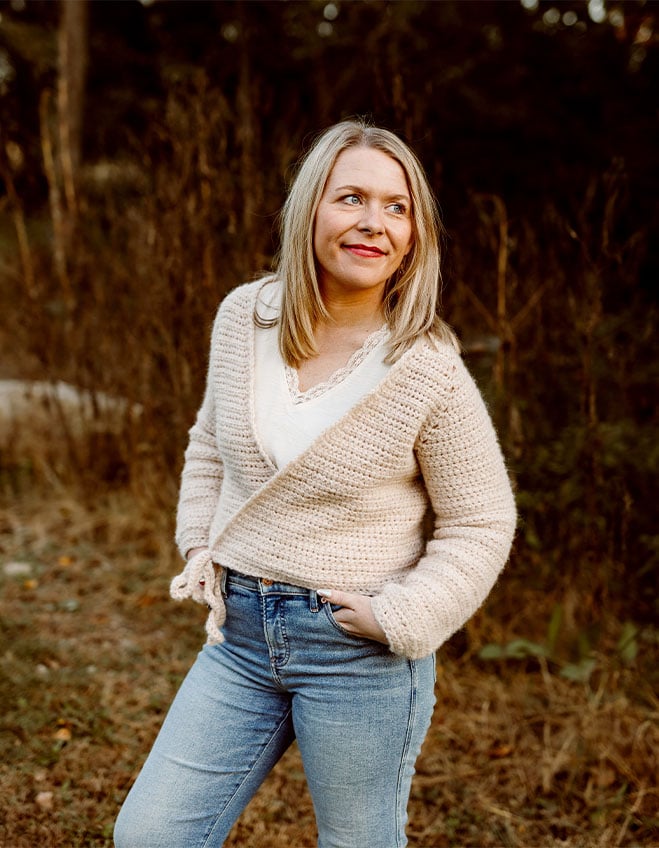
The Author
Emily Davies
Crochet designer working almost entirely in seamless, top down garments, and a committed grader: every pattern in this book runs to nine sizes. She learned to crochet from her grandmother, started designing in 2017, and travels constantly for work.
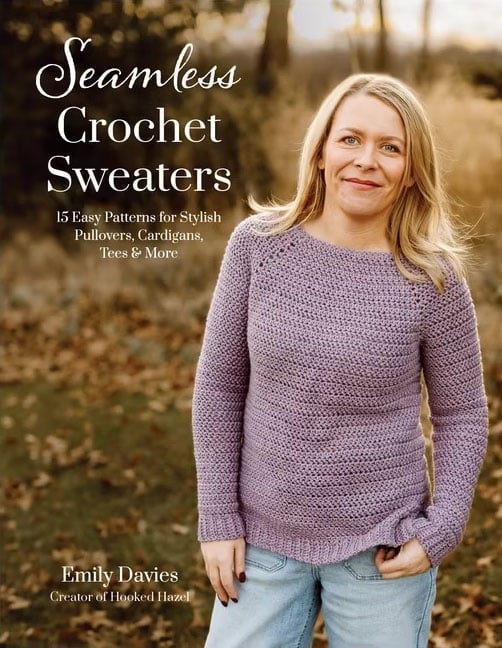
Seamless Crochet Sweaters
Page Street Publishing · 2026
Part One
A long way from pot holders
Two answers about the years between a first hook and a first sweater that fits.
You learned to crochet from your grandmother in elementary school, and that first Christmas everyone in the family got a pot holder. What was the moment you realized a hook could make something other than a square or a rectangle?
It took a lot of years! I crocheted off and on through school, and into adulthood. Most of what I made back then was scarves, a blanket or two, washcloths – simple things like that. It wasn’t until my daughter was 4 or 5 that I really started making other things. She came to me with a picture of a mermaid tail blanket, and really wanted one. That was maybe the first time I ever made anything in the round. It definitely opened up my mind to there being more possibilities. Crochet was really exploding on YouTube at this time and I used it to learn more.
Your first garment patterns, back in 2017, were by your own description not much more than shapes seamed together. What did you have to go learn between then and now to design a sweater that actually fits?
Well, I’ve always had the kind of mindset that if I’m going to do something, I want to go all in and do it correctly. I spent a lot of time figuring out what kind of construction worked best for my body and kind of took it from there. I like seamless top down sweaters because you can try them on as you go. So I put time into learning circular yokes and raglan. Honestly, I used a lot of books and articles geared towards knitting designers and then applied those principals to crochet. I think within the last few years the fiber community has seen a lot more publicly available information and guides on crochet sweater construction, which is wonderful.
Part Two
The case against seams
Three answers about a preference that turned into a method, and the fabric it asks for.
You’ve written that you never enjoyed sewing much. Was seamless a preference that hardened into a principle over time, or was there one specific project where you decided you were done seaming for good?
I’m not totally anti-seaming, sometimes it can give some needed structure to a heavy garment, but it’s definitely my preference to not seam. Some people really get into the flow of seaming but for me it was always boring. Honestly – I think seamless construction gives me more instant gratification. It also makes it easier to adjust patterns as you go since you can try it on. That being said – if I have a design in my head that requires seaming, I won’t let it stop me.
You reach for extended single crochet and linked double crochet in places where a lot of designers would default to standard sc or dc. What do those stitches give a garment that the standard ones can’t?
I LOVE linked stitches for a garment. The linked double crochet specifically offers the same height as a dc without the gaps or looseness that a traditional dc would have. I don’t consider my designs modest per se, but I do want them to be very wearable, and linked stitches help to create a more solid fabric. I like to switch up the stitches I use, it keeps things interesting to me – and hopefully interesting for anyone who makes my patterns!
Split hems, and sleeve ribbing worked back onto the piece, are the moments where seamless construction gets genuinely tricky to explain in writing. Is there a transition you rewrote more times than any other to make it read clearly on the page?
Funnily enough – I think the split hem on the Freshman Raglan had the most edits back and forth. In my head, it was really simple. With my hands, it was so easy to do. For whatever reason, it was difficult for me to translate that to paper. Sometimes as a designer you know exactly what you want to say but aren’t sure how to put it down. That’s another area where my tech editor really helped a lot.
Part Three
Nine sizes, and a first sweater
Two answers about who a pattern is written for, and who gets to start.
Every pattern in the book is graded to nine sizes, from a 30 inch bust to 66.25 inches. Most collections don’t commit to that. What does grading at that range actually cost a designer in time, math, and testing, and what would you say to a designer who wants to do it but finds the work intimidating?
Well first and foremost, I have to say I used an amazing tech editor for this book and she was so much help. I have to give her a lot of the credit on the math. Size inclusiveness is really important to me. I’ve been a lot of different sizes over the years – up and down. I know first hand how disheartening it is to want to make something and it’s either not available in my size or doesn’t look good in my size when I put it on after spending hours making it. I never want someone to have that experience with my patterns. Bodies come in all shapes and sizes, and we all deserve the experience of making our own clothes if we want to. It is a bigger time investment than only including limited sizes, but it’s worth it. I know it makes me a better designer. For any designer who isn’t sure they can extend their size offering – I’d tell them to give it a try. Reach out to other designers in the community for help – there are many who are willing to give advice and share resources. A lot of my joy comes from knowing my patterns are accessible to more people, and I’d love for other designers to feel that same sense of pride.
“Bodies come in all shapes and sizes, and we all deserve the experience of making our own clothes if we want to.”
On grading every pattern to nine sizes
The Freshman Raglan is the only pattern in the book marked Basic, but it’s still top-down raglan shaping with sized math throughout. What does a crocheter need to already have under their belt before that’s the right first sweater for them?
Really all they need to know is how to work in joined rounds, and do basic increases and decreases. The Freshman Raglan is a great option for a first garment. I specifically love it because once you make it as it is in the book – I think it offers a lot of room for easy personalization. A crocheter could add stripes, color blocking, adjust the sleeve length, and more. It’s a very versatile pattern that also happens to be very easy to make!
Part Four
Beyond the book
Four answers about the chapter that sounds most like her, the person it is dedicated to, and what is on the hook now.
Your four chapters (Sleek Styles, Bold Textures, Crochet in Color, Negative Space) read like four different design moods. Which chapter is the most you?
Sleek Styles is probably most me. I travel a ton for work and I like clothes that I can easily mix and match, and I think the patterns in this chapter fall into that category the most for me. These patterns are also the ones where I could get most “in the zone” and crochet while watching tv or listening to music.
The book carries a dedication to your daughter. Has being her mother changed what you make, or how you work?
Allera is, quite simply, the coolest girl I know. She’s 19 now, and if I make something that gets a thumbs up from her, I know I’m onto something good! She’s been a huge part of my design journey. In the early days, she’d model beanies for me and help me set up at markets. Now she is my biggest cheerleader and sounding board.
What’s on your hook right now that has nothing at all to do with this book?
So, I have been knitting more lately, I think because in the process of writing this book I crocheted so much! However, I do have a grey, worsted weight sweater on my hook that I have been working on. It has bands of different textures and I’m really excited about it.
What’s one thing you’d want a reader to know before they start their first project from the book, something that isn’t in the pattern instructions?
That this book is really a love letter to sweater making. I get so much personal satisfaction out of making a garment. I’ve messed up so many times, frogged more than I care to admit, but through it all, I’ve learned things and had fun. That is what I want readers to experience as well (well, maybe not the frogging!). Really for me, what I hope for most of all is that readers enjoy making the patterns in the book and get additions to their wardrobe that they love.
Now open
Win a copy of Seamless Crochet Sweaters
Page Street is sending one copy straight to the winner. Entering takes about twenty seconds.
01
Drop your email below to enter. You’ll also join the Knotions list if you’re new here.
02
We draw one winner and email you. That is the whole thing.
Optional: repin the review on Pinterest to help us out.
Leave a Reply