
Fifteen sweaters, no sewing, and nine sizes (up to a 62 inch bust!) with shaping that’s specific to each size. “Easy” undersells what’s inside. For an intermediate crocheter, this book is worth every penny.
Win a copy of this book. Enter the giveaway (closes October 31, 2026).
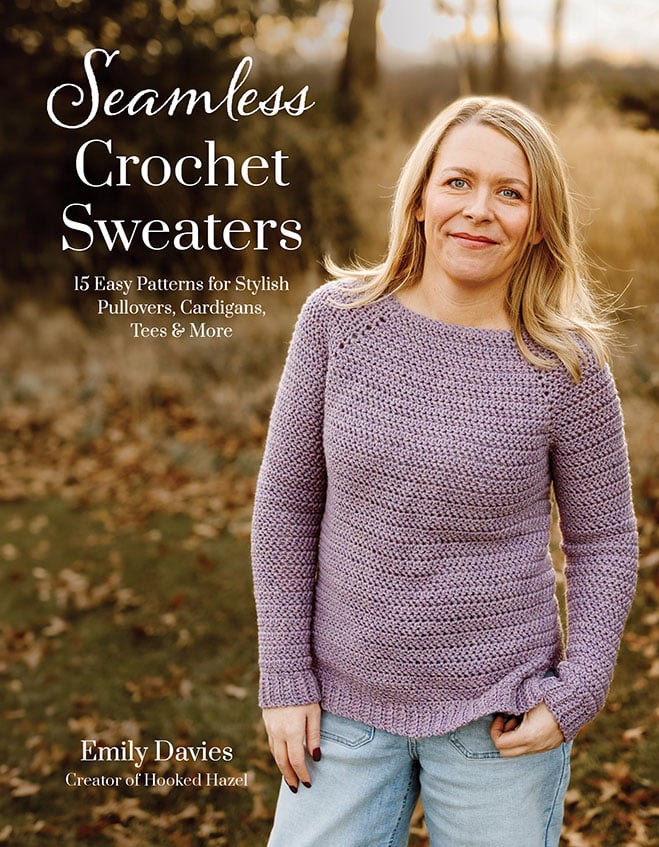
Seamless Crochet Sweaters
Emily Davies · Page Street Publishing
| Patterns | 15 |
| Chapters | 4 |
| Sizes | 9, to fit 30 to 62 in bust |
| Skill levels | 1 Basic, 13 Intermediate, 1 Complex |
| Craft | Crochet |
| Publisher | Page Street, 2026 |
| ISBN | 979-8-89003-529-5 |
Why this book caught my eye
Seamless construction is one of those things crocheters either swear by or have never quite trusted. Emily Davies, of Hooked Hazel, built an entire book around making the case for it. Fifteen patterns, no sewing. That is a bold promise for a craft that has historically leaned on granny squares and panels sewn together after the fact. It is exactly the kind of promise worth putting to the test.
What’s inside
Four chapters, moving roughly from common stitches up through cabled, colorwork, and openwork pieces.
Sleek Styles
Common stitches, where the construction does the work.
Bold Textures
Cables and surface interest worked into the seamless build.
Crochet in Color
Colorwork, including the book’s one Complex pattern.
Negative Space
The openwork end of the range.
Every pattern is graded to nine sizes, which is a real commitment rather than a token size range. The sizing charts are built to fit a 30 inch through 62 inch bust, with finished measurements that vary by garment depending on how much ease the design carries. A “Before You Begin” section covers gauge, yarn substitution, color choice, skill levels, both steam and wet blocking, and care and storage. It reads less like a pattern dump and more like Davies is trying to set you up to actually finish something that fits and wear it for years to come.
Davies has compiled a true “how to craft a sweater,” and I don’t believe I have seen all this information presented together in one place before.
If you like making sweaters, or even if you just aspire to, take the time to read this section. Davies has compiled a true “how to craft a sweater,” and I don’t believe I have seen all this information presented together in one place before. Even if you never make a single sweater from the book, that section alone covers what you paid for it.
This is a book for the crocheter who already knows their stitches and wants to build real garments, not a first-project book. The cover calls them fifteen easy patterns, and the book defines four skill levels running Basic, Easy, Intermediate, and Complex. Here is how the designs are actually categorized: one is marked Basic, thirteen are Intermediate, one is Complex, and not a single design in the book is labeled Easy.
Standout techniques and tips
The seamless-first approach is the point of the book, not a marketing hook. Davies writes that each sweater is constructed in one piece with no sewing required, which lets you try the piece on at any stage rather than hoping at the end. Sweaters are worked top down, and nearly everything is turned at the end of each pass, so the work feels like rows even where the book calls them rounds. The Brontë Pullover is the exception, spiraling in continuous rounds with no join and no turn. The two cardigans and the Étoile Wrap are worked flat. Sleeves are separated from the body partway down. Finishing details like sleeve ribbing are worked sideways directly onto the piece and joined as you go, rather than made separately and sewn on.
Most crochet sweater books stay inside single, half double, and double crochet. Davies doesn’t. The Brontë Pullover is built on extended single crochet, and the Étoile Wrap and Exploration Fuzz both use linked double crochet. She frames these as aesthetic choices, the “understated elegance” of extended single crochet and a new take on double crochet. She describes the resulting Brontë fabric as squishy with a beautiful drape.
Davies does not grow the body and the sleeves at the same rate [but rather, they] stay in proportion to how a body changes shape as the sizes get larger.
Here is the thing that genuinely impressed me, and it is the thing I did not expect to find. Davies does not grow the body and the sleeves at the same rate through the yoke. Her increases are placed so the armhole and the sleeve stay in proportion to how a body changes shape as the sizes get larger. The execution still stays easy. You are working ordinary increases and you barely notice anything clever is going on, which is the best kind of clever.
This matters most at the top of the size range, and the top of this range is a 62 inch bust. Anyone who has crocheted a plus-size yoke sweater from a pattern that simply multiplied everything knows what you get instead: an armhole you could fit a second arm through and a sleeve like a bell. The grading here is not a multiplier. Across the fifteen patterns there are more than a hundred instruction lines written for particular sizes only. Every single pattern has at least one. Davies also tells you, in more than one pattern, to try the piece on before separating for sleeves and make sure you can pinch the yoke comfortably under your arm. I do not see this kind of care very often, and I am truly in awe by it.
And then there is the one that made me sit up.
Every pattern in this book includes a gauge swatch. All fifteen.
Not just a gauge figure to hit, an actual written swatch pattern, worked in the stitch pattern of that garment, with a row count and a closing instruction to measure your gauge avoiding the edge stitches and adjust your hook size accordingly. Frances Jumper’s swatch includes the cable crosses. Foxglove Tee’s includes the open shells. Lodge Cardigan’s includes the bobble rows. Two of them, the Brontë Pullover and the Sagebrush Tee, are even worked in the round to match the way the garment is worked. Every gauge is given as a 4 x 4 inch square, blocked. The Before You Begin section tells you to block your swatch the same way you plan to block the finished sweater, measure the internal stitches only, and change hook size rather than fight your own tension.
You all know how I feel about gauge swatches. Emily did good with this one.
Really good.
Do the visuals hold up?
Photography is by Andee Rettele, and it is consistent throughout, natural light and real outdoor settings.
Written instructions are dense. Multi-size patterns read like this hhdc 17 (17, 18, 18, 19) (19, 20, 21, 21), which is standard for graded garment patterns. Rounds that apply to only some sizes use X placeholders for the rest, as in hhdc X (X, X, X, X) (6, 3, 4, 2). That is normal for nine-size grading, but it means a first-time garment crocheter will want to circle their own size in every row before starting.
Read our article on making multi-size patterns.
What could be better
There is no photo tutorial for the seamless techniques
Just written steps, which is a gap for a book whose whole identity is seamless. There is no techniques section in the contents, and the index has no entry for a step-by-step or a tutorial. A few photos of the trickiest transitions, sleeve separation above all, would go a long way for anyone attempting this construction for the first time. The Everwood Raglan is the sharper example: an inset mosaic colorwork pattern, the one piece marked Complex, carried entirely on written instructions.
The foundation stitches are used but never taught
Thirteen of the fifteen patterns use a foundation stitch, fhdc or fsc. Five of them open with one in the very first round of the garment, and several of the rest use one to build the underarm when the sleeves separate. Both appear in the abbreviation list, spelled out as foundation half double crochet and foundation single crochet. That is the last you hear of them. Neither is in the Special Stitches section, which does take the time to define herringbone half double crochet, extended center single crochet, linked double crochet, and more than a dozen others. If you already work foundation stitches, fine. If you do not, you are off to a video before you finish round one.
The skill labeling sets the wrong expectation
Calling these fifteen easy patterns on the cover, then labeling thirteen of them Intermediate inside, sets up the wrong expectation for exactly the reader most likely to be drawn in by the word easy. And look at the one pattern that carries the book’s gentlest label. The Freshman Raglan is the one pattern marked Basic, and it is worked start to finish in herringbone half double crochet. The book’s own definition of Basic is a pattern that uses basic stitches. Herringbone hdc is not difficult once someone shows you the move, but basic? It is not a stitch most crocheters already have in hand, and it is not what a person picking up a book that promises easy expects to meet on page one.
Final verdict
Worth it for anyone who already crochets garments and wants to stop sewing seams. Less of a fit for someone whose most complex project to date is a scarf, since the sizing math and construction logic assume some comfort with shaping already. A confident intermediate crocheter ready to level up into garments would get a lot out of this one.
Buy it if you
- Already crochet garments and want to stop sewing seams
- Want nine sizes with the shaping written for each one
- Are a confident intermediate ready to level up
- Like construction you can try on as you go
Maybe not if you
- Have never worked anything more shaped than a scarf
- Want photo tutorials for an unfamiliar construction
- Were drawn in by the word easy on the cover
Now open
Win a copy of Seamless Crochet Sweaters
Page Street is sending one copy straight to the winner. Entering takes about twenty seconds.
01
Drop your email below to enter. You’ll also join the Knotions list if you’re new here.
02
We draw one winner and email you. That is the whole thing.
Optional: repin the review on Pinterest to help us out.
I have been knitting for much of my adult life. Recently I have been interested in giving crochet a chance, especially in making garments, like the featured sweater.
give it a go! crochet is such a wonderful craft!
and if you didn’t enter our giveaway for a chance to win the book, you should do that too!