
Knitting spy stories show up in our feeds every few months. We traced the famous ones back to their sources. Some hold up. Some don’t.
By Jody Richards
You have probably seen at least one of them. The grandmothers who knitted train schedules into their scarves. The knitting patterns banned from the mail. The spy who smuggled codes in her yarn.
I love these stories. Knitting is such an everyday skill, and the idea that it helped people hide secrets in plain sight delights me.
But a story that gets shared this often rarely gets checked. So we went looking for where each one came from. Here is what we found.
The train-watching knitters: true, but it was World War I
This is the most shared story, and usually it is set in World War II. The earliest account we found puts it in 1914.
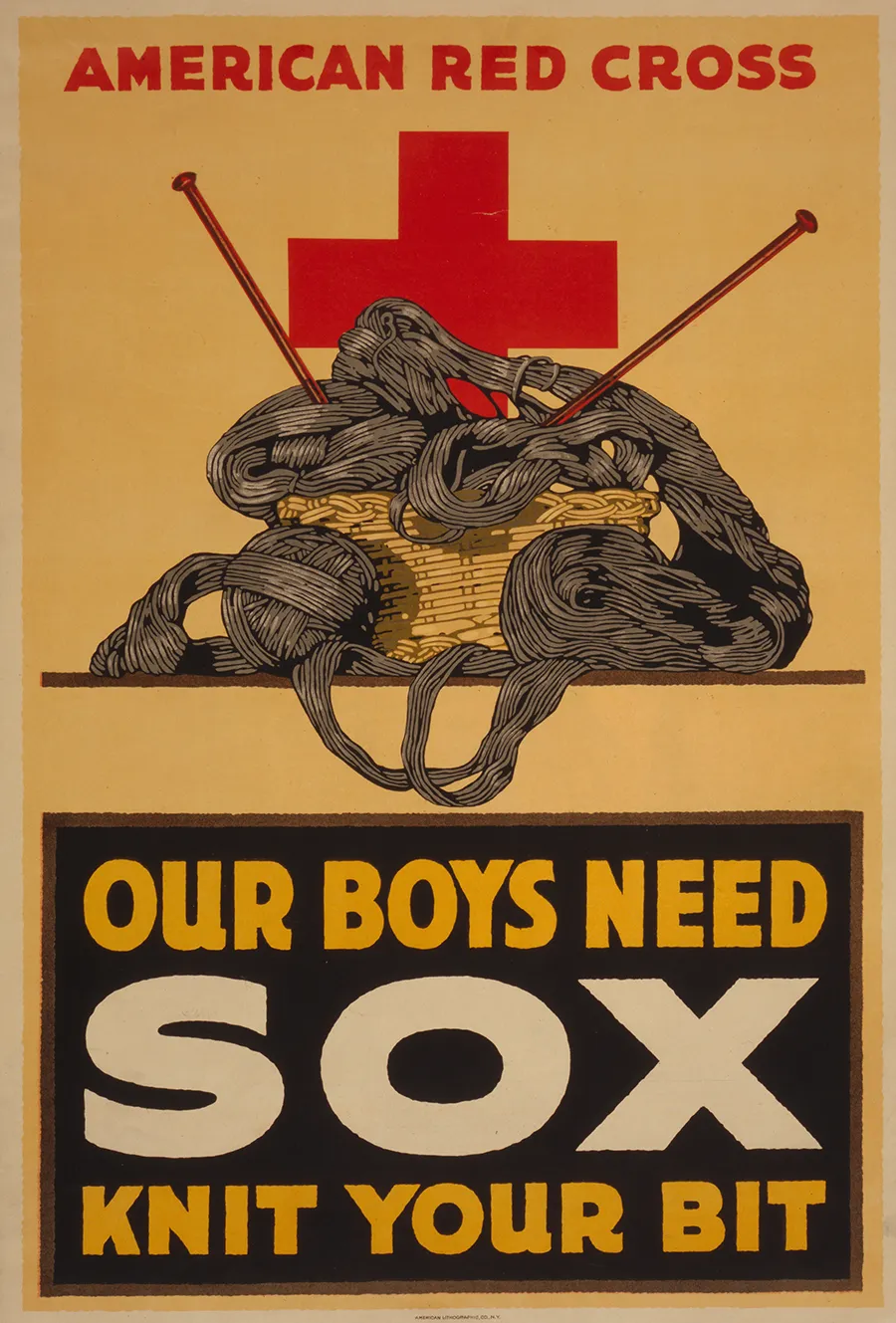
“Our Boys Need Sox, Knit Your Bit,” American Red Cross, 1918. Library of Congress.
In a BBC Radio 4 history of the British intelligence service MI6, the story goes like this. British agents in occupied Belgium recruited older women whose windows overlooked the rail lines. As trains passed, the women recorded them in their knitting: “drop one for a troop train, purl one for an artillery train.”
Nobody looks twice at an older woman knitting by her window. That was the point.
Verdict: true, wrong war. Most retellings move it to World War II. The documented version is World War I.
The spy who hid her codes in her hair: true
Phyllis Latour was a British Special Operations Executive agent. On May 1, 1944, she parachuted into occupied Normandy under the codename Genevieve and worked as a wireless operator, sending coded messages back to Britain.
I always carried knitting because my codes were on a piece of silk.
Phyllis Latour
Her codes were printed on a small piece of silk. She hid the silk inside a flat shoelace and used that shoelace to tie up her hair. Her codes were, quite literally, tied up in her hair.
When a German soldier searched her and eyed her hair, she pulled the lace out, shook her hair loose, and tied it back up. The codes were never found.
Latour died in 2023 at 102.
Verdict: true. One detail matters for knitters: the knitting was her hiding place, not her code.
The knitter who signaled with her feet: probably true
In German-occupied France during World War I, a woman known as Madame Levengle had a German officer living in her home.
She sat at her window knitting and watching troop movements, and tapped signals with her heels to her children, who wrote them down as if doing schoolwork.
Verdict: probably true. The account appears in Kathryn Atwood’s history Women Heroes of World War I. We did not find a second, independent source, so we treat it as plausible rather than proven.
Knitting patterns banned from the mail: unconfirmed
This is the claim that started our search. It is usually stated as fact: during World War II, the US Office of Censorship banned knitting patterns from being mailed abroad, because a pattern could hide a coded message.
The Office of Censorship was real. It ran from December 1941 to 1945 and reviewed communications going into and out of the United States. Censors did worry about messages hidden in ordinary-looking material.
But every version of the knitting pattern ban we found traces back to a 2014 newspaper trivia column, with no original document behind it. Standard histories of the Office of Censorship do not mention it.
Verdict: unconfirmed. It may be true. We just can’t prove it.
If you have a wartime letter, newspaper clipping, or family story that proves this one, we would love to see it.
Rumors and legends
A few stories are better treated as folklore.
- Messages in knots: a British magazine claimed in 1918 that German agents sent messages through knots in wool. Even the historians who repeat it think it was likely exaggerated.
- Molly “Mom” Rinker: during the American Revolution, she supposedly hid messages for George Washington’s army inside balls of yarn and dropped them from a cliff. It is a beloved local legend with little documentation.
- Madame Defarge: the knitter in Charles Dickens’s A Tale of Two Cities (1859) records the names of the doomed in her stitches. She is fiction, but she may be why the idea of knitted codes feels so believable.
Why knitting makes a good hiding place
There is real science under these stories.
Knitting has two basic symbols, knit and purl, much like the dots and dashes of Morse code. A row of stitches can carry a pattern that means something only to a reader who knows the key.
Hiding a message so no one knows it exists is called steganography, from the Greek for “covered writing.” It is different from encryption.
Encryption scrambles a message so it can’t be read. Steganography hides the fact that there is a message at all.
In practice, the cover may have mattered more than any code. A knitter at a window, or a knitting bag on a train, simply didn’t look like a threat.
I can easily see how these stories were plausible. I could knit a code into a sock or a lace scarf, and no one would be the wiser.
Think about how much information already lives in a lace chart. Every yarn over, every decrease, every knit stitch is a deliberate choice, read in order.
Swap a few of them according to a key, and the scarf still looks like a scarf. Another knitter might notice that the pattern wanders a little. A soldier searching a suitcase never would.
My background is in math and computer science, and knitting just feels a lot like code to me. Knit and purl are a binary system. A chart is a program you run with your hands.
So when I read these stories, my first reaction isn’t “could that really work?” It’s “of course it could.” The harder question is whether anyone actually did it, and that’s why we checked.
This story is part of our Tech Threads issue. While you’re here, read what’s really stopping crafters from choosing sustainable yarn.
Sources
- Jacqueline Witkowski, on knitting and wartime espionage, InVisible Culture (University of Rochester), citing BBC Radio 4, “MI6: A Century in the Shadows” (2009)
- Phyllis Latour obituary and Wikipedia entry, including her own accounts
- Kathryn Atwood, Women Heroes of World War I
- Lucy Adlington, Stitches in Time, citing Pearson’s Magazine, October 1918
- “The Wartime Spies Who Used Knitting as an Espionage Tool,” Atlas Obscura
- Office of Censorship, Wikipedia
About the Author: Jody Richards

Jody is the founder and lead editor of Knotions. She loves poring over stitch dictionaries and trying out new stitches.
She’s also on a mission to get everyone to embrace the blocking. And, to avoid using garter stitch edges in swatches.
And while she likes all things crafting (well ok, except that one thing), yarn crafts are her true love (and she has the stash to prove it).
Leave a Reply