
There are different weights (thicknesses) to yarn. In general, a thinner yarn translates to a smaller gauge. Conversely, a thicker yarn often means a larger gauge.

Many commercially made sweaters are knitted in small gauges. Often, they’re much thinner than what hand knitters will achieve (or will want to do given that it takes a long time to knit at a fine gauge). Don’t let this difference discourage you from knitting or crocheting!
Instead, know that this is the case. Meaning, don’t choose a silhouette that works in a super-fine gauge and expect it to also look good in the gauge you can work at. If you do, you’re setting yourself up for failure (or, at minimum, frustration).
Instead, know that this is the case and choose a project that embraces a gauge that’s more typical for hand knitters.

If you’re really concerned (especially important when you’re starting out and not sure), make a gauge swatch. Feel it. Work with it (folding it) and even put it next to your skin (inside a sleeve or even an undergarment) so you can experience it the way you will once it’s done.
Basically, do a little extra work now so you can avoid doing a lot of work later or just being disappointed in the end.
What are the Typical Yarn Weights?
Yarns tend to be categorized in this order (going from the thinnest to the thickest). The Category that’s listed after each name is the weight system of the Craft Yarn Council https://www.craftyarncouncil.com/standards/yarn-weight-system.
- Cobweb (Category 0)
- Laceweight (Category 0)
- Fingering (Category 1)
- Sport (Category 2)
- DK (Category 3)
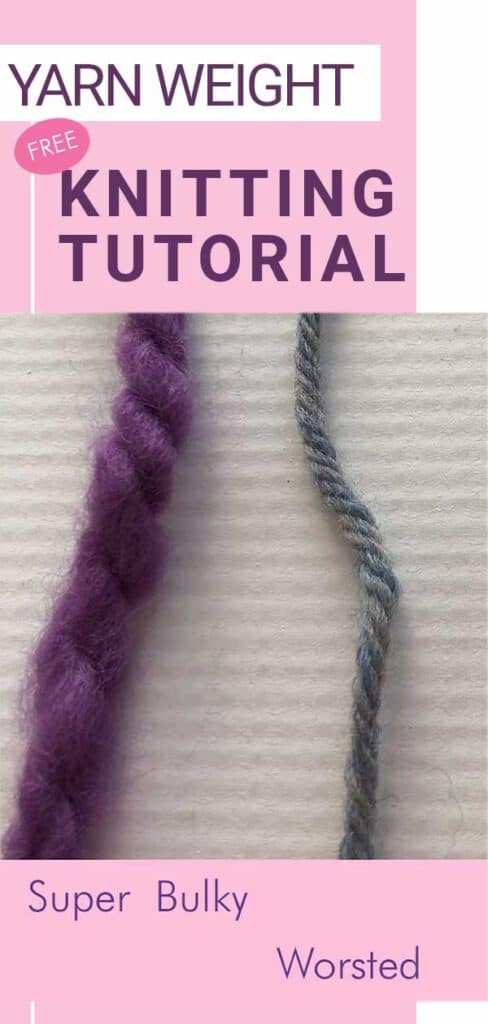
- Worsted (Category 4) – This term is often used in U.S. English. It’s smaller than Aran (below).
- Aran (Category 4) – This term is often used in British English. It’s larger than Worsted (above).
- Bulky (Category 5)
- Super Bulky (Category 6)
You might have just read this list and you’re wondering what you should choose. Read on for our recommendations on this.
What Weight Should I Choose?

If you’re just getting started, I suggest following what the pattern says.
If you’re working with a heavier-weight yarn, the resulting fabric will be thicker. This is regardless of the gauge that you work it at.
Can I control the thickness by Changing the Gauge?
You can impact the thickness, but you can’t totally change it.
What I mean is – you might be able to change the thickness by working at a recommended gauge of one weight away.
But, you can’t change the thickness to be 3 or 4 weights away. Ok, technically you might be able to do this but the resulting fabric won’t be acceptable in most cases. You’ll likely get a fabric that’s either flimsy or too firm and lacking the ability to fold nicely (more like a piece of cardboard).
What Size Should I Use When Practicing?
I’d suggest selecting a mid-weight yarn to start – either a Worsted or Bulky.
I recommend this because it won’t feel “too” thick or “too” thin. You’ll be able to work with it. You should be able to hold it, grab it with needles or a hook, wrap it around them and work with it.
What else should I consider?
In addition to yarn weight, you should also consider yarn plies – even as a beginner.
The issue of plies is complex enough that we’ve dedicated an entire post to it.
CYC Designations
The Craft Yarn Council (CYC) has created designations for yarn. While it’s not a perfect system, it’s quite good and many people rely on it and will say things like they’re “using a #4 yarn”. So, it’s good for you to be familiar with it.


Leave a Reply