
Stitchopedia · Mosaic
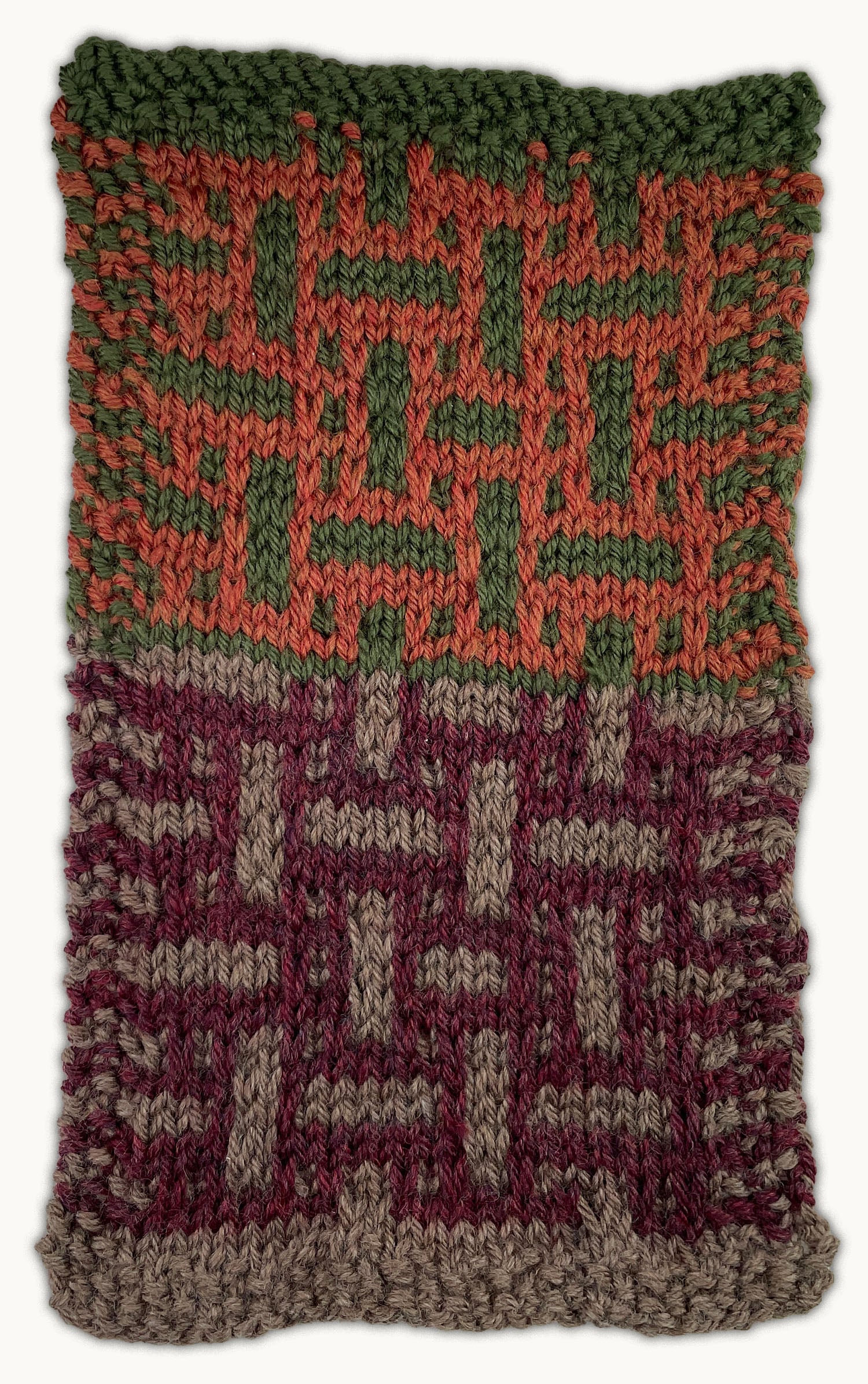
A woven grid built one color at a time. Nothing crosses, nothing twists, and the whole over-under illusion comes from where the slipped stitches land.
At a glance
- Difficulty
- Intermediate
- Technique
- Slipped-stitch mosaic
- Repeat
- 10 sts + 5
- Row repeat
- 16 rows + setup
- Colors
- 2 at a time
- Worked
- Flat
- Yarn
- Cascade 220 Superwash Merino
- Needles
- US 5 / 3.75 mm
How to work it
One color per pair of rows, so there is never a second strand to balance across the row.
- A 39 Walnut Heather
- B 79 Bordeaux Heather
- C 59 Chive
- D 76 Flame Heather
Change color every 2 rows. Each pair of rows is worked in a single color, so the resting yarn can be carried up the side rather than cut and rejoined at every change.
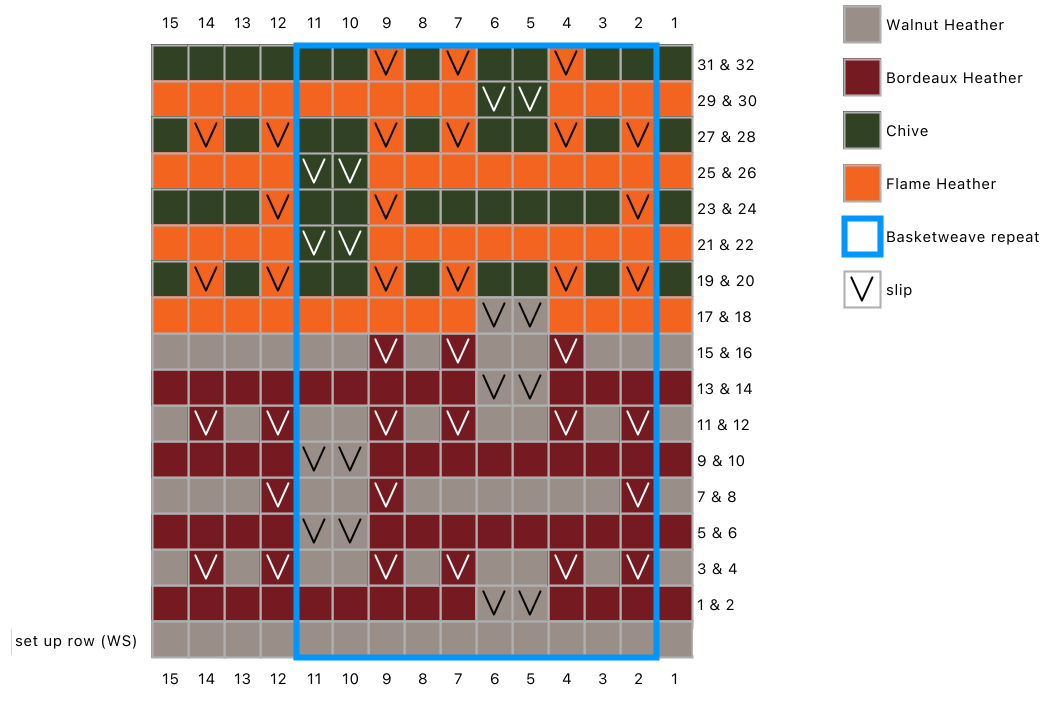
Set up 1 row
Set up Row WSKnit.
First run, Walnut and Bordeaux rows 1 to 16
1 & 2K1, (k3, sl × 2, k5), k4.
3 & 4K1, ((sl, k1, sl, k2) × 2), (sl, k1) × 2.
5 & 6K1, (k8, sl × 2), k4.
7 & 8K1, (sl, k6, sl, k2), sl, k3.
9 & 10Repeat rows 5 & 6.
11 & 12Repeat rows 3 & 4.
13 & 14Repeat rows 1 & 2.
15 & 16K1, ((k2, sl) × 2, k1, sl, k2), k4.
Second run, Chive and Flame rows 17 to 32
17 & 18Repeat rows 1 & 2.
19 & 20Repeat rows 3 & 4.
21 & 22Repeat rows 5 & 6.
23 & 24Repeat rows 7 & 8.
25 & 26Repeat rows 9 & 10.
27 & 28Repeat rows 11 & 12.
29 & 30Repeat rows 13 & 14.
31 & 32Repeat rows 15 & 16.
One thing to expect at the color change. The two slipped stitches on rows 17 and 18 pull up Walnut, because Walnut is the last color they were knitted in and Chive has not appeared yet. That is correct, and it is the only place in the swatch where a slipped stitch carries a color from the previous pairing.
What to watch for
Always slip purlwise
Whichever side you are on, insert the needle as if to purl when you slip. Slipping knitwise twists the stitch, and in mosaic that twist sits right on the surface where the motif is, so it shows. On right side rows keep the yarn behind the work and on wrong side rows bring it to the front. Where the yarn sits changes. The direction of the slip never does.
The setup row is a single WS row
It comes before row 1 and it does two jobs. It keeps every patterned row that follows on a right side row. And since you are already slipping stitches in row 1, it puts a row underneath them so there is something to actually slip.
Carry the resting color up the side
Two rows is a short enough gap that the unused strand travels up the edge instead of being cut and rejoined at every change. Keep the carry loose or the selvedge draws in and the swatch stops lying flat.
Beyond the Stitch
A technique you can take to any project.
Squint at it. Stand back from your swatch, or take a photo and make it black and white. If the motif still reads, your two colors are doing their job. If it turns into a flat field, they are not, no matter how good they look side by side in the skein.
The two halves of this swatch make the case by themselves. Below, Bordeaux against Walnut separates cleanly, one deep and one pale, and the grid reads from across the room. Above, Chive against Flame almost melts together, and the same grid goes quiet. Both halves came off the identical chart. The only thing that changed is how far apart the two colors sit in value, meaning how light or dark they are, rather than what color they are.
That is the whole principle. A mosaic motif is built on value, not hue. Two colors can be as different as green and orange and still sit at the same value, in which case the pattern you worked so carefully will only show in raking light and will vanish entirely in a photograph.
This is the cheapest test in knitting and it takes four seconds. It works on any colorwork, not just mosaic, and it will save you from a project you finish and quietly never wear.
Why it works
Basketweave is the mosaic people recognize before they can name it, which makes it the right one to start with. The motif is large enough to read from across a room and regular enough that most knitters stop checking the chart after the second repeat.
It also sits right at the center of what we look for in this kind of work. The fabric looks like two yarns were handled together but it was actually only ever one at a time. For the same trick worked at a larger scale, see Caesar’s Check. For a version that lets the grid wander off, see Mosaic Maze. Among the earlier entries, Turnpike is the closest relative.
Make it yours
- Pillow front
- Blanket square
- Bag panel
- Cowl
- Table runner
- Laptop sleeve
The Knotions twist
Hold the pattern color steady and change only the ground halfway up. The grid keeps its shape while the field shifts underneath it, which reads as a deliberate gradient rather than a running-out-of-yarn save.
Show us yours
Post your swatch in the Knotions group and tell us which pairing you picked. We want to see the quiet one as much as the loud one.
Leave a Reply