
Stitchopedia · Mosaic
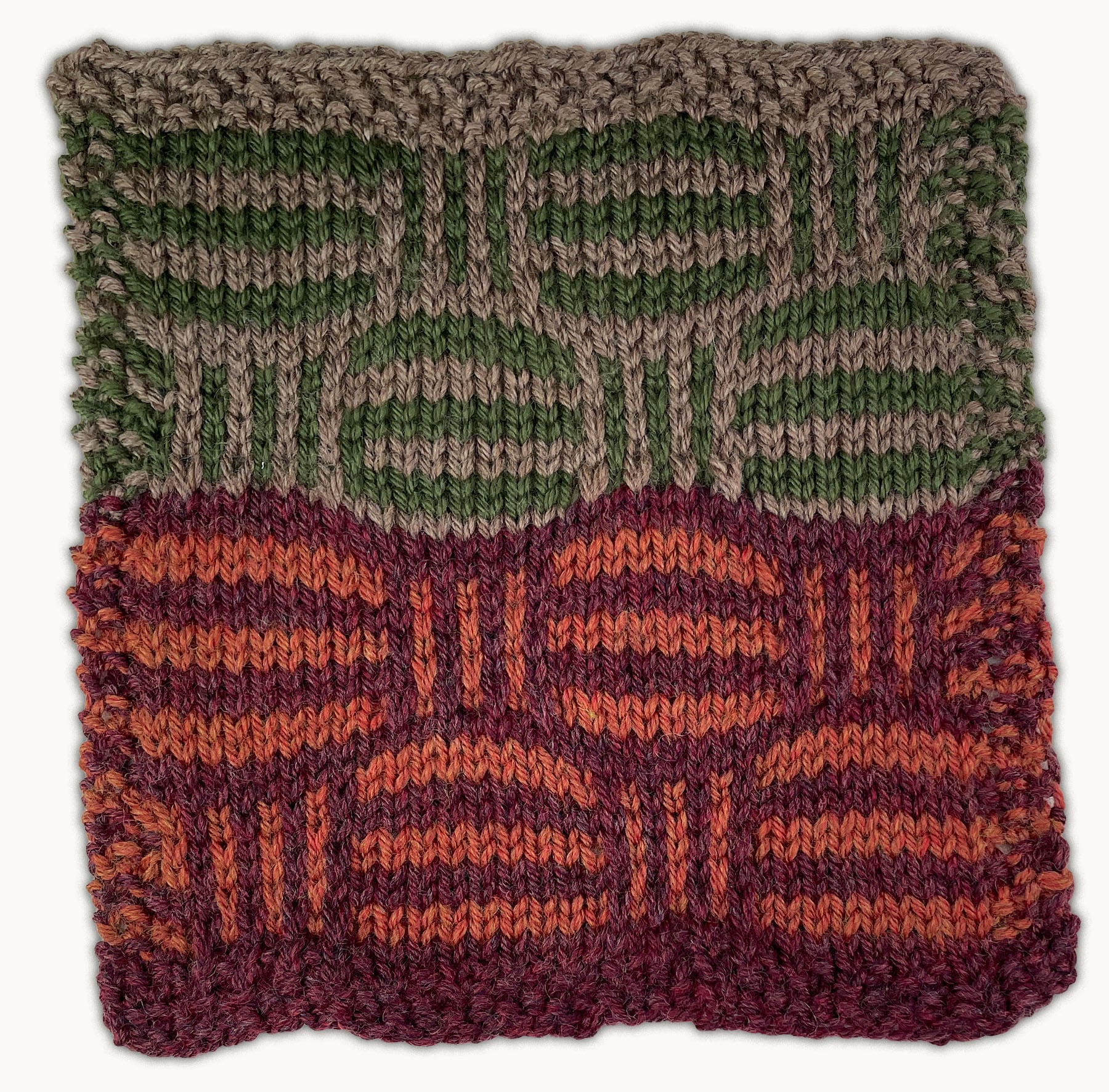
Two sections of texture, offset like brickwork. Up close it is a field of dashes, and the check only assembles itself when you put the swatch down and step back.
At a glance
- Difficulty
- Intermediate
- Technique
- Slipped-stitch mosaic
- Repeat
- 16 sts + 1
- Row repeat
- 26 rows, worked as 13 pairs
- Colors
- 2 at a time, 4 across the full chart
- Worked
- Flat
- Yarn
- Cascade 220 Superwash Merino
- Needles
- US 5 / 3.75 mm
How to work it
The largest repeat of the three, sixteen stitches plus one across and twenty-six rows tall. This is the one that wants the chart propped open and a row counter going. You might memorize it after you have worked the pattern a bit.
- A 79 Bordeaux Heather
- B 76 Flame Heather
- C 39 Walnut Heather
- D 59 Chive
Change color every 2 rows. Each numbered line on the chart is worked over two rows in a single color, which is why the row numbers run in pairs. No setup row is needed at the start, because rows 1 and 2 are plain and lay the ground for row 3.
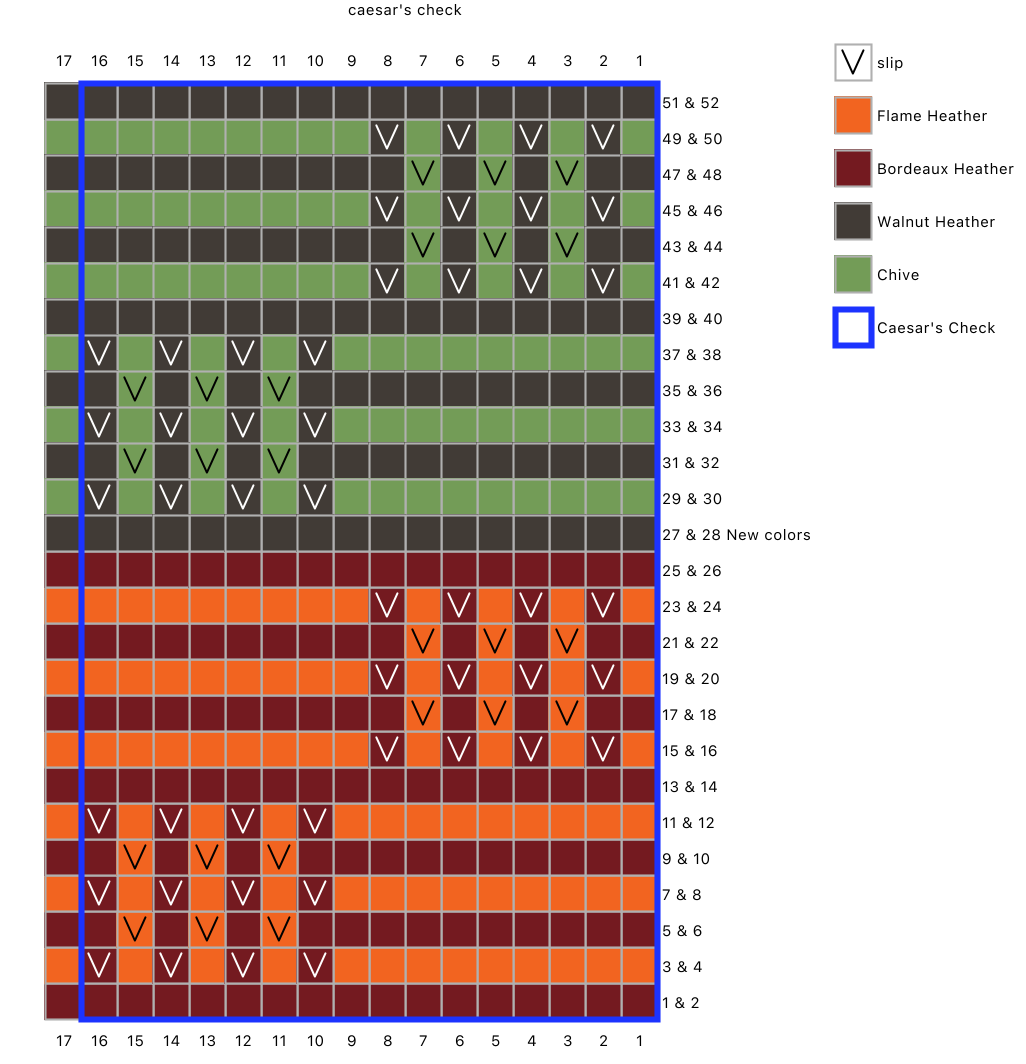
First run, Bordeaux and Flame rows 1 to 26
1 & 2Knit.
3 & 4*K9, (sl, k1) × 3, sl; rep from * until 1 st rem, k1.
5 & 6*K10, (sl, k1) × 3; rep from * until 1 st rem, k1.
7 & 8Repeat rows 3 & 4.
9 & 10Repeat rows 5 & 6.
11 & 12Repeat rows 3 & 4.
13 & 14Knit.
15 & 16*(K1, sl) × 4, k8; rep from * until 1 st rem, k1.
17 & 18*K2, (sl, k1) × 2, sl, k9; rep from * until 1 st rem, k1.
19 & 20Repeat rows 15 & 16.
21 & 22Repeat rows 17 & 18.
23 & 24Repeat rows 15 & 16.
25 & 26Knit.
Second run, Walnut and Chive rows 27 to 52
27 & 28Knit. This is the changeover to the second pairing.
29 & 30Work as rows 3 & 4.
31 & 32Work as rows 5 & 6.
33 & 34Repeat rows 29 & 30.
35 & 36Repeat rows 31 & 32.
37 & 38Repeat rows 29 & 30.
39 & 40Knit.
41 & 42Work as rows 15 & 16.
43 & 44Work as rows 17 & 18.
45 & 46Repeat rows 41 & 42.
47 & 48Repeat rows 43 & 44.
49 & 50Repeat rows 41 & 42.
51 & 52Knit.
What to watch for
The offset is the pattern
The two textured sections sit half a repeat apart, which allows each one to make up for the height difference in the other. Line them up by accident and you get sections that bow out sitting next to sections that pull tight and will not stretch. That half-repeat offset is what keeps the fabric even.
One chart row is two knitted rows
Each numbered line on the chart stands for two rows, so skipping one line means skipping two rows, not one. The good news is that it tells on itself fast: the chart will have you work the same color for a third row, and the moment your stripes stop being stripes, you know exactly where you slipped.
It needs blocking more than the other two
Dense slip-stitch fabric comes off the needles tight and narrow. The check does not square up until it has been wet blocked, so judge the finished swatch then, not before.
Beyond the Stitch
A technique you can take to any project.
You can never add just one row. Flat knitting alternates sides. Row 1 is a right side row, so every odd row faces you and every even row faces away. That alternation is not bookkeeping. It is the structure everything else is built on.
Add a single row anywhere, or lose one, and every row above it swaps sides. The row that was a wrong side row is now a right side row, and it stays swapped for the rest of the piece. In plain stockinette you might never notice. In mosaic you will. On a right side row you slip with the yarn held in back, and on a wrong side row you slip purlwise with the yarn in front. Same symbol on the chart, two different hands, and the harder one is the side you were not expecting.
This is why patterns tell you to end after a wrong side row rather than after row 26, and why setup rows come in the counts they do instead of whatever you would prefer. It is also the repair rule. When you find a missing row, do not add one back at a convenient spot. Add two, take out two, or rip down to the mistake. Anything else moves the problem instead of solving it.
Why it works
This is the most demanding of the three and the most rewarding for it. Twenty-six rows is a long enough cycle that the motif has room to be genuinely large, which is why the check reads from across a room when the other two read from arm’s length. Give it your attention for one full repeat and the logic of the offset becomes obvious enough to carry the rest.
It is worked exactly the way Basketweave Mosaic is, one color per pair of rows, and it only looks harder. For a version that lets the grid wander off entirely, see Mosaic Maze.
Make it yours
- Placemat
- Blanket square
- Tote front
- Pot holder
- Table runner
- Cushion back
The Knotions twist
Rotate every second swatch ninety degrees when you seam a set together. The check reverses direction across the join and the whole panel reads as a woven basket rather than a grid of identical tiles.
Show us yours
Work one repeat in a pairing you would never have chosen and post it next to one you would. The comparison is the interesting part, and it is the fastest way to see what value contrast actually does.
Leave a Reply