
Stitchopedia · Mosaic
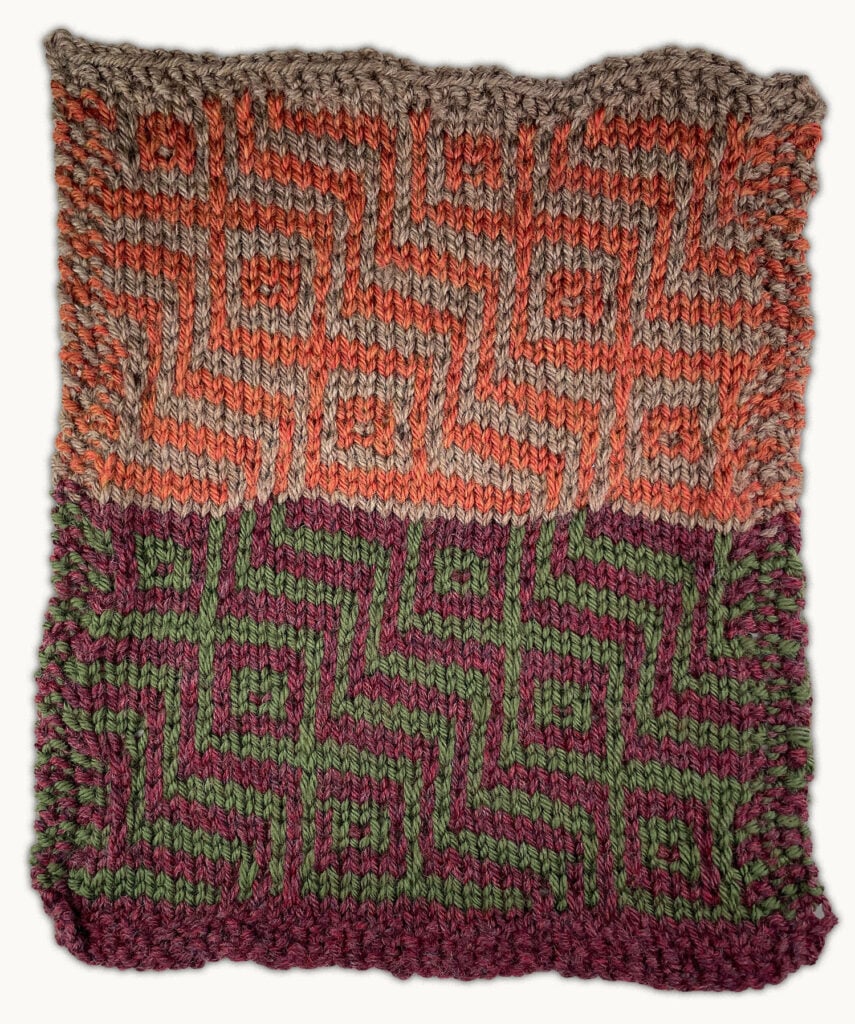
A single path that wanders across the swatch and turns back on itself. The largest motif of the three, and the one that pays back a high-contrast pair most obviously.
At a glance
- Difficulty
- Intermediate
- Technique
- Slipped-stitch mosaic
- Repeat
- 18 sts + 2
- Row repeat
- 35 rows
- Colors
- 2 at a time
- Worked
- Flat
- Yarn
- Cascade 220 Superwash Merino
- Needles
- US 5 / 3.75 mm
How to work it
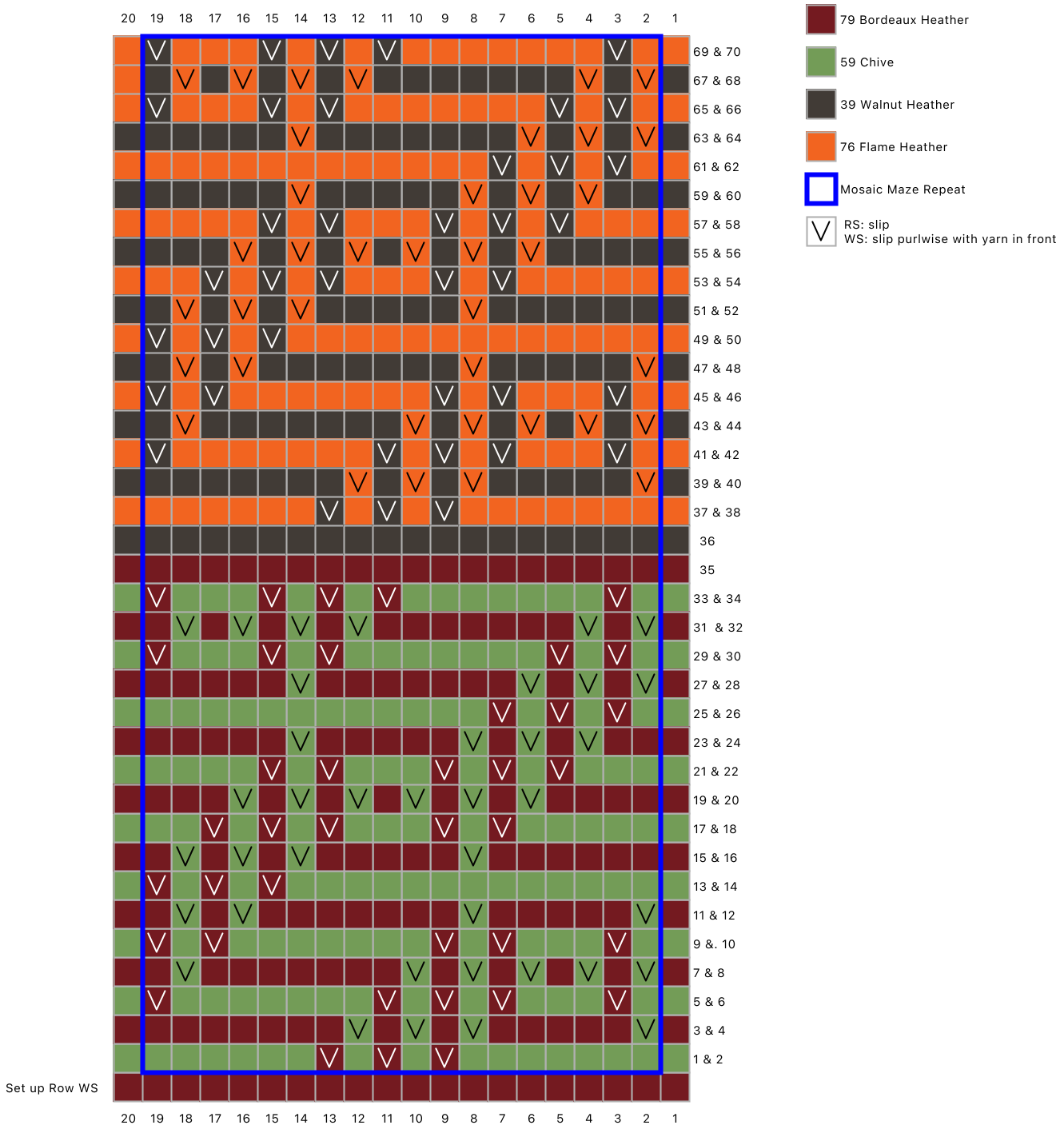
Thirty-five rows before anything comes round again, so this is the one entry where the chart stays open the whole way.
- A 79 Bordeaux Heather
- B 59 Chive
- C 76 Flame Heather
- D 39 Walnut Heather
Change color every 2 rows. The whole 35-row repeat is worked twice, once in each pairing, so the swatch is its own contrast comparison.
Set up, first run 1 row
Set up Row WSPurl.
First run, Bordeaux and Chive rows 1 to 35
1 & 2K1, (k7, (sl, k1) × 2, sl, k6) twice, k1.
3 & 4K1, (sl, k5, (sl, k1) × 2, sl, k7) twice, k1.
5 & 6K1, (k1, sl, k3, (sl, k1) × 2, sl, k7, sl) twice, k1.
7 & 8K1, ((sl, k1) × 4, sl, k7, sl, k1) twice, k1.
9 & 10K1, (k1, sl, k3, sl, k1, sl, k7, sl, k1, sl) twice, k1.
11 & 12K1, (sl, k5, sl, k7, (sl, k1) × 2) twice, k1.
13 & 14K1, (k13, (sl, k1) × 2, sl) twice, k1.
15 & 16K1, (k6, sl, k5, (sl, k1) × 3) twice, k1.
17 & 18K1, (k5, sl, k1, sl, k3, (sl, k1) × 2, sl, k2) twice, k1.
19 & 20K1, (k4, (sl, k1) × 5, sl, k3) twice, k1.
21 & 22K1, (k3, (sl, k1) × 2, sl, k3, sl, k1, sl, k4) twice, k1.
23 & 24K1, (k2, (sl, k1) × 2, (sl, k5) × 2) twice, k1.
25 & 26K1, ((k1, sl) × 3, k12) twice, k1.
27 & 28K1, ((sl, k1) × 2, sl, k7, sl, k5) twice, k1.
29 & 30K1, ((k1, sl) × 2, k7, sl, k1, sl, k3, sl) twice, k1.
31 & 32K1, (sl, k1, sl, k7, (sl, k1) × 4) twice, k1.
33 & 34K1, (k1, sl, k7, (sl, k1) × 2, sl, k3, sl) twice, k1.
35 (RS)Knit.
Set up, second run 1 row
36 (WS)Purl.
Second run, Flame and Walnut rows 37 to 70
37 & 38K1, (k7, (sl, k1) × 2, sl, k6) twice, k1.
39 & 40K1, (sl, k5, (sl, k1) × 2, sl, k7) twice, k1.
41 & 42K1, (k1, sl, k3, (sl, k1) × 2, sl, k7, sl) twice, k1.
43 & 44K1, ((sl, k1) × 4, sl, k7, sl, k1) twice, k1.
45 & 46K1, (k1, sl, k3, sl, k1, sl, k7, sl, k1, sl) twice, k1.
47 & 48K1, (sl, k5, sl, k7, (sl, k1) × 2) twice, k1.
49 & 50K1, (k13, (sl, k1) × 2, sl) twice, k1.
51 & 52K1, (k6, sl, k5, (sl, k1) × 3) twice, k1.
53 & 54K1, (k5, sl, k1, sl, k3, (sl, k1) × 2, sl, k2) twice, k1.
55 & 56K1, (k4, (sl, k1) × 5, sl, k3) twice, k1.
57 & 58K1, (k3, (sl, k1) × 2, sl, k3, sl, k1, sl, k4) twice, k1.
59 & 60K1, (k2, (sl, k1) × 2, (sl, k5) × 2) twice, k1.
61 & 62K1, ((k1, sl) × 3, k12) twice, k1.
63 & 64K1, ((sl, k1) × 2, sl, k7, sl, k5) twice, k1.
65 & 66K1, ((k1, sl) × 2, k7, sl, k1, sl, k3, sl) twice, k1.
67 & 68K1, (sl, k1, sl, k7, (sl, k1) × 4) twice, k1.
69 & 70K1, (k1, sl, k7, (sl, k1) × 2, sl, k3, sl) twice, k1.
What to watch for
This one insists on contrast
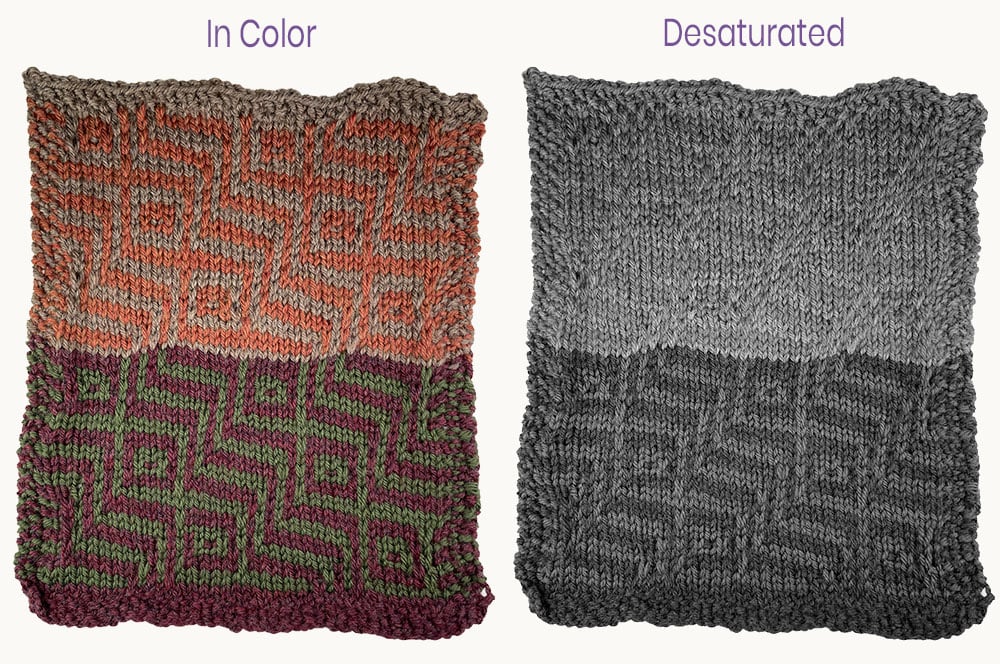
Green with wine reads far more clearly here than taupe with orange, and not because it is prettier. The two sit further apart in value, the light-to-dark measure underneath the color. Photograph your pairing and drop the saturation to zero before you cast on. If the yarns collapse into one gray, the path vanishes no matter how different they look on the ball.
Mark the halfway point
Thirty-five rows is long enough that losing your place costs real time. A stitch marker on the needle at stitch 18 turns a full recount into a glance.
Plan the edges before you cast on
With an 18 stitch repeat the motif only centers at certain widths. Deciding the finished measurement first, rather than casting on a round number and hoping, is the difference between a framed motif and one that runs off the side.
Why it works
Every mosaic pattern trades repeat length against how impressive the result looks, and this one spends everything on the second. Thirty-five rows is a real commitment by stitch-dictionary standards, and what you get back is a motif with no obvious tile boundary, the kind of thing that looks hand-plotted rather than repeated.
It is still one color per pair of rows, exactly like Basketweave Mosaic and Caesar’s Check. That gap between how hard it looks and how it is actually worked is the whole reason it is in this issue.
Beyond the Stitch
A technique you can take to any project.
The quiet half is not a mistake.
Both halves of this swatch came off the same chart, in the same yarn, at the same gauge. Below, Bordeaux with Chive holds its path the whole way. Above, Flame with Walnut… not so much. Take the color away and the difference stops being subtle: the bottom is still a maze, the top is a gray field.
Nothing went wrong up there. Those two yarns simply sit close together in value, meaning close in how light or dark they are, and a slipped stitch motif has nothing to work with but that difference. Hue cannot rescue it. Two colors can look like a strong pairing wound on the ball and still flatten into one tone the moment they become fabric.
Which makes this a decision rather than a defect. A high contrast pairing gives you a graphic that reads across a room. A close one gives you something that only shows up close, on the person wearing it, when the light is right. Both are worth making. What you cannot do is pick one by accident and find out after the bind off.
So decide before you cast on rather than after. Basketweave Mosaic shows you how to check in about four seconds. This entry is what it is checking for.
Make it yours
- Pillow front
- Wall hanging
- Bag panel
- Scarf center
- Blanket center panel
- Bench cushion
The Knotions twist
Work one repeat as a framed panel and set it into a plain stockinette ground rather than tiling it. The motif was built to be looked at, and giving it space does more for it than repeating it four times.
Show us yours
Post your swatch in the Knotions group. If you find a pairing that keeps the path readable, say which two, because that is the hard part of this one.
Leave a Reply