
Everything Knotions publishes about crochet, in one place.
Stitch tutorials with photos and short videos. How crochet fabric actually works, so patterns make sense instead of feeling like instructions to follow blindly. Yarn and color, explained for crochet specifically. And Year of Color, our free year-long series of crochet squares in Cascade yarn.
Start wherever you are. Nothing here has to be read in order.
How to start · Stitch tutorials · How crochet works · Yarn · Color · Year of Color · Patterns · Reference
How to start crocheting
Crochet needs one hook, one ball of yarn, and scissors. That is the whole kit. Start with a smooth, light-colored worsted weight yarn and a 5.5 mm (I-9) or 6 mm (J-10) hook. Smooth so you can see your stitches, light so they show up, worsted because it is big enough to handle and small enough to be useful.
There are four things to learn first, in this order: the slip knot, the chain, single crochet, and turning at the end of a row. Everything else in crochet is a variation on those four. Learn them on a swatch, not a project, and make the swatch about 20 stitches wide so you can practice turning without it taking forever.
Your first rows will be tight, uneven, and probably narrower at the top than the bottom. That is normal and it is not a sign you are doing it wrong. Tension settles on its own after a few hours of hooking; the fix is to keep going, not to start over.
Count your stitches at the end of every row for the first few projects. Losing or gaining a stitch at the turn is the beginner mistake, and catching it on the row it happens is a ten-second fix instead of a ripped-out afternoon.
When you are ready for a pattern, read it through once before you pick up the hook, look up any abbreviation you do not know, and check whether it is written in US or UK terms. The two systems use the same words for different stitches, and Knotions patterns are always US.
Once the four basics feel steady, the stitch tutorials below are where to go next. Granny stitch and lemon peel are both good second stitches.
Crochet stitch tutorials
Each tutorial has step-by-step photos, and a note on what the stitch is good for. US terms throughout.
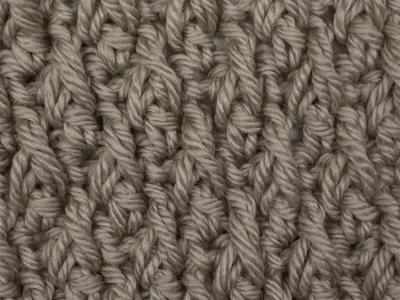


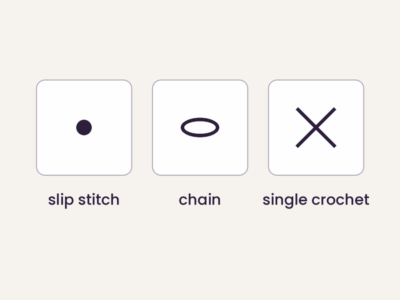
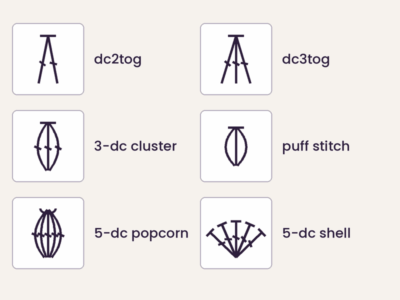


Looking for a stitch that is not here yet? Tell us.
How crochet works
Crochet builds fabric one stitch at a time, with only one live loop on the hook. That single fact explains most of what is distinctive about it. The only stitch that can unravel is the one on the hook, so you can put your work down mid-row, and ripping back is controlled: pull the yarn and stitches come out one at a time.
Stitches are sorted by height. Single crochet is the shortest, then half double, double, and treble. Each taller stitch adds one yarn over before you insert the hook and one more pull-through after. Height decides how the fabric behaves. Single crochet makes a firm, dense fabric. Double crochet in the same yarn is more open and drapes more. Mixing heights in one row is what makes shells, fans, and clusters.
Crochet fabric is denser and less stretchy than knitting because every stitch is knotted closed as you make it. That is why crochet holds shape well in bags and baskets, uses more yarn per square inch than knitting, and needs blocking more than most people give it.
Texture in crochet comes mostly from where you insert the hook. Working into both top loops is the default. Working into the back loop only or front loop only leaves a ridge. Working around the post of a stitch from the row below, instead of into its top, pulls that stitch forward: that is a front post stitch, and it is the basis of alpine stitch, waffle stitch, basketweave, and crochet cables.
Turning chains are the thing most likely to throw your count off. A chain 1 before single crochet never counts as a stitch. A chain 3 before double crochet traditionally does, though many modern patterns say otherwise. If your piece is narrowing, you are missing the last stitch or the turning chain. If it is widening, you are working the first stitch twice. Check the pattern notes; they should say which convention is in use.
Count rows along the side edge, one visible layer per row. Put a stitch marker in the first stitch of every round. With one live loop, the start of a round disappears the moment you work past it.
Yarn for crochet
Most of what is true of yarn in general is true in crochet, with a few things that hit harder.
Crochet uses more yarn than knitting for the same area. Each stitch wraps the yarn more times, so budget roughly a third more than a knitting pattern of similar size would call for. It is the most common reason a crochet project runs short.
Smooth, plied yarn shows texture. Every stitch in crochet is a small, distinct shape, and a tightly plied yarn with a clean surface lets those shapes read. A soft single ply, a halo, or a heavy heather blurs them. For post stitches, shells, and anything with dimension, choose the smoothest yarn you can. Save the fuzzy and the variegated for stitches that are meant to disappear into color.
Splitting yarn is the enemy. The hook enters and exits each stitch several times, and a loosely spun yarn that splits will slow you down and leave uneven stitches. If a yarn splits on a swatch, it will split for the whole project.
Fiber behaves the way it always does, but crochet fabric is less forgiving of it. Cotton has no memory, so a large cotton piece stretches and stays stretched. Wool springs back. Superwash wool drapes more and shows stitch definition well, which is why Cascade 220 Superwash and Heritage are the yarns Knotions uses for Year of Color. Acrylic is fine for texture but does not block; steam it lightly and accept what you get.
Hook size is a tool, not a rule. Going up a hook size loosens the fabric and adds drape without changing the stitch count. Going down tightens it. A pattern’s hook is a starting point; the gauge is the target.
Color and colorwork in crochet
Color reads differently in crochet than in knitting because the stitches are taller and the rows are more distinct. A stripe in single crochet is a thin, crisp line. The same stripe in double crochet is twice as tall and softer at the edge. Choose your stitch height with the color effect in mind, not just the fabric.
Stripes are the entry point. Change color at the end of a row by finishing the last stitch with the new yarn, or carry the unused color up the side and pick it up when you need it. An odd number of colors keeps one-row stripes tidy without cutting yarn.
Granny squares are their own color logic. Each round is a decision. Working from a dark center to a light edge reads differently than the reverse, and a single round of a neutral between two saturated colors is often what makes a square look intentional instead of loud.
Tapestry crochet carries the unused color inside the stitches and works over it, giving a solid, reversible-looking fabric that suits bags and baskets. Mosaic crochet uses one color per row with long stitches dipping into the row below, so the wrong side stays clean and the front reads as a graphic pattern. Corner-to-corner and pixel work build pictures one block at a time.
Whatever the method, value does most of the work. Two colors that are different hues but similar in lightness will blur together at arm’s length. Take a photo of your yarn in black and white before you start; if the colors disappear into each other, the finished piece will too.
The Knotions Color Library goes deep on all of this, with every example swatched in Cascade 220 Superwash, a worsted weight, and shown in both knitting and crochet.
Year of Color: free crochet squares, one a month
Year of Color is a free craft-along with Cascade Yarns. Each month there is a new crochet square with its pattern, a color story, and a short series of emails on the color science and history behind that month’s palette.
The squares are standalone. Start with any month, in any order, and make as many or as few as you like. Twelve squares is not a blanket, and we do not pretend it is. We show you what to make with them instead.
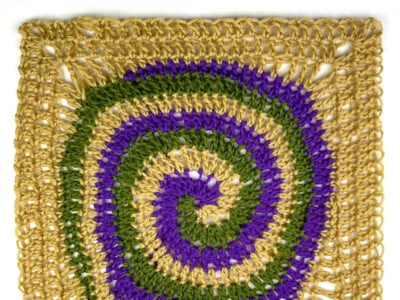
Join the Year of Color
Join over 400 makers.
Free forever. Unsubscribe anytime.
Crochet patterns
Tech-edited crochet patterns from Knotions issues, plus every free Year of Color square.
Crochet reference
Knotions has published knitting and crochet since 2007. The crochet side is growing, and this page grows with it.
Leave a Reply