
1. Meet the Stitch
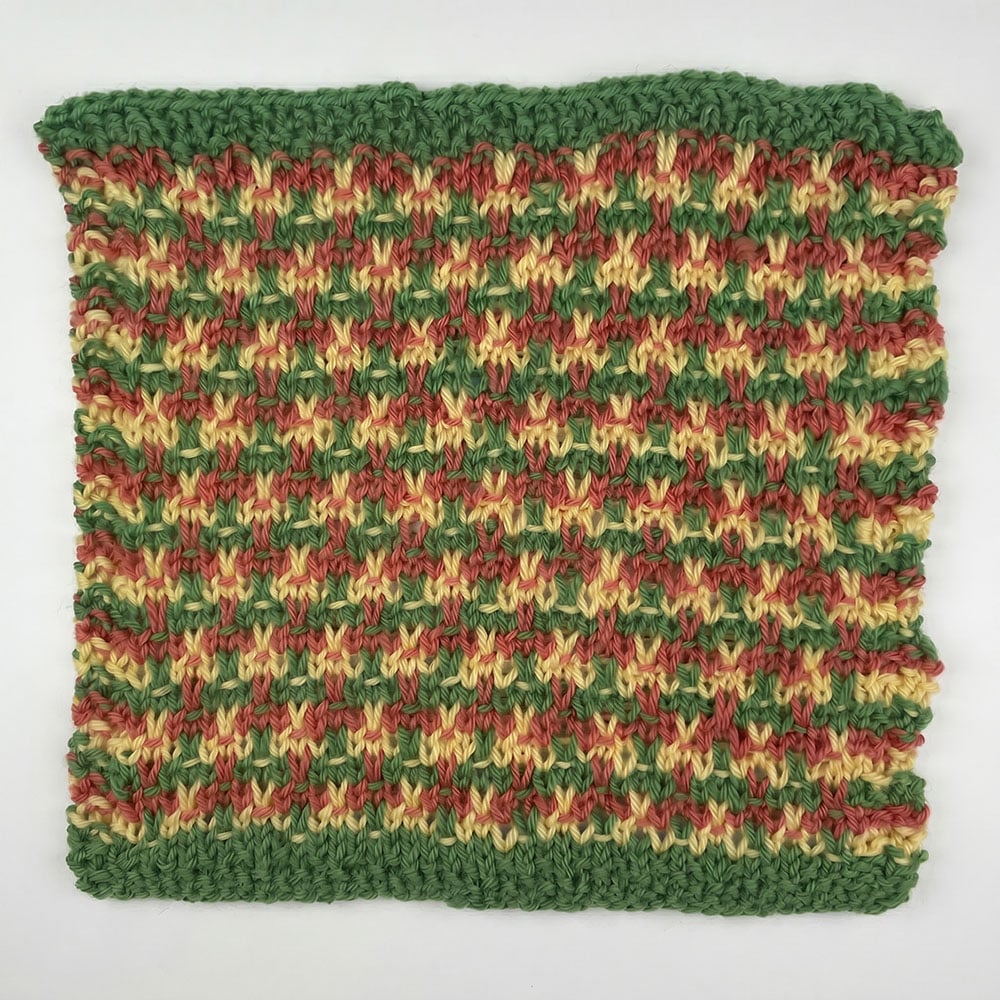
If you’ve ever admired the look of handwoven tweed fabric and wondered if you could knit something that comes close, the 3-Color Flecked Tweed stitch is your answer. It’s a classic slipped-stitch colorwork technique that creates a richly speckled, tweedy fabric using nothing more than three colors and a simple one-row-at-a-time approach. No stranding, no floats, no holding two yarns at once. Just knit, slip, repeat.
You’ve probably seen this effect in vintage pattern books or on those heathered, flecked accessories that look like they took serious skill. They didn’t. That’s the beautiful secret of this stitch.
2. Why This Stitch Rocks
The 3-Color Flecked Tweed stitch earns its name honestly. Worked across a 4-stitch repeat, with three stitches after the repeat to balance the row, it cycles through three colors one row at a time. The slipped stitches pull colors from previous rows up into the current row, creating that signature scattered, tweedy fleck without ever knitting with more than one strand at a time.
The result looks complex. The execution is not. That’s the whole game with slipped-stitch colorwork, and this stitch plays it beautifully.
It’s also wonderfully practical: because you work one color per row, yarn management is simple, tension is easy to control, and the fabric grows with satisfying speed.
3. What to Watch For
A few things to keep in mind before you cast on:
Slipped stitches pull the fabric in slightly, so your gauge will run a little tighter than plain stockinette in the same yarn. Swatch first, and don’t be surprised if you need to go up a needle size.
Carrying three yarns up the side works cleanly with an odd number of colors (which is exactly what you have here), but keep those floats loose. Tugging them tight will pucker your edges.
Count carefully at the start. The repeat is 4 stitches with 3 stitches after, so your cast-on should be a multiple of 4 plus 3. Getting that foundation right means smooth sailing for every row after.
4. Perfect Projects for This Stitch
The 3-Color Flecked Tweed stitch shines anywhere you want color interest without the complexity of stranded colorwork. Think:
- Hats and beanies (the tweedy texture reads beautifully in the round)
- Cowls and neck warmers
- Bags and totes, where the fabric density is actually a plus
- Colorful blanket squares (hint, hint for Year of Color)
Fingering weight in smooth, plied yarn shows the color separation most clearly, which is exactly why Heritage is such a good match here. Avoid fuzzy or halo yarns; they’ll muddy the fleck effect.
5. Try It Now: Stitch Breakdown
See the Written Instructions here, or, see the chart below.
Cast on: Multiple of 4 sts, plus 3.
Colors: A (Dusky Coral), B (Lemon), C (Herb)
Difficulty: Intermediate
Stitches are slipped purlwise. The yarn position (in back or in front) varies by row and is specified in the instructions. Or, see the chart below.
Row 1 (WS): Purl. (39 sts)
Row 2 (RS): (K1, sl wyif, k2) 9 times, k1, sl wyif, k1.
Row 3: P1, sl wyif, p1, (p2, sl wyif, p1) 9 times.
Row 4: (K3, sl wyif) 9 times, k3.
Row 5: P3, (sl wyif, p3) 9 times.
Rows 6-13: Repeat rows 2-5.
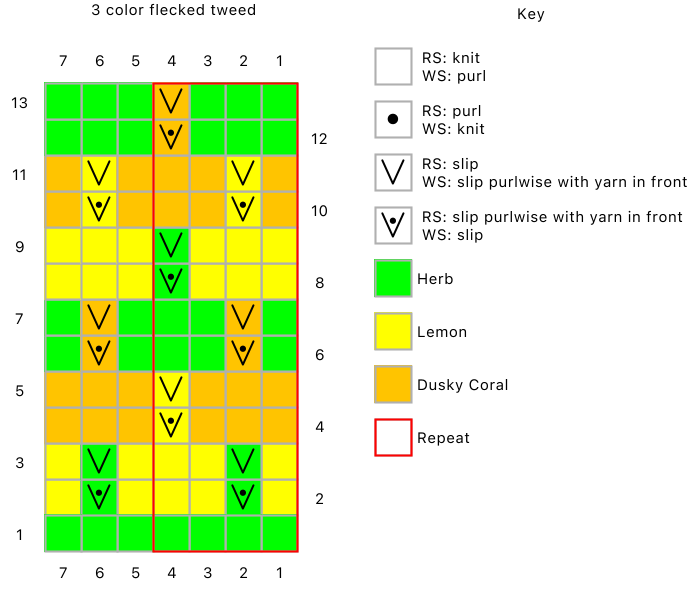
Swatch shown: Cascade Heritage fingering weight in Dusky Coral (A), Lemon (B), Herb (C). Needles: US 5 (3.75 mm)
6. Knotions’ Take: Design Twist
Try reversing your color order every third repeat to create a subtle mirrored effect in the flecking. Or designate one color as your “ground” (the one you knit more stitches in) and use the other two strictly as accent flecks by adjusting which rows you slip versus knit. You can shift the whole mood of the fabric just by changing which color leads.
This stitch also makes a surprisingly good edging on a bag or the brim of a hat, worked flat for just an inch or two before switching to your main stitch. The tweedy texture anchors the piece without overwhelming it.
7. TL;DR Recap
- Best for: Hats, cowls, bags, colorwork blanket squares
- Difficulty: Intermediate
- Yarn: Smooth fingering weight; Heritage is ideal
- Why try it: Three-color impact, one-color-at-a-time simplicity, fabric that looks like it took twice the effort it did
8. Your Turn!
Have you ever tried slipped-stitch colorwork? It’s one of those techniques that feels almost like cheating once you see how it works. Knit up a little swatch in three colors you love and share it with us using #Knotions. We want to see your color combos!
Leave a Reply