

There is no single inventor of the shawl. No patent, no founding moment. The shawl arrived the way most genuinely useful things do: gradually, across multiple cultures simultaneously, because humans discovered that draping a piece of cloth over your shoulders solved a problem elegantly.
That it also turned out to be beautiful was apparently a bonus.
The oldest garment you still own
Wrapped and draped garments predate sewn ones by thousands of years. The shawl, in its most basic form, is just that: a piece of material large enough to cover the upper body, worn without fastening.
What makes the shawl interesting historically isn’t its simplicity. It’s how many cultures arrived at the same solution and then made it entirely their own. In Kashmir, shawls were being woven from Changthangi goat fiber as early as the 15th century. These were not humble wraps. They required months of labor, featured intricate woven motifs (the paisley pattern that would later obsess European fashion is originally a boteh, a teardrop form from this tradition), and were considered appropriate gifts for royalty. By the 16th century the shawl was already a status object, a carrier of craft.
How the shawl conquered Europe
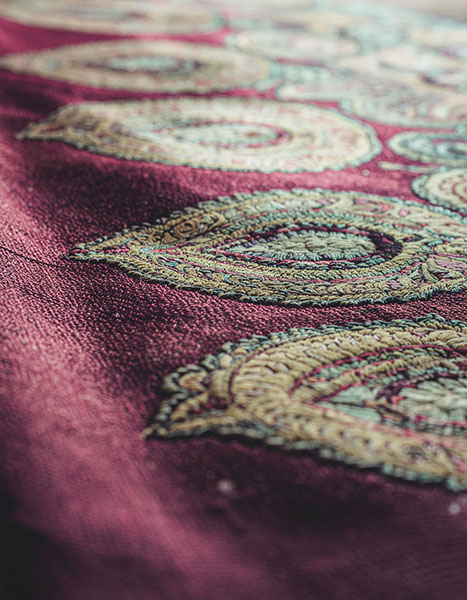
Napoleon’s Egyptian campaign in the late 1790s brought French soldiers into contact with fine wool shawls they’d never seen before. They brought them home. Josephine Bonaparte received one as a gift and reportedly became obsessed, eventually owning several hundred. Where Josephine led, European fashion followed.
The problem was supply. Genuine Kashmiri shawls were expensive and slow to produce. European manufacturers found a way to meet demand locally. By the early 19th century, shawl production had taken root in Paisley, Scotland; Norwich, England; and Lyon, France. The town of Paisley wove so many shawls featuring the boteh motif that it eventually lent its name to the pattern permanently. For the first time, a woman who wasn’t wealthy could own a shawl that looked like one.
By the 1870s, the bustle silhouette had made shawls structurally incompatible with fashionable dress, and the industry collapsed almost as quickly as it had grown.
The shawl goes underground
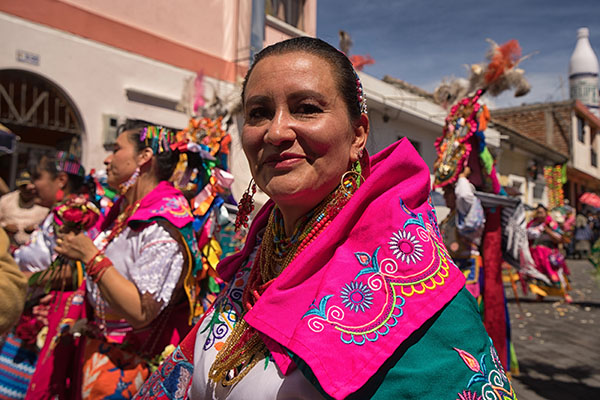
The shawl didn’t disappear. It went regional.
In rural communities across Europe, the Middle East, Central Asia, and the Americas, shawls had never been fashion objects. They were workwear. They carried babies, covered heads, marked ethnic and regional identity.
The rebozo in Mexico, a long narrow wrap woven in a tradition predating Spanish colonization, is still in daily use. The tallit, a Jewish prayer shawl with a history stretching back to biblical texts, is worn by millions every week. These are not fashion revivals. They are unbroken lineages. The shawl was never really a single thing. It was always multiple things happening simultaneously in different places, some of them high fashion, some of them daily necessity, some of them devotional.
The fiber arts revival

If you learned to knit after 2005, there’s a reasonable chance the first pattern you ever wanted to make was a shawl. The modern handknitting revival made the shawl its signature project for practical reasons: shawls don’t require fitting. A shawl that turns out slightly larger or smaller than planned is still a shawl. For new knitters, that forgiveness is significant. For experienced knitters, it’s a canvas for technique, the place you put your best lace, your most ambitious colorwork, your most interesting yarn.
Contemporary shawl patterns bear almost no resemblance to their 19th-century counterparts. Triangular, crescent-shaped, asymmetrical, worked from the center out or from a spine or from the edge. The only consistent definition is the original one: something you drape over your shoulders.
Crochet designers were working in the form throughout the 20th century, often in contexts that didn’t get treated as design history but absolutely were.
What a shawl does that other garments don’t
The shawl works across a wide range of body sizes without modification. It layers over anything. It can be worn six different ways. It functions as a blanket in a cold theater and a scarf on a windy street. And it’s one of the most visible ways to wear handmade work. A shawl draped over a shoulder in public is an advertisement for the craft. People ask about them. Conversations happen.
This might be part of why the shawl has survived every fashion cycle that should have killed it. It’s too useful to disappear and too beautiful to stay practical.
The shawls in this issue are working in a tradition that stretches back centuries, through Kashmir and Paisley and the granny-square revival and every knitter who ever threw something over her shoulders because the room was cold and the thing was beautiful. They’re also entirely contemporary. That’s the thing about a form this old. There’s room for everyone in it.
Leave a Reply