
The short version: drape is the quality that makes fabric fall, flow, and move with your body instead of standing away from it. It’s shaped by your fiber, your yarn weight, your stitch structure, and your finished dimensions, and knit and crochet fabric behave differently from each other in ways worth understanding.
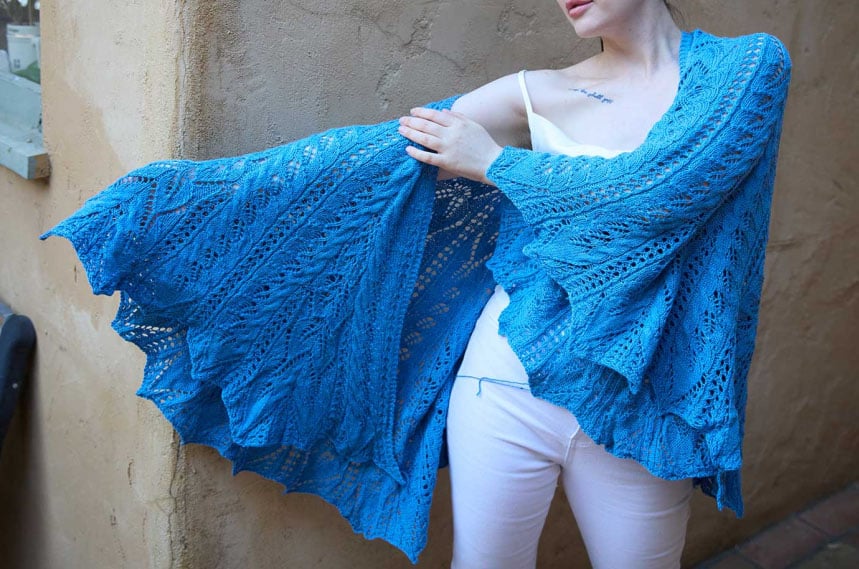
It starts with fiber
The raw material matters more than almost anything else. Protein fibers like wool have natural elasticity and memory. They want to spring back, which gives woolen fabrics body and bounce but works against fluid drape. Cotton, linen, and bamboo have no memory. They submit to gravity, which gives them their characteristic liquid quality and also why they grow and stretch over time. Silk is a protein fiber with almost no memory, heavy for its volume, and that combination produces its legendary fluidity. Blends split the difference, and often that’s where the most interesting drape lives.
Within any fiber category, twist matters too. A loosely spun single drapes more than a tightly plied yarn in the same fiber. Tight twist adds structure and resistance.
Stitch structure: where knit and crochet diverge
Knit fabric is built from interlocking loops with relatively open structure, stretchy in at least one direction, and that stretch is part of what allows it to flow. Stockinette in particular has very little inherent resistance to drape. Left alone, it wants to fall.
Crochet fabric is built differently. Each stitch is more self-contained, with more yarn per stitch and more structural integrity at the stitch level. This is not a flaw. It means crochet has more body, more definition, more stability, and more inherent resistance to drape in the way knit fabric drapes.
This surprises crocheters who find their finished pieces don’t flow the way they expected. The solution isn’t to fight crochet’s natural properties but to work with them. Open stitches, mesh patterns, shell sequences, and lacework all reduce fabric density and allow more movement.
Some of the most beautifully draped crochet pieces use relatively simple stitch combinations because the negative space is doing as much work as the yarn.
Shape and dimensions
The same yarn worked the same way can behave very differently depending on geometry.
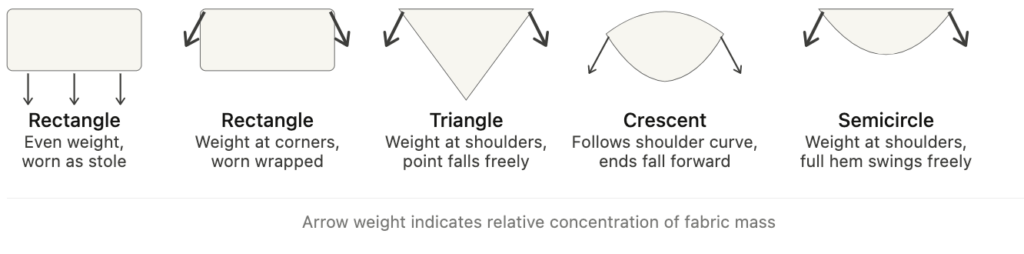
A rectangle worn as a wrap distributes weight evenly along its long edge. The drape is consistent but passive. A triangle worn point-at-center-back concentrates weight at the bottom and lets the fabric fall away from the shoulders. A crescent is shaped to follow the curve of the shoulders, so the fabric naturally sits along the upper back and the ends fall forward. The geometry does the positioning work for you. A semicircle has significant mass at the bottom hem, and that weight creates a dramatic, full fall that swings and moves.
None of these is better. They’re different tools producing different results.
Gauge and blocking
Working at a looser gauge than recommended opens up the fabric and generally increases drape.
If you’ve ever made a garment that came out the right size but felt stiffer than expected, gauge may have been part of the answer.
Blocking is where a lot of drape is actually realized. Wet blocking relaxes fibers, opens up stitches, and allows fabric to settle into its finished state. Pieces that feel stiff off the needles or hook often transform completely with a good soak and careful pin-out. For lace especially, blocking isn’t optional. It’s the last step of the pattern.
Putting it together
When you look at a pattern now, you have a richer set of questions to ask. What fiber? What twist? What stitch structure, and is it open or dense? What’s the geometry, and how will it distribute weight on the body? These questions have answers you can work out before you cast on. You don’t have to hope the drape works out. You can make it on purpose.
Leave a Reply