
1. Meet the Stitch
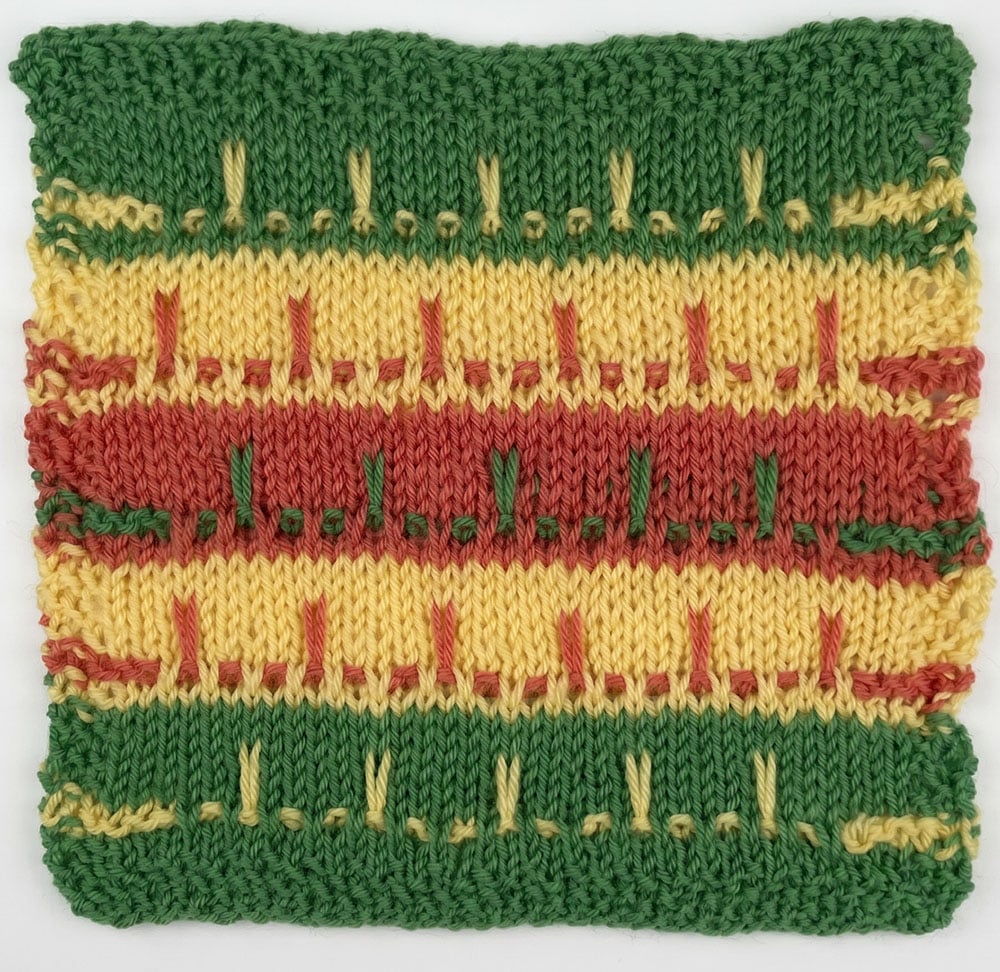
Some stitches get their names from geometry. Some from tradition. And some, like Bean Sprouts, get their names because the moment you see the fabric, you just know. Those little elongated loops reaching up through a striped ground? Sprouts. Exactly.
Bean Sprouts is a slipped-stitch colorwork pattern that creates vertical elongated stitches in two different lengths, giving the fabric an organic, almost botanical feel. It’s worked flat, one color at a time, and produces a result that genuinely stops people in their tracks. “How did you do that?” is the correct response from onlookers.
2. Why This Stitch Rocks
What makes Bean Sprouts clever is the layering. By slipping stitches over multiple rows before finally knitting them, you create those characteristic upright loops that pop off the fabric surface. Short slips (over 2 rows) give you the small sprouts; long slips (over 6 rows) give you the tall ones. The contrast between the two lengths is what gives the stitch its playful, almost three-dimensional quality.
The color striping underneath does the supporting work, and those elongated stitches punch through it in a way that feels spontaneous even though it’s completely controlled. It’s a stitch that rewards patience with a seriously impressive payoff.
3. What to Watch For
The long slips, those 6-row ones, need room to breathe. If you knit tightly, they’ll pull and pucker the rows beneath them. Keep a deliberately relaxed tension when slipping, and consider going up a needle size if you’re a naturally tight knitter.
The stitch repeat is 6 stitches, with 3 before and 4 after, so check your cast-on math before you start. Losing track of where you are in the slip sequence is the most common trip-up; a row counter is your friend here.
Because you’re carrying yarns up the side across several rows at a time, particularly for the 6-row slips, keep those side floats loose. Pin them or catch them every 2-3 rows if the float gets long enough to pull.
This stitch does not block flat the way a smooth stockinette fabric does. The sprouts will soften slightly with blocking but they’re meant to stand up, so don’t try to press them flat.
4. Perfect Projects for This Stitch
Bean Sprouts has real personality, so it works best where that personality has room to show:
- Hats, where the vertical sprouts draw the eye upward
- Headbands and ear warmers, where a small repeat goes a long way
- Colorful blanket squares (you may have seen one recently)
- Tote bags, where the texture adds structure and interest
Smooth, plied fingering weight like Heritage lets every sprout read clearly. Avoid anything too rustic or textured; the stitch itself is doing the visual work and it doesn’t need competition.
5. Try It Now: Stitch Breakdown
Cast on: Multiple of 6 sts, plus 3 before and 4 after.
Colors: A (Dusky Coral), B (Lemon), C (Herb)
Difficulty: Intermediate
Stitches are slipped purlwise with yarn in back on RS rows, and purlwise with yarn in front on WS rows.
See the Written Instructions here, or, see the chart below.
Row 1 (RS): Knit. (13 sts)
Row 2 (WS): Purl.
Row 3: K3, (sl, k1) × 3, sl, k3.
Row 4: K3, (sl wyif, k1) × 3, sl wyif, k3.
Row 5: K6, sl, k6.
Row 6: P6, sl wyif, p6.
Rows 7-8: Repeat rows 5-6.
Row 9: Knit.
Row 10: Purl.
Rows 11-12: Repeat rows 9-10.
Row 13: K2, (sl, k1) × 4, sl, k2.
Row 14: K2, sl wyif, k1, (sl wyif, p1) × 2, sl wyif, k1, sl wyif, k2.
Row 15: K3, sl, k5, sl, k3.
Row 16: P3, sl wyif, p5, sl wyif, p3.
Rows 17-18: Repeat rows 15-16.
Row 19: Knit.
Row 20: Purl.
Rows 21-22: Repeat rows 19-20.
Row 23: Repeat row 3.
Row 24: Repeat row 4.
Row 25: Repeat row 5.
Row 26: Repeat row 6.
Rows 27-28: Repeat rows 25-26.
Row 29: Knit.
Row 30: Purl.
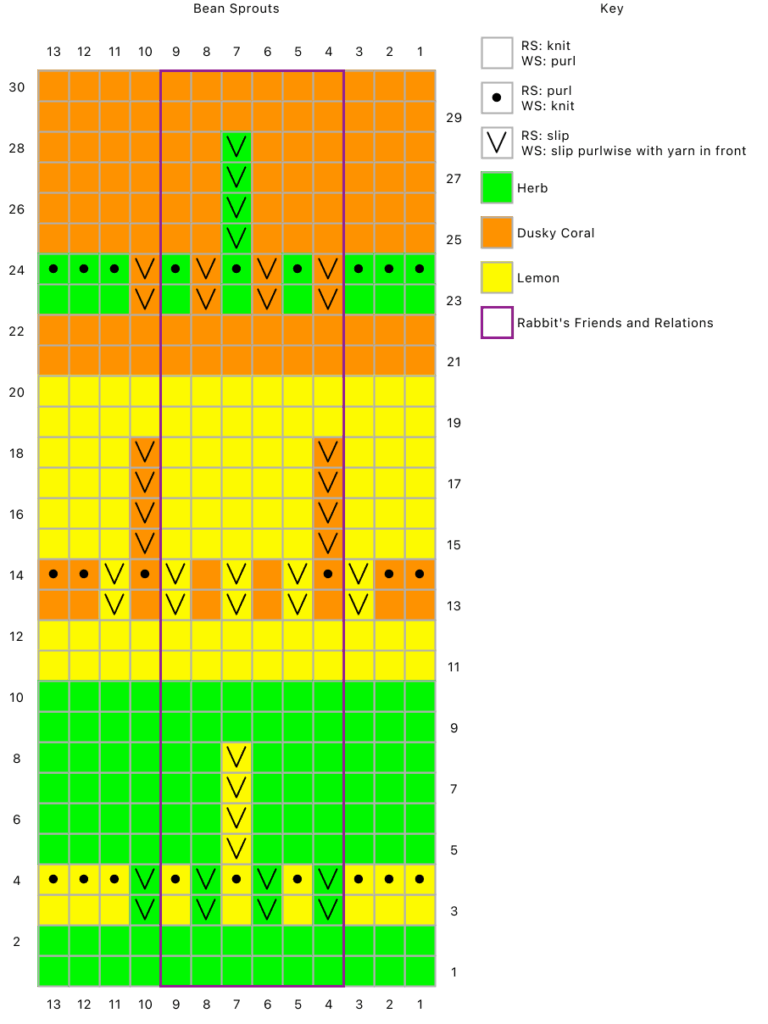
Swatch shown: Cascade Heritage fingering weight in Dusky Coral (A), Lemon (B), Herb (C). Needles: US 5 (3.75 mm)
6. Knotions’ Take: Design Twist
Try using your most saturated color for the long sprouts and a softer neutral as the ground. The tall slips will catch the eye first and the shorter ones will read as texture rather than color, giving you a focal point without chaos.
Bean Sprouts also works beautifully as a panel rather than an allover fabric. Run a vertical column of it down the center of a hat or along the spine of a bag, flanked by plain stockinette, and it reads almost like an intentional woven inlay. A little goes a long way with this one.
7. TL;DR Recap
- Best for: Hats, headbands, blanket squares, totes
- Difficulty: Intermediate
- Yarn: Smooth fingering weight; Heritage is ideal
- Why try it: Two-length elongated slips create a botanical, almost sculptural texture that looks far more complex than it is
8. Your Turn!
Bean Sprouts is one of those stitches that photographs beautifully, and we want to see yours. Knit a swatch, pick your three colors, and share it with us using #Knotions. We’re especially curious: which color did you choose for the long sprouts?
Leave a Reply