
Finding the Article That Speaks to You
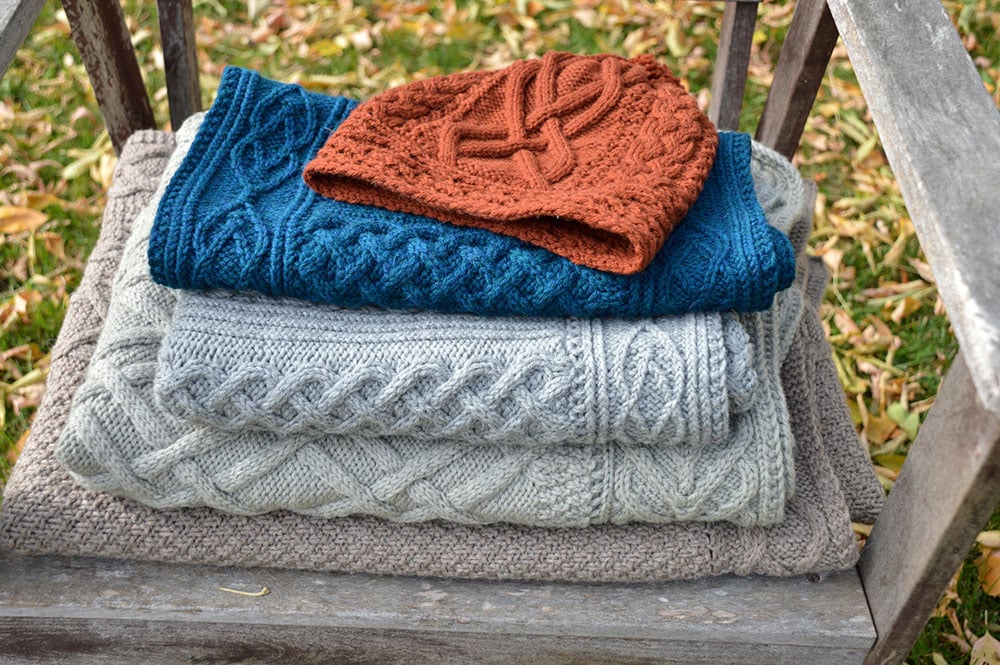
Cable knitting is both ancient craft and living art. For centuries, knitters have been translating the visual language of Celtic knotwork into dimensional fabric, creating texture that’s as structurally sound as it is beautiful. But there’s no single path to cable mastery – different knitters need different knowledge at different times.
This issue brings you three substantial articles, each offering a distinct lens on cable work. You might read all three cover to cover, or you might dive straight into the one that speaks to your current needs. Here’s how to choose:
The Technical Knitter
Adapting Cable Motifs Across Weights: From Fingering to Bulky
You’ll love this if: You’ve ever looked at a cable pattern and thought, ‘I wish I could make this in a different yarn weight.’ You enjoy understanding the mechanics of how things work. You’re comfortable with gauge math and want to know the why behind the how.
Skip this if: You prefer to follow patterns exactly as written without modifications. Technical calculations make your eyes glaze over. You’re still building confidence with basic cable techniques.
Key takeaway: Cables don’t scale linearly – stitch-to-row ratios, crossing frequency, and background stitches all need adjustment when you change yarn weight, but with the right approach, you can successfully translate any cable motif.
What you’ll learn: How to adjust crossing frequency for different weights, calculate proportional background stitches, maintain cable character across the weight spectrum, and swatch strategically for cross-weight adaptations.
Best for: Knitters who adapt and modify patterns, those building a cable design skillset, and anyone frustrated by the limits of ‘use the yarn specified.’
The Practical Knitter
Understanding Cable Density: A Guide to Evaluating Patterns and Choosing Yarns
You’ll love this if: You want to make smarter choices before casting on. You’ve been disappointed by finished projects that were too stiff, too heavy, or didn’t drape the way you hoped. You’re standing in a yarn shop trying to figure out if your favorite skein will work with that cable pattern.
Skip this if: You’re happy to knit anything and see how it turns out. You don’t mind frogging and starting over. You have unlimited time and yarn budget for experimentation.
Key takeaway: The ratio of cables to background fabric (cable density) determines drape, warmth, weight, and knitting time – learn to recognize it in patterns and you’ll choose projects that actually deliver what you want.
What you’ll learn: How to evaluate density in pattern photos and charts, match yarn fiber to density levels, spot red flags before casting on, and adjust density when substituting yarns or modifying patterns.
Best for: Knitters choosing their next project, those substituting yarns, anyone who wants their finished objects to actually be wearable, and knitters building pattern evaluation skills.
The Creative Knitter
The Architecture of Cables: How Celtic Knotwork Translates to Knitting and Crochet
You’ll love this if: You’re fascinated by the ‘why’ behind techniques. You love connecting your craft to history and art. You want to understand cables as a design language, not just a set of instructions. You find inspiration in seeing the principles behind the practice.
Skip this if: You just want clear, step-by-step instructions. Design theory doesn’t interest you. You prefer practical troubleshooting over conceptual frameworks.
Key takeaway: Cables follow the same visual logic as Celtic knotwork – continuous paths, alternating crossings, balanced symmetry – and understanding these principles makes even complex patterns intuitive.
What you’ll learn: How to read cables by tracing paths instead of following row-by-row instructions, recognize symmetry patterns that make memorization easier, borrow design principles from Celtic art (continuous flow, negative space, strategic complexity), and see the connection between ancient knotwork and modern cable techniques.
Best for: Knitters and crocheters who want deeper understanding, those interested in cable design, crafters who love the historical context of techniques, and anyone who finds that conceptual frameworks make techniques ‘click.’
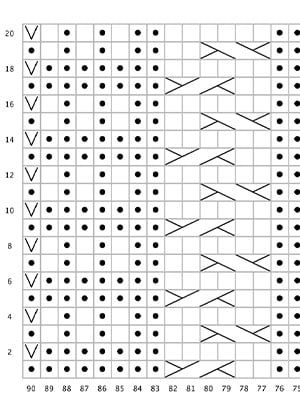


Three lenses on cable work: technical understanding, practical evaluation, and design principles. Each offers essential knowledge for cable mastery.
How to Use These Articles
Read in any order. Each article stands alone. Start with whichever speaks to your current question or curiosity.
Read all three for comprehensive understanding. Together, these articles give you the technical skills (Adapting Cable Motifs Across Weights), practical evaluation tools (Understanding Cable Density), and conceptual framework (Architecture of Cables) for true cable mastery. They reference and reinforce each other – Architecture of Cables‘s discussion of crossing frequency connects to Understanding Cable Density‘s density concepts; Understanding Cable Density‘s yarn guidance informs Adapting Cable Motifs Across Weights‘ adaptation strategies.
Suggested reading paths:
If you’re planning a specific project: Start with Understanding Cable Density to evaluate whether the pattern will work for your needs, then move to Adapting Cable Motifs Across Weights if you need to adapt yarn weight.
If you’re feeling stuck or frustrated with cables: Try Architecture of Cables for a fresh perspective that might make everything click, then revisit Understanding Cable Density for practical troubleshooting.
If you want to level up your cable skills: Read in order: Architecture of Cables for conceptual foundation, Understanding Cable Density for evaluation skills, Adapting Cable Motifs Across Weights for technical adaptation abilities.
If you’re designing your own cables: All three are essential. Architecture of Cables gives you design principles, Understanding Cable Density helps you control density intentionally, and Adapting Cable Motifs Across Weights lets you translate your designs across weights.
A Note on Learning Styles
We all learn differently. Some knitters need to understand the theory before the technique makes sense (that’s Architecture of Cables). Others need practical guidelines they can apply immediately (Understanding Cable Density). Some want to tinker and modify until they’ve mastered something through experimentation (Adapting Cable Motifs Across Weights).
There’s no wrong way to approach these articles. Trust your instincts about what you need right now. The other articles will be here when you’re ready for them.
Why These Three?
Cable knitting can feel like it requires encyclopedic pattern knowledge – memorizing dozens of specific cable variations, learning individual crossing sequences, accumulating a mental library of techniques. These articles take a different approach.
Instead of giving you fish, we’re teaching you to fish. Architecture of Cables teaches you to see the underlying logic in any cable pattern. Understanding Cable Density teaches you to evaluate whether a pattern will work before you invest time and yarn. Adapting Cable Motifs Across Weights teaches you to adapt patterns to your needs rather than limiting yourself to patterns written for your exact yarn.
Master these three approaches, and you’ll have transferable skills that work across every cable pattern you encounter. You won’t just be following instructions – you’ll understand what you’re doing and why, which means you’ll be able to troubleshoot, adapt, and eventually create with confidence.
That’s the kind of knowledge that transforms you from a pattern follower into a cable knitter.
So: which article calls to you? Trust that instinct, and dive in.
About the Author: Jody Richards

Jody is the founder and lead editor of Knotions. She loves poring over stitch dictionaries and trying out new stitches.
She’s also on a mission to get everyone to embrace the blocking. And, to avoid using garter stitch edges in swatches.
And while she likes all things crafting (well ok, except that one thing), yarn crafts are her true love (and she has the stash to prove it).

Leave a Reply