
Steel
Mauve
Dusty Blue
One brief went out: show me the STEM. Every answer that came back was math you can wear.
Every issue starts with a question. This one started with a confession.
I came to knitting from math and computer science, and for a long time I kept those two parts of my life in separate rooms. One was work. The other was what I did to get away from work.
It took me embarrassingly long to notice they were the same room. A chart is a grid of instructions. Lace repeat is a loop. A decrease round is an equation that has to balance or the hat won’t close. Every sweater I had ever made was an algorithm someone else had written, and I had been running it by hand.
So the brief for this issue was simple. Show me the STEM. It didn’t have to be obvious. Some of the best connections are the quiet ones.
Olha Bykova sent two designs, and the first is about sound. The Waves of Sound Tote is crochet, built around a filet crochet panel. Filet is having a real moment right now, and it fits this issue better than you might expect, because filet is a grid of filled blocks and open blocks. On or off. One or zero. It is a bitmap you can carry groceries in.
The rest of the bag is worked in alpine stitch, a dense, textured post stitch that gives it enough structure to actually carry them.
The panel draws a sound wave, the shape audio takes when you see it on a screen. Sound is pressure moving through air, invisible until something translates it. Here, the translation is a grid of stitches.
Her second design is built around data flow. The Data Flow Cowl is a crochet cowl in a steel gray she chose to read as metal and server hardware. Its raised vertical lines are grouped in powers of two, like packets of data moving through a system, and the bobbles are the nodes, the points where information connects and changes direction. Even the width of the fabric is a power of two.
And it is a cowl on purpose. A circle with no beginning and no end, wrapped around you, the way information wraps around all of us now.
Savita Khurana went to biology. The Pluripotent Cowl is knit, and its texture comes from nupps, the small raised bobbles of Estonian lace. Each nupp is a cell. Look at how they are arranged and you can see the order in it, clusters that read like cells under a microscope.
The name is the clever part. A pluripotent stem cell hasn’t decided yet what it will become. A nupp starts the same way: one stitch that opens into several loops, then gathers back into one. A lot of potential packed into a very small space.
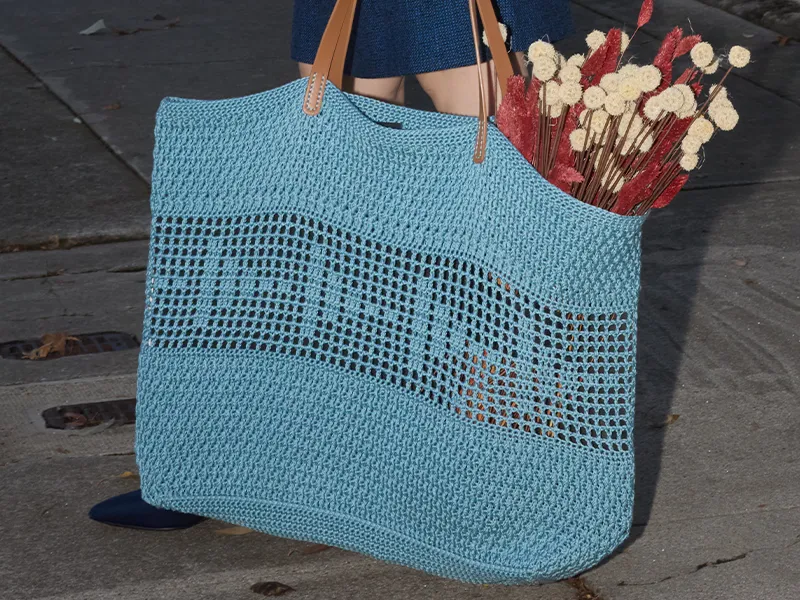
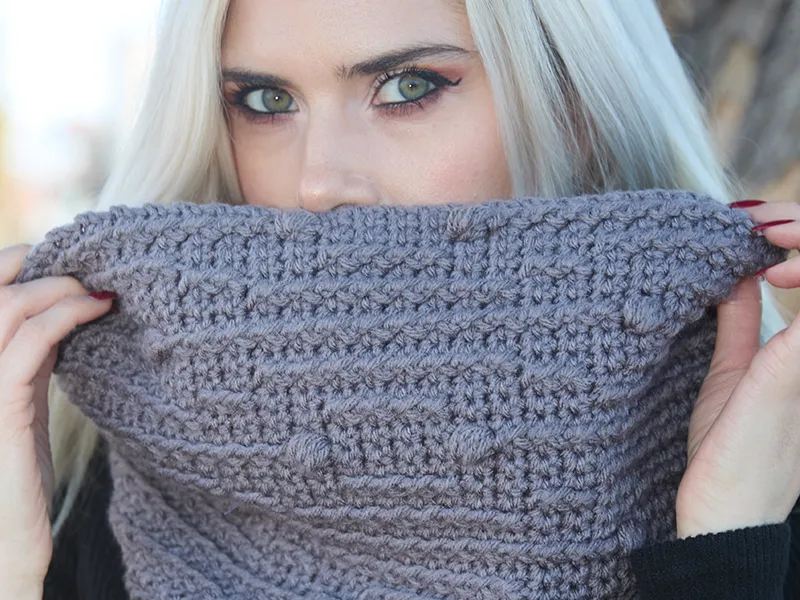
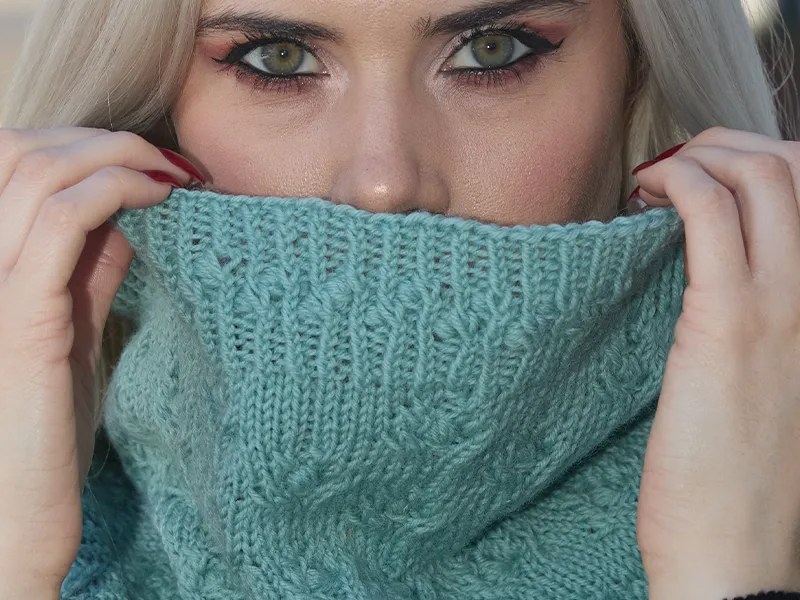
Three designs, three sciences: physics, computer science, biology. What they share is that each one starts with something you can’t see. Sound moving through air. Data moving through a network. A cell that hasn’t chosen yet. Each designer found a way to turn it into something you can hold, wear, or sling over your shoulder.
There is more in here than the designs.
If the Waves of Sound Tote caught your eye, start with the alpine stitch tutorial. It looks like cabling, and it’s only a four-row repeat, two of them plain single crochet. Then settle in with Olha’s deep dive into filet crochet. It goes well past open and filled squares, into the history and the techniques that make filet so much more than a grid.
A review of Crochet Buffet, a book of food-animal mashups that turned out to be a better geometry lesson than some textbooks I own. A conversation with its author, Naomi Fox, about how a taco becomes a dinosaur.
I also went looking for the knitting spies. Those stories show up in our feeds every few months, so I traced the famous ones back to their sources. Some hold up. Some don’t.
Katiella Huffman of Eco Amigurumi asked 1,005 fiber artists why sustainable yarn hasn’t caught on. Caring about it turns out not to be the problem. Cost, access, and knowing what to look for are.
And a horoscope that has checked your math.
One more thing before I let you go. In 1843, Ada Lovelace was trying to explain what Charles Babbage’s Analytical Engine could do, a machine that ran on punched cards borrowed from the Jacquard loom. She wrote that it “weaves algebraical patterns just as the Jacquard-loom weaves flowers and leaves.” The first description of what we would now call a computer program, and she reached for textiles to explain it.
We have been doing math with our hands for a very long time. It felt worth saying in an issue about exactly that.
Cast on something clever.
Jody
Editor, Knotions
What’s in Tech Threads
[Number] pages. Start anywhere.
Patterns 3
- Waves of Sound Tote Olha Bykova, crochet
- Data Flow Cowl Olha Bykova, crochet
- Pluripotent Cowl Savita Khurana, knit
Stitchopedia [count]
- [Stitchopedia entries]
Reviews 1
- Crochet Buffet Naomi Fox
Interviews 1
Articles [count]
- The Tech Threads Horoscope sarcasm with a scientific spin
- [Other articles]
- From the Editor you are here
Leave a Reply